NRA-L-000004 / 1806

Letter from Rosaes ceba to Don Rafael Policarpo Sanz

Spanish letter dated 13 April 1806 from Martimuñoz, sent via Arebalo to Olmedo, mentioning local deaths, burial, an embargo involving priests, and household goods.

Neruda Archives
NRA-L-000004

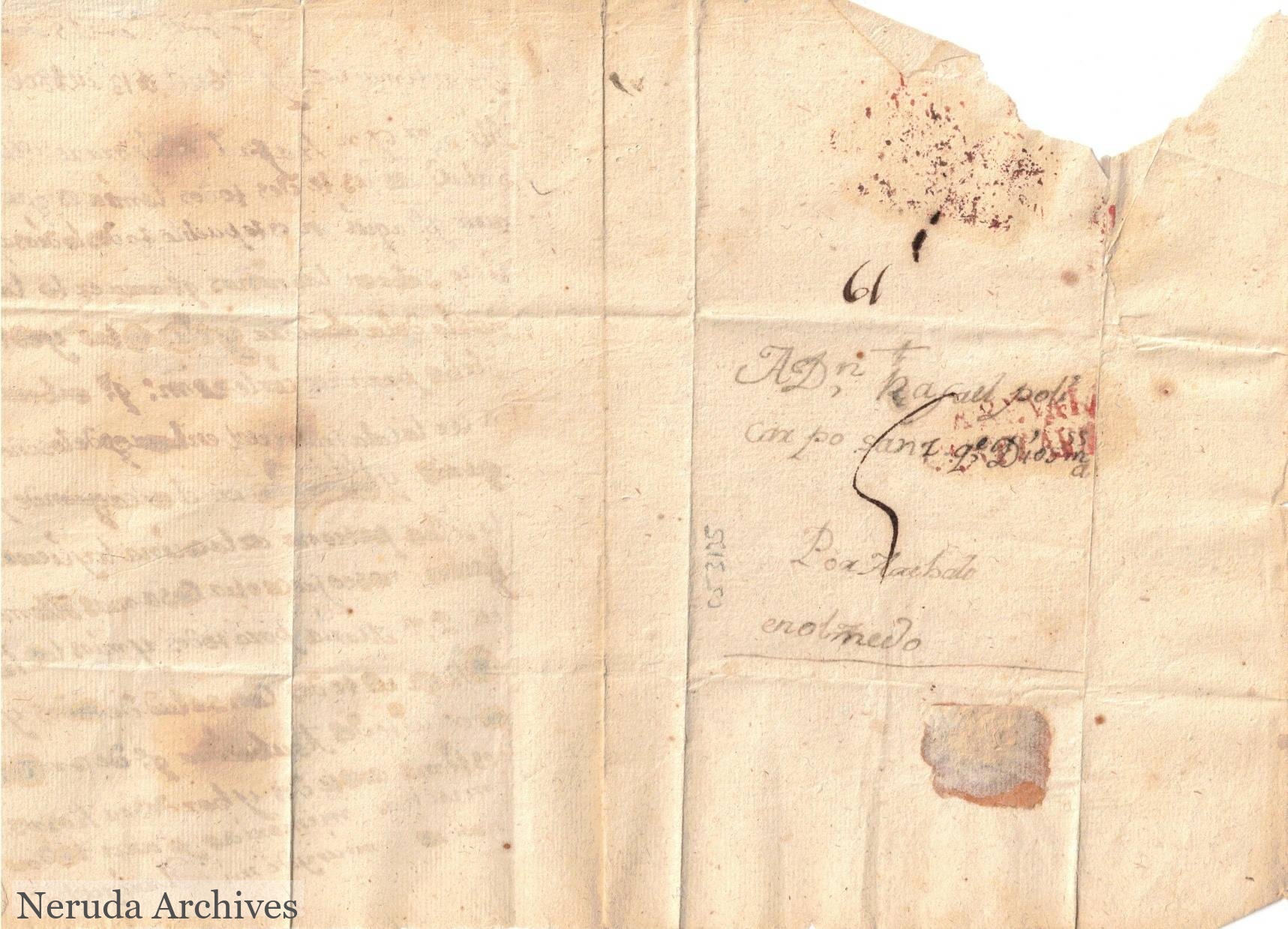
NRA-L-000004 image 1 showing the address to Don Rafael Policarpo Sanz, via Arebalo, in Olmedo.
Image 1Address Panel.
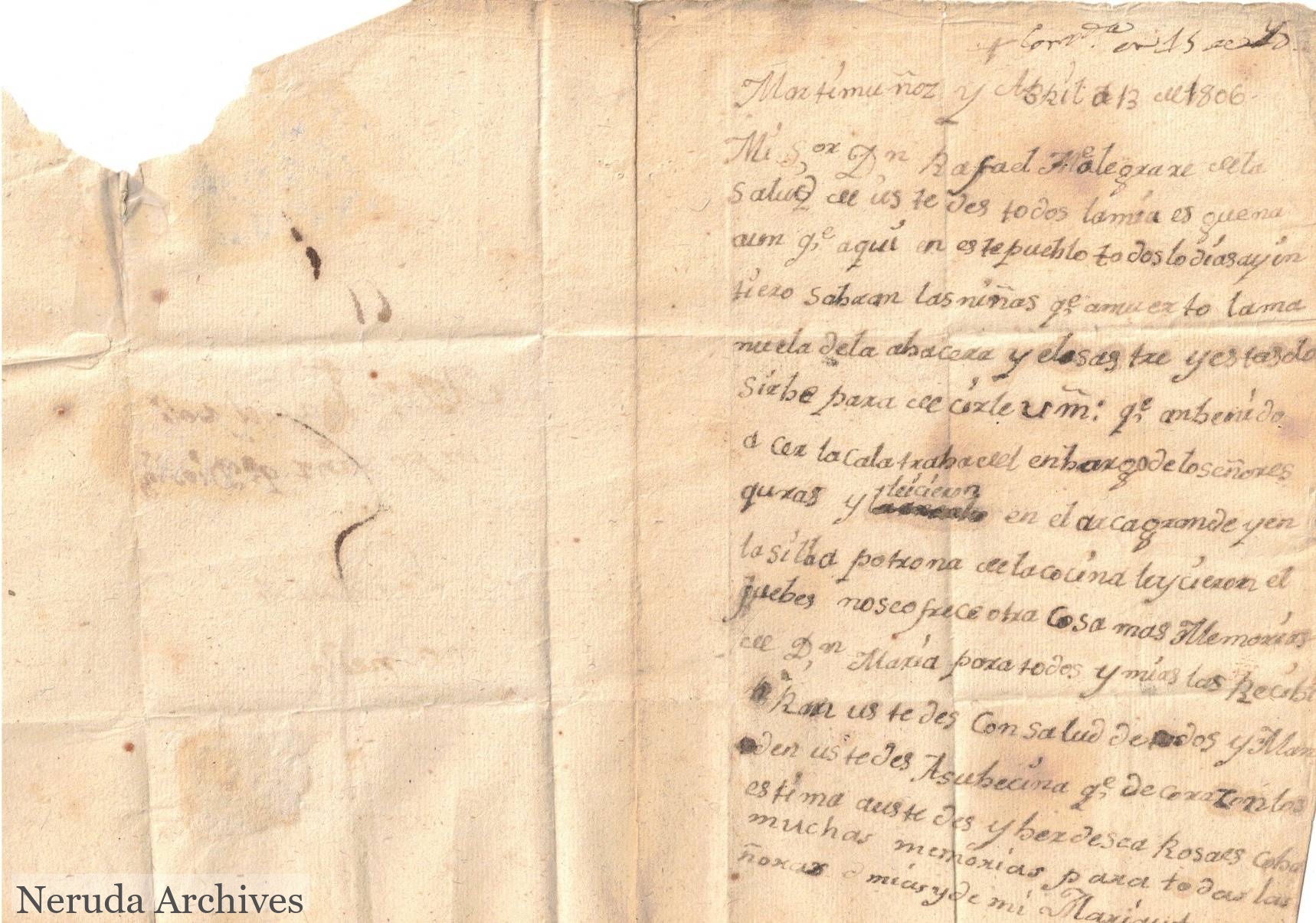
NRA-L-000004 image 2 showing the letter text dated 13 April 1806 from Martimuñoz.
Image 2Letter Text - Page 1.

Transcript and English translation

working scholarly aid

Address Panel

Original transcript

A D.n + Rafael poli
car po sanz q.e Dios g.de
Por Arebalo
en olmedo

Address Panel

English translation

To Don + Rafael Policarpo Sanz, whom God keep
Via Arebalo
in Olmedo

Letter Text - Page 1

Original transcript

y corr.da en 15 de d.o
Martimuñoz y Abril á 13 de 1806.
Mi S.or D.n Rafael M.e alegrare de la
salud de us te des todos lamia es guena
aun q.e aqui en este pueblo todos los dias ay in
tiero sabaan las niñas q.e a mu erto la ma
nuela dela abacera y el sas tre y esto lo
sirbe para de cirle v m: q.e anbenido
a dar la [cala traba?] del enbargo de los eñores
quras y [crossed out: leicieron] en el arca grande y en
la sitha poltrona de la cocina le ycieron el
juebes nos eofrece otra cosa mas Memorias
de D.n Maria para todos y mias las Recibi
[blot]Raan us te des Con salud de todos y Man
[blot]den us te des Asubecina q.e de corazon los
estima auste des y bezdesca Rosaes ceba
muchas memorias para todas las
ñoras mias y de mi Mariquit[a]

Letter Text - Page 1

English translation

Later manuscript record
[Answered on the 15th of the same month.]
Martín Muñoz, 13 April 1806.
My dear Don Rafael,
I shall be glad to hear that you are all well; I am well, although here in this town there is a burial every day. The girls will already know that Manuela from the grocer's and the tailor have died. I am also taking this opportunity to tell Your Grace that they came to carry out the seizure ordered by the reverend priests and that on Thursday they seized the large chest and the upholstered armchair in the kitchen.
There is nothing else to report. Doña María sends her regards to everyone, as do I. May they find you all in good health, and command your neighbour, who esteems you all from the heart and blesses you,
Rosaes Ceba
Many regards to all my ladies, from me and from my Mariquita.

Discovery Terms

  • Spanish correspondence
  • local deaths
  • burial
  • embargo
  • writ of attachment
  • priests
  • household goods
  • Martimuñoz
  • Olmedo

Historical context

A burial every day in April 1806

Two deaths and a regional crisis

Rosa assures Don Rafael that she is well, then says there is a burial every day. She reports two deaths: Manuela from the grocer's and the tailor. The letter comes just after the worst years of the Castilian grain and mortality crisis. In one study based on parish registers, the sample of 22 places in neighbouring Ávila still recorded 28.2 per cent more deaths than the study's baseline in 1806. That figure is for the Ávila sample as a whole; it cannot tell us how many people died in Rosa's village, or why.[1, 2]

Which Martín Muñoz?

The letter is dated at “Martimuñoz.” Its address directs it to Olmedo via Arévalo. Two nearby places, Martín Muñoz de las Posadas and Martín Muñoz de la Dehesa, are plausible; the address does not distinguish them. Las Posadas is among the Segovian parishes whose baptism and death registers were used in a published study. Comparing the individual entries from April 1806 in both parishes could help locate the letter if they record the two deaths Rosa mentions.[1, 3, 4]

Evidence and limits

The surviving wording does not establish the village or the causes of death. Rosa's account of frequent burials is not a count from a register.[1, 3, 4]

Sources & evidence (4)
  1. Primary source: manuscript Neruda Archives, NRA-L-000004, Rosa to Rafael Policarpo Sanz, 13 April 1806, letter and address panel. Read the letter and address Gives the place as Martimuñoz, the postal direction via Arévalo to Olmedo and the report of frequent burials and two deaths.
  2. Historical demographic research Enrique Llopis and Felipa Sánchez, “The Crisis of 1803–1805 in the Two Castiles: Foodstuff, Mortality and Institutional Collapse,” Revista de Historia Económica 34, no. 2 (2016), pp. 295–322, table 3, p. 307. See the published mortality table Compares mortality in seven provincial samples and reports 28.2 per cent excess mortality for 22 Ávila places in 1806; Segovia is not included in this table.
  3. Diocesan directory Diócesis de Segovia, Arciprestazgos, Coca–Santa María. See both parishes in the diocesan directory Lists both Martín Muñoz de la Dehesa and Martín Muñoz de las Posadas as distinct places.
  4. Historical demographic research Enrique Llopis, José A. Sebastián, Vanesa Abarca and Àngel L. Velasco, “Mortalitat i benestar a la Castella rural en els segles XVIII i XIX,” Recerques 82 (2023), pp. 35–68, appendix, p. 67. See the study's bibliographic record Lists Martín Muñoz de las Posadas among the Segovian places contributing to the parish-register sample; it does not reproduce the individual entries for April 1806.

Reviewed 2026-11-21 · Context version 1.0

Document image

Loading document viewer...