NRA-L-000011 / 1829

Letter from Christine to Félicité Palaud, 1829-12-01

French letter from Christine in the Visitation convent at Limoges to Félicité Palaud. Christine describes convent life, relatives and acquaintances, and adds further messages in the margins and on the address side.

Neruda Archives
NRA-L-000011

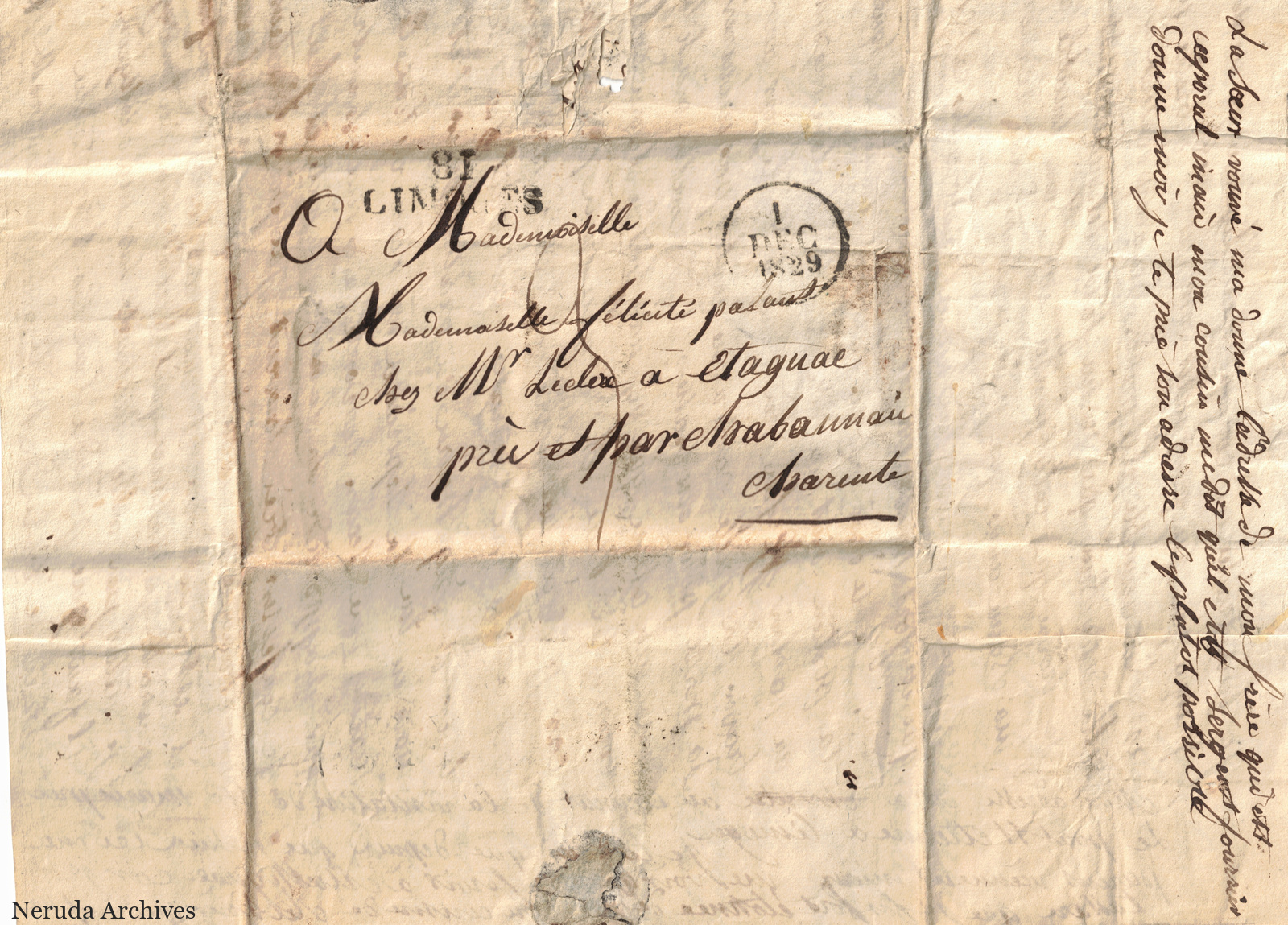
NRA-L-000011 image 1 showing the address panel and postal marks for Christine's 1829 letter to Mademoiselle Felicite Pacaud in Charente.
Image 1Address panel and postal marks.
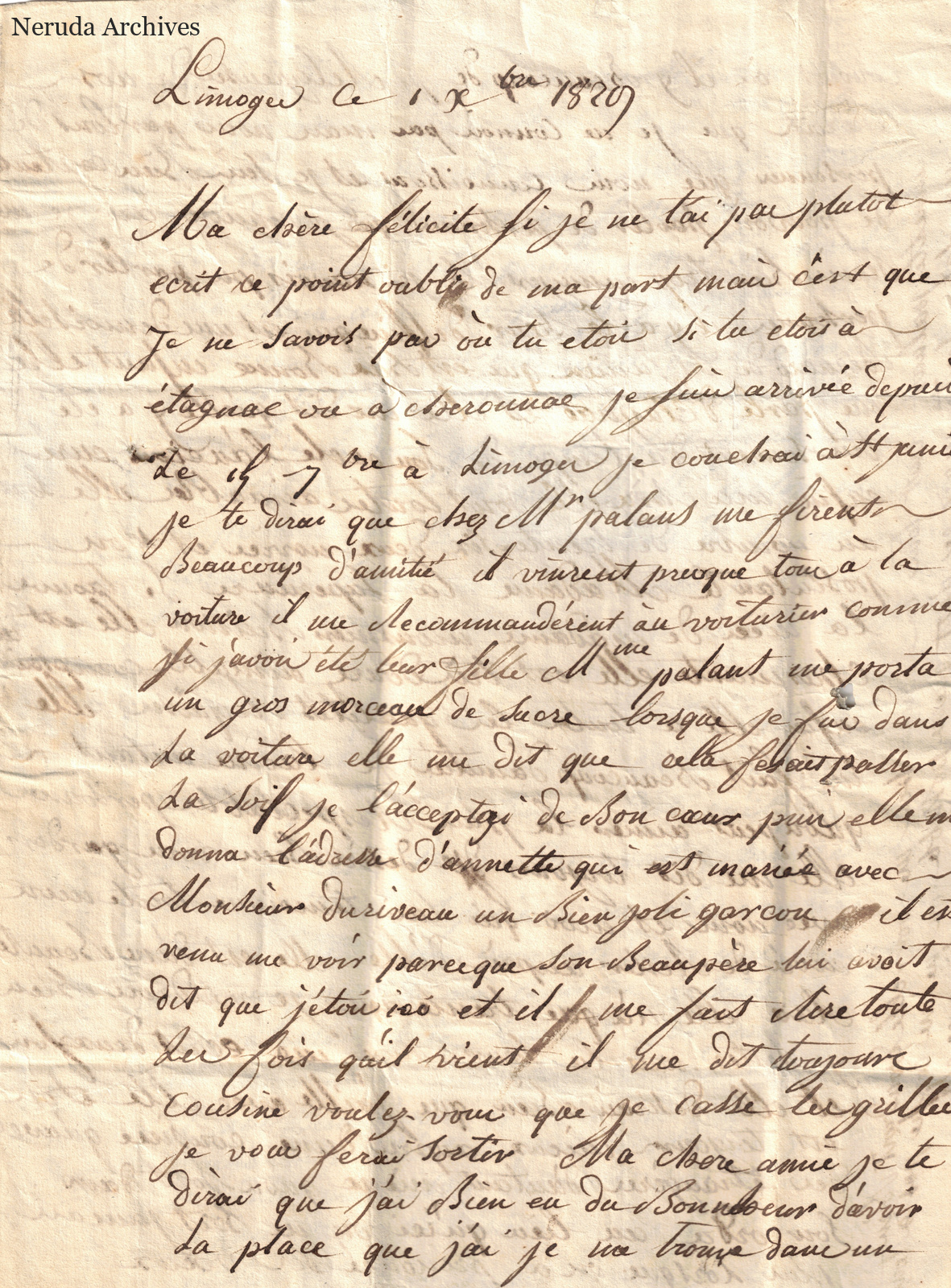
NRA-L-000011 image 2 showing the first page of Christine's letter from Limoges, dated 1 December 1829.
Image 2Letter text - Page 1.
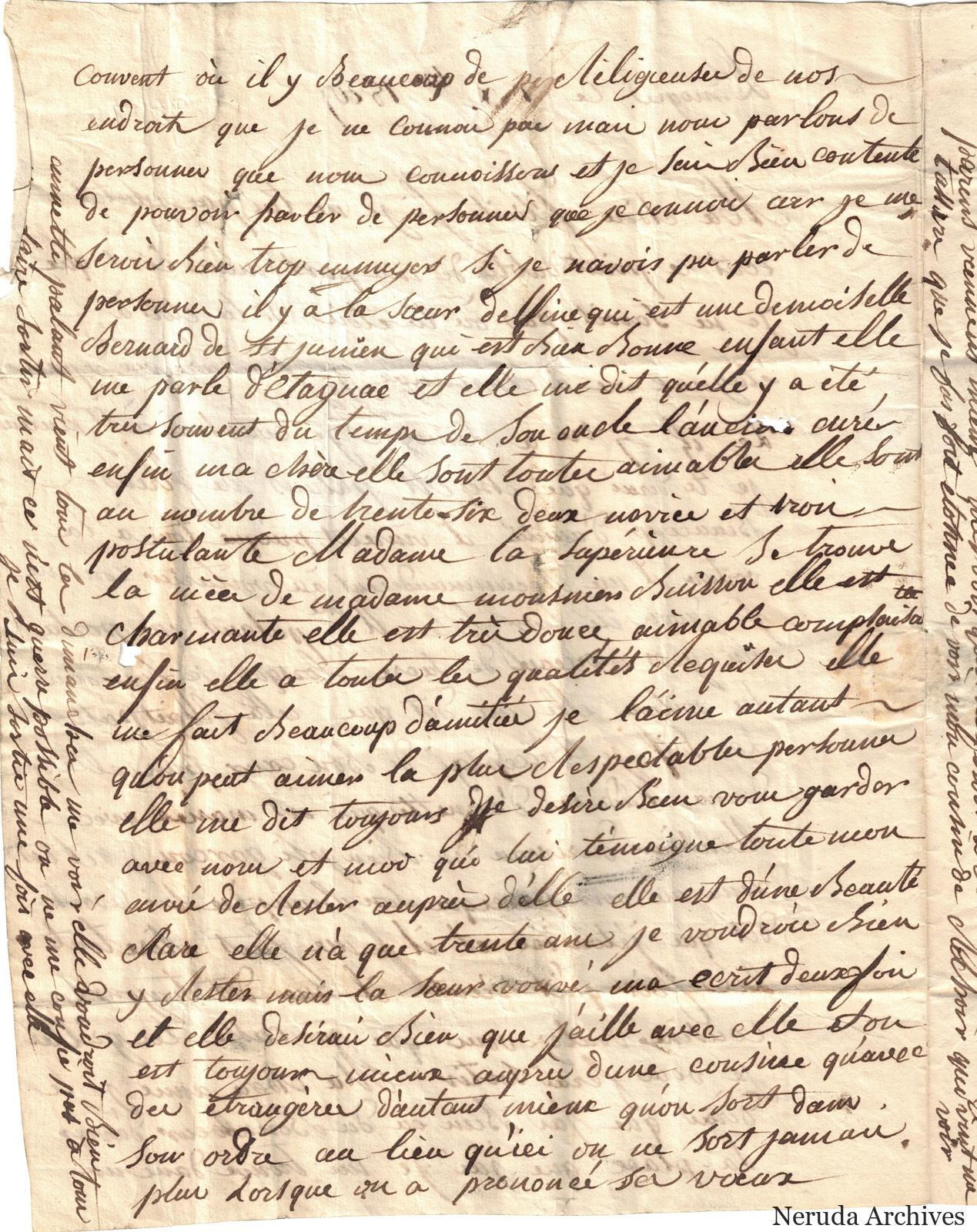
NRA-L-000011 image 3 showing the second page of Christine's letter, with marginal writing.
Image 3Letter text - Page 2.
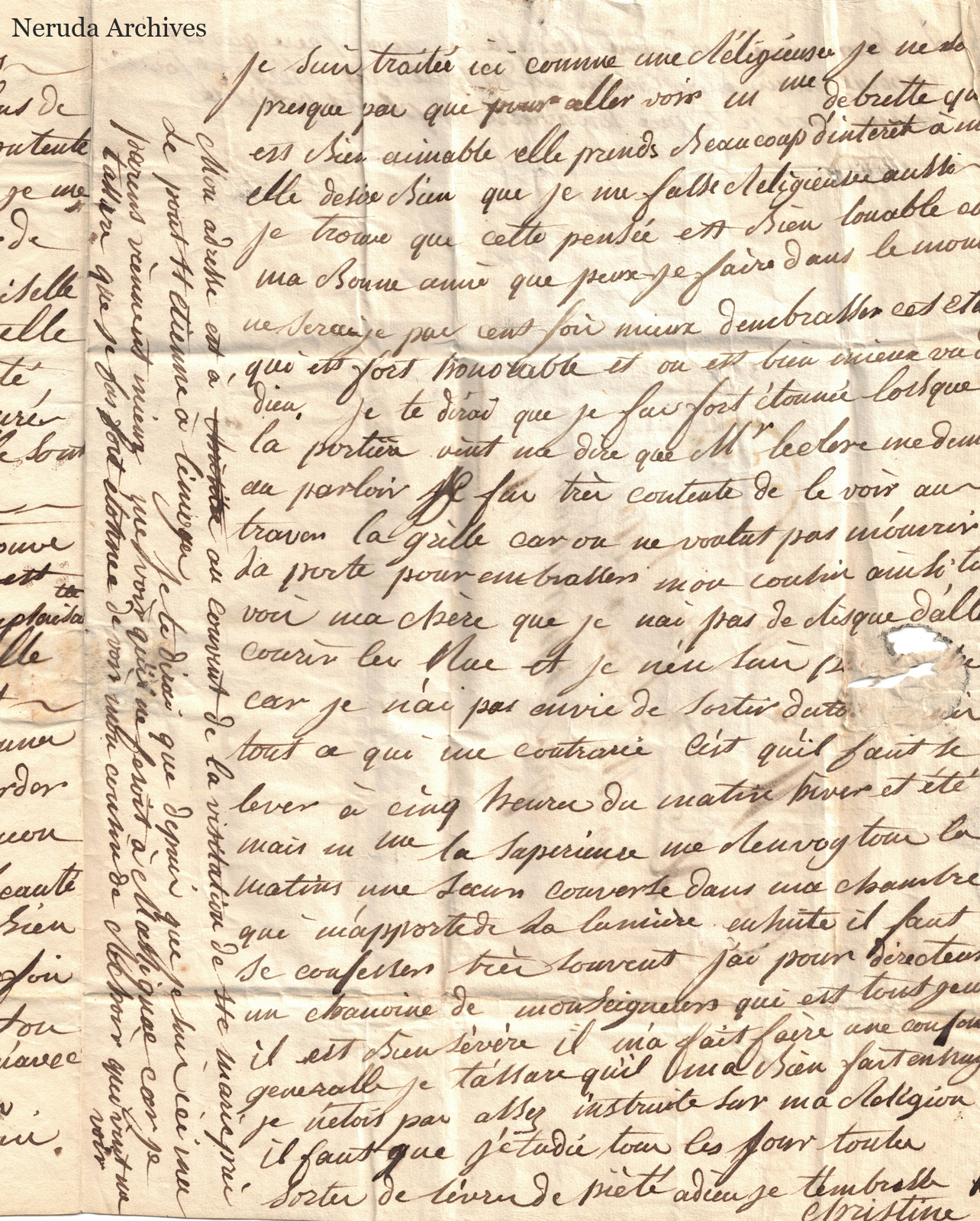
NRA-L-000011 image 4 showing the final page and signature of Christine's letter.
Image 4Letter text - Page 3 and signature.

Transcript and English translation

working scholarly aid

Address Panel

Original transcript

A Mademoiselle
Mademoiselle félicité palaud
chez Mr Lecler a Etagnac
près et par chabanais
Charente

Address Panel

English translation

To Mademoiselle
Mademoiselle Félicité Palaud
Care of Mr Lecler, at Étagnac
Near and via Chabanais
Charente

Letter Text - Page 1

Original transcript

Limoges ce 1 Xbre 1829
Ma chère félicite si je ne tai pas plutot
ecrit ce point oubli de ma part mais c'est que
Je ne savois pas ou tu etois si tu etois à
étagnac ou a cherounac je suis arrivée depuis
Le 17 7bre à Limoges je couchai à St junien
je te dirai que chez Mr palaud me firent
Beaucoup d'amitié et vinrent presque tous à la
voiture et me recommanderent au voiturier comme
si j'avois été leur fille Mme palaud me porta
un gros morceau de sucre lorsque je fus dans
la voiture elle me dit que cela fesait passer
la soif je l'acceptai de bon cœur puis elle me
donna l'adresse d'annette qui est mariée avec
Monsieur Duriveau un bien joli garçon il est
venu me voir parceque son beaupere lui avoit
dit que j'etois ici et il me fait dire toute
les fois qu'il vient il me dit toujours
cousine voulez vous que je casse les grilles
je vous ferai sortir Ma chere amie je te
dirai que j'ai bien eu du Bonheur d'avoir
la place que j'ai je me trouve dans un

Letter Text - Page 1

English translation

Limoges, 1 December 1829
My dear Félicité, if I have not written to you sooner, it is not at all an oversight on my part, but because I did not know where you were, whether you were in Étagnac or in Chéronnac. I arrived in Limoges on the 17th of September; I slept in Saint-Junien.
I will tell you that at Monsieur Palaud's they showed me great kindness and almost all came to the carriage, commending me to the coachman's care as though I had been their daughter. Madame Palaud brought me a large piece of sugar after I was in the carriage; she said it would quench my thirst. I accepted it gladly. Then she gave me the address of Annette, who is married to Monsieur Duriveau, a very handsome young man. He came to see me because his father-in-law had told him that I was here, and he sends word to me every time he comes; he always says, 'Cousin, do you want me to break the bars? I shall get you out.'

Letter Text - Page 2

Original transcript

Couvent où il y beaucoup de [pe?] religieuses de nos
endroits que je ne connois pas mais nous parlons de
personnes que nous connoissons et je suis bien contente
de pouvoir parler de personnes que je connois car je me
serois bien trop ennuyees si je navois pu parler de
personnes il y a la sœur delfine qui est une demoiselle
Bernard de st junien qui est bien bonne enfant elle
me parle d'etagnac et elle me dit qu'elle y a été
très souvent du temps de son oncle l'ancien curé
enfin ma chère elle sont toutes aimables elle sont
au nombre de trente-six deux novice et trois
postulante Madame la supérieure se trouve
la nièce de madame mousnier suisson elle est [tr?]
charmante elle est très douce aimable complaisante
enfin elle a toutes les qualités requises elle
me fait beaucoup d'amitié je l'aime autant
qu'on peut aimer la plus respectable personne
elle me dit toujours je desire bien vous garder
avec nous et moi qui lui témoigne toute mon
envie de rester auprès d'elle elle est d'une beauté
rare elle n'a que trente ans je voudrois bien
y rester mais la sœur vouvé m'a ecrit deux fois
et elle desirait bien que j'aille avec elle l'on
est toujours mieux auprès d'une cousine qu'avec
des étrangères d'autant mieux qu'on sort dans
son ordre au lieu qu'ici on ne sort jamais
plus lorsque on a prononcé ses vœux
annette palaud vient tous les dimanches me voir elle voudroit bien me
laisser sortir mais ce n'est guere possible on ne me confie pas à tous
je suis sortie une fois avec elle

Letter Text - Page 2

English translation

My dear friend, I will tell you that I have been very fortunate to obtain the place I have. I find myself in a convent where there are many nuns from our part of the country whom I do not know, but we talk about people we know, and I am very glad to be able to talk about people I know, for I would have been far too bored if I had been unable to talk about people. There is Sister Delfine, née Mademoiselle Bernard of Saint-Junien, who is a very good-natured girl. She talks to me about Étagnac and tells me she was there very often in the time of her uncle, the former parish priest.
In short, my dear, they are all amiable. There are thirty-six of them, two novices, and three postulants. The Mother Superior is Madame Mousnier Suisson's niece; she is charming, very gentle, kind, and obliging; in short, she has all the requisite qualities. She shows me great kindness; I love her as much as one can love a person worthy of the greatest respect. She is always saying to me, 'I very much want to keep you with us,' while I show her how much I wish to remain with her. She is remarkably beautiful; she is only thirty years old.
I would very much like to stay here, but Sister Vouvé has written to me twice and very much wants me to go to her. One is always better off with a cousin than among strangers, all the more so because in her order one goes out, whereas here one never goes out again after taking one's vows.
Annette Palaud comes to see me every Sunday. She would very much like to let me go out, but it is hardly possible; they do not entrust me to just anyone. I went out with her once.

Letter Text - Page 3

Original transcript

je Suis traitée ici comme une religieuse je ne vo[is]
presque pas que pour aller voir mme debrette qu[i]
est bien aimable elle prends beaucoup d'interêt a m[oi]
elle desire bien que je me fasse religieuse aussi
je trouve que cette pensée est bien louable car
ma bonne amie que peux-je faire dans le monde
ne serais je pas cent fois mieux dembrasser cet etat
qui est fort honorable et ou on est bien mieux vu de
dieu. je te dirai que je fus fort étonnée lorsque
la portiere vint me dire que Mr leclere me demanda[it]
au parloir je fus très contente de le voir au
travers la grille car on ne voulut pas m'ouvrir
la porte pour embrasser mon cousin aussi tu
vois ma chere que je nai pas de risque d'aller
courir les rues et je n'en suis p[as fâ]chée
car je n'ai pas envie de sortir d'ici.
tout ce qui me contrarie c'est qu'il faut se
lever a cinq heures du matin hiver et été
mais mme la superieure m'envoye tous les
matins une soeur converse dans ma chambre
qui m'apporte de la lumiere ensuite il faut
se confesser très souvent j'ai pour directeur
un chanoine de monseigneur qui est tout jeune
il est bien sévère il m'a fait faire une confession
generalle je t'assure qu'il m'a bien fait enrager
je n'etais pas assez instruite sur ma religion
il faut que j'etudie tous les jours toutes
sortes de livres de pieté adieu je t'embrasse
Christine
Mon adresse est a christine au couvent de la visitation de ste marie près
de pont st etienne a limoges je te dirai que depuis que je suis ici mes
parens viennent mieux me voir qu'ils ne fesoit à étagnac car je
t'assure que je suis fort étonnée [...]

Letter Text - Page 3

English translation

I am treated here like a nun; I see almost no one except when I go to see Madame Debrette, who is very amiable. She takes a great interest in me and very much wants me to become a nun too. I find this thought very praiseworthy, for, my good friend, what can I do in the world? Would I not be a hundred times better off embracing this state, which is highly honourable and in which one is regarded much more favourably by God?
I will tell you that I was very surprised when the portress came to tell me that Monsieur Leclere was asking for me in the parlour. I was very glad to see him through the grille, for they would not open the door to let me embrace my cousin. So you see, my dear, that there is no danger of my going out to run the streets, and I am not sorry, for I have no wish to leave this place.
The only thing that vexes me is having to get up at five o'clock in the morning, winter and summer; but every morning the Mother Superior sends a lay sister to my room to bring me a light. Then one must go to confession very often. My spiritual director is one of the bishop's canons, quite young and very strict. He made me make a general confession; I assure you that he thoroughly infuriated me. I had not been sufficiently instructed in my religion; I must study all sorts of books of piety every day.
Farewell, I embrace you.
Christine
My address is: Christine, at the Convent of the Visitation of Sainte-Marie, near Pont Saint-Étienne, Limoges. I will tell you that since I have been here, my relatives have come to see me more often than they did at Étagnac, for I assure you that I am very surprised [...].

Address-side Continuation

Original transcript

La Soeur vouvé ma donne ladresse de mon frère qui est caporal mais mon cousin me dit qu'il etoit Sergent fourrier donne moi je te prie ton adresse le plutot possible

Address-side Continuation

English translation

Sister Vouvé gave me my brother's address. He is a corporal, but my cousin tells me that he was a quartermaster sergeant. Please give me your address as soon as possible.

Discovery Terms

  • Historical correspondence
  • Private collection
  • Letter
  • French language

Historical context

A visit through the grille

Before taking vows

Christine was pleased to see her cousin at the parlour grille, but the door was not opened for her to embrace him. The order's directions for the portress describe keeping the parlours locked and caring for their grilles. Its constitutions normally barred a sister from leaving after she took her vows, allowing exceptions for a legitimate reason approved by the bishop. Christine was still considering whether to become a nun. She had gone out once with Annette and described giving up such outings as part of the choice she faced.[1, 2]

The address Christine gives

In the margin of the last page Christine gives her return address as the Visitation of Sainte-Marie near Pont Saint-Étienne. The old convent of the same name, on what is now rue François-Chénieux, is not a reliable guide to where she lived. The Haute-Vienne departmental archives catalogue an 1813 plan and nineteenth-century building records for that former convent among the records of the Limoges jail.[1, 3, 4]

Evidence and limits

The letter locates Christine near the bridge but gives no street number. Neither the precise building nor a record of her taking vows has been identified.[1]

Sources & evidence (4)
  1. Primary source: manuscript Neruda Archives, NRA-L-000011, Christine to Félicité Palaud, Limoges, 1 December 1829, text pages 2–3 (images 3–4). Read Christine's letter and return address Describes the visit, the one outing with Annette, Christine's consideration of taking vows and her return address near the bridge.
  2. Primary source: rules of the order François de Sales, Constitutions pour les Sœurs Religieuses de la Visitation (1622 text), Constitutions II and XV; Directoire de la Sœur Portiere, in Œuvres de saint François de Sales, tome XXV, Opuscules IV, Annecy edition. Read the order's rules for enclosure and visitors The constitutions regulate enclosure after profession, including exceptions, and conversations with visitors. The directions for the portress refer to locked parlours, keys and grilles; they are not a local rulebook for Limoges in 1829.
  3. Official archival finding aid Archives départementales de la Haute-Vienne, Répertoire numérique détaillé de la sous-série 1 Y, p. 20, 1 Y 105, Bâtiments de l'ancienne communauté des Visitandines, 1806–1850. Find the old buildings under 1 Y 105 (PDF) Catalogues the plan and work on the buildings of the former Visitandine community under the Limoges jail and identifies the buildings with the later Caserne de la Visitation.
  4. Official heritage record Ministère de la Culture, POP, notice Mérimée PA00100339, Ancien couvent des Visitandines, Limoges. See the heritage record of the old convent Locates the former convent on rue François-Chénieux; it does not identify the house named in the letter.

Reviewed 2026-11-21 · Context version 1.0

Document image

Loading document viewer...