NRA-L-000012 / 1826

Letter from Belot to Monsieur Roget, Greffier en chef de la Cour Royale de Metz, 1826-05-24

French legal letter from Belot to Roget, chief clerk of the Royal Court of Metz, explaining time limits for appeals in cassation. Metz is retained as the single place entity; its role as the inferred place of origin is stated separately.

Neruda Archives
NRA-L-000012

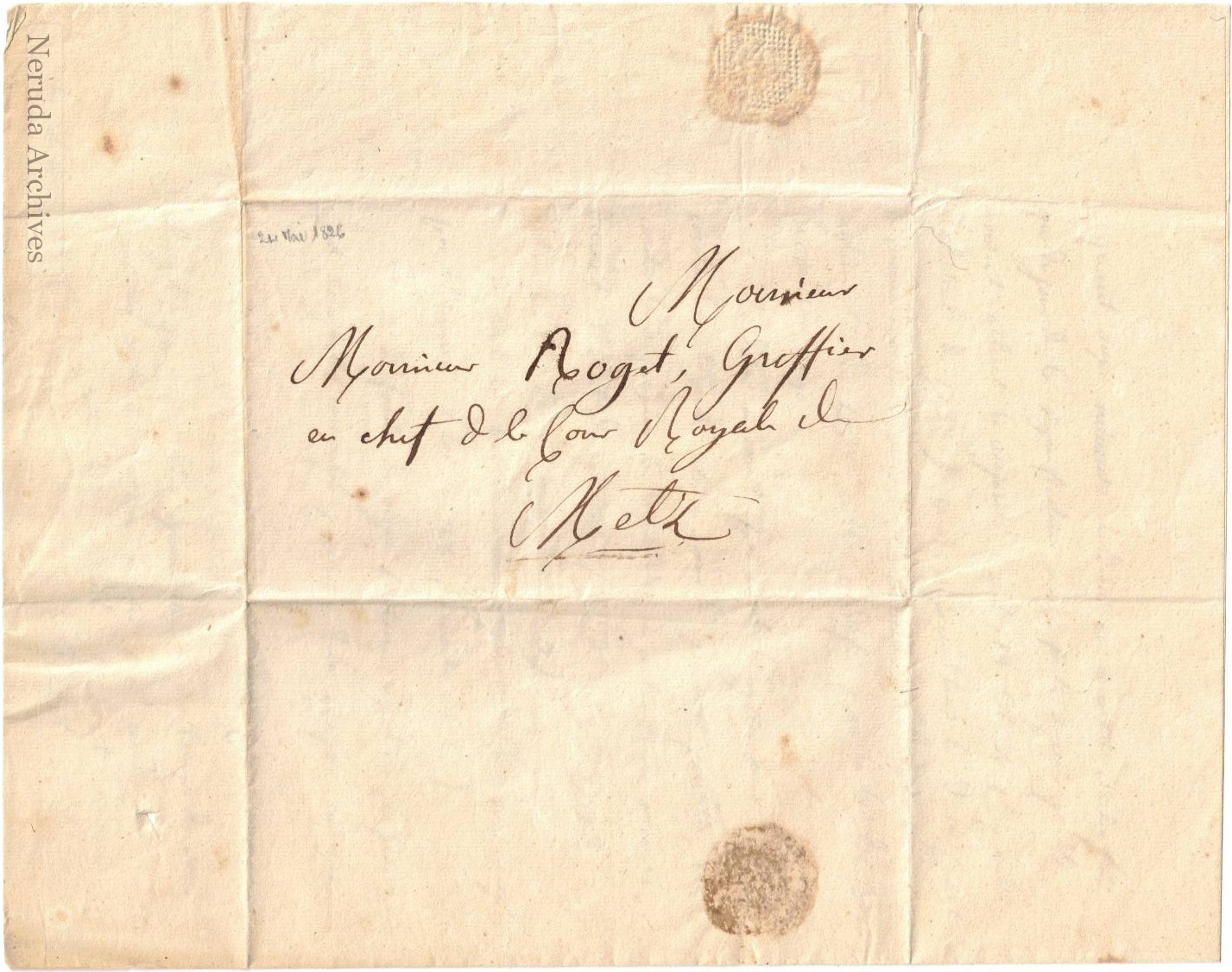
NRA-L-000012 image 1 showing the address panel, postal marks and address-side date for Belot's letter to Monsieur Roget, Chief Clerk of the Royal Court of Metz.
Image 1Address panel, postal marks and address-side date.
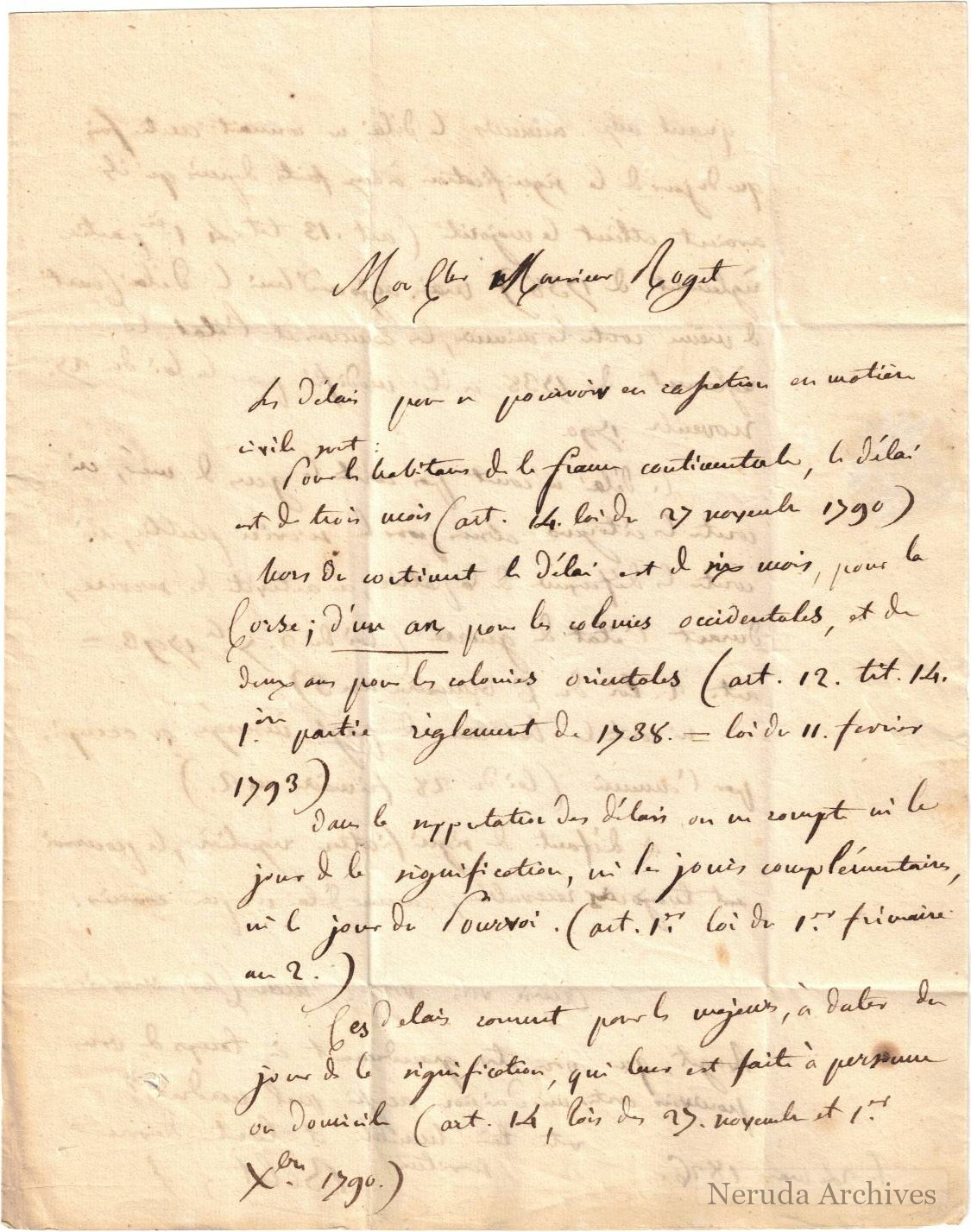
NRA-L-000012 image 2 showing the first page of Belot's letter from Metz, dated 24 May 1826, concerning time limits for appeal in cassation.
Image 2Letter text - Page 1.
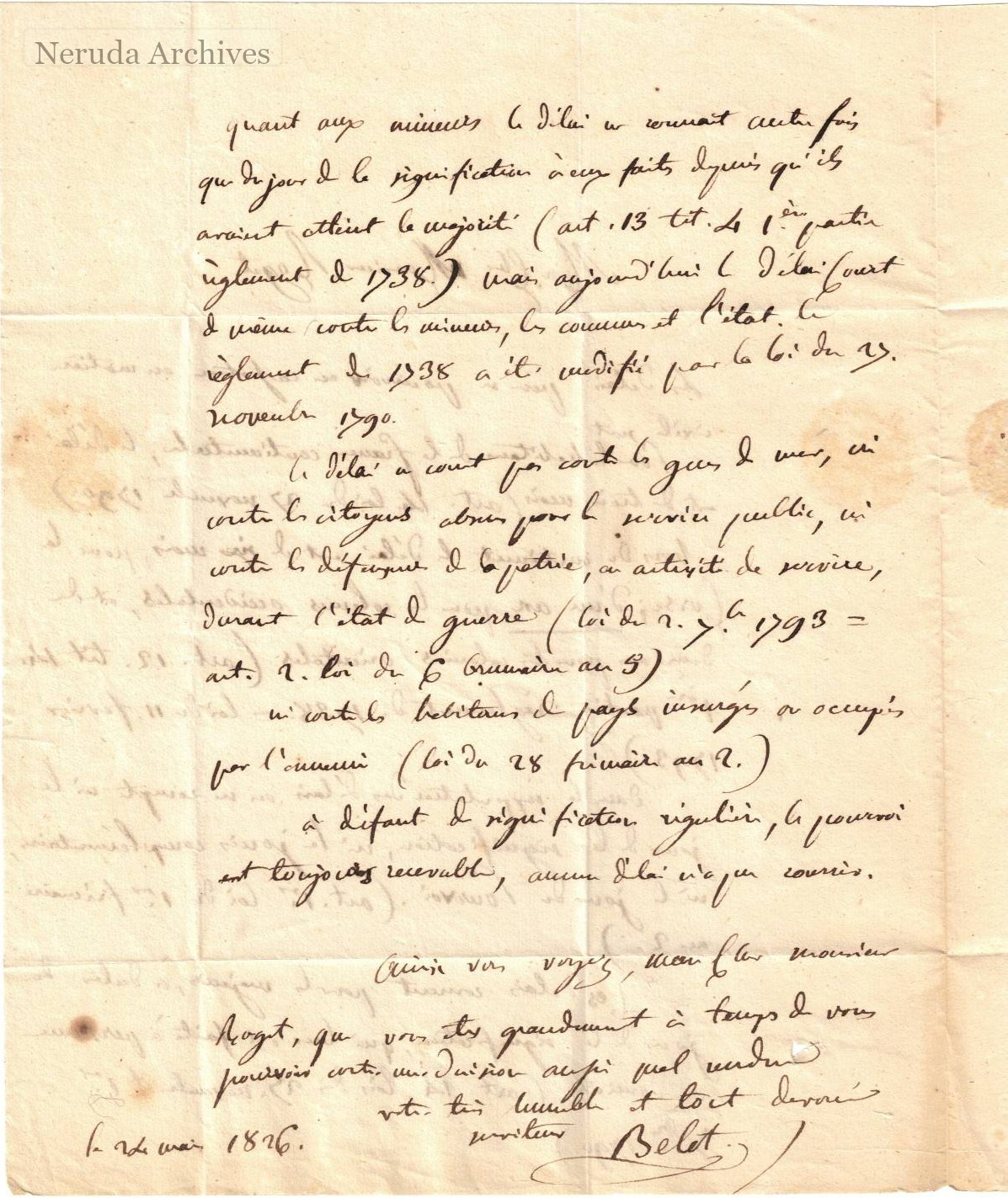
NRA-L-000012 image 3 showing the second and final page, closing and signature of Belot's letter from Metz, dated 24 May 1826.
Image 3Letter text - Page 2 and signature.

Transcript and English translation

working scholarly aid

Address Panel

Original transcript

Monsieur
Monsieur Roget, Greffier
en chef de la Cour Royale de
Metz

Address Panel

English translation

To Monsieur Roget
Chief Clerk of the Royal Court
of Metz

Letter Text - Page 1

Original transcript

Mon cher Monsieur Roget
Les délais pour se pourvoir en cassation en matière
civile sont :
Pour les habitans de la france continentale, le délai
est de trois mois (art. 14. loi du 27 novembre 1790)
hors du continent le délai est de six mois, pour la
Corse ; d'un an pour les colonies occidentales, et de
deux ans pour les colonies orientales (art. 12. tit. 14.
1ère partie règlement de 1738. = loi du 11. fevrier
1793)
Dans la supputation des délais on ne compte ni le
jour de la signification, ni les jours complémentaires,
ni le jour du pourvoi . (art. 1er loi du 1er frimaire
an 2.)
Ces délais courent pour les majeurs, à dater du
jour de la signification, qui leur est faite à personne
ou domicile (art. 14, lois des 27. novembre et 1er
Xbre 1790.)

Letter Text - Page 1

English translation

My dear Monsieur Roget,
The time limits to appeal in cassation in civil matters are:
For the inhabitants of continental France, the time limit is three months (art. 14. law of 27 November 1790)
outside the continent the time limit is six months, for Corsica; one year for the western colonies, and two years for the eastern colonies (art. 12. tit. 14. 1st part regulation of 1738. = law of 11 February 1793)
In the computation of the time limits, neither the day of service, nor the complementary days, nor the day of the appeal are counted. (art. 1 law of 1 Frimaire Year 2.)
These time limits run for adults, starting from the day of service, which is made to them in person or at their domicile (art. 14, laws of 27 November and 1 December 1790.)

Notes

Legal terminology: Pourvoi en cassation is translated as appeal in cassation, and signification as formal service. Frimaire and Brumaire are months of the French Republican calendar and are retained in the cited legal dates.

Letter Text - Page 2

Original transcript

quant aux mineurs le délai ne courait autrefois
que du jour de la signification à eux faite depuis qu'ils
avaient atteint la majorité (art. 13 tit. 4 1ère partie
règlement de 1738.) mais aujourd'hui le délai court
de même contre les mineurs, les communes et l'état. Ce
règlement de 1738 a été modifié par la loi du 27.
novembre 1790.
Le délai ne court pas contre les gens de mer, ni
contre les citoyens absens pour le service public, ni
contre les défenseurs de la patrie, en activité de service,
durant l'état de guerre (loi du 2. 7bre 1793 =
art. 2. loi du 6 brumaire an 5)
ni contre les habitans de pays insurgés ou occupés
par l'ennemi (loi du 28 frimaire an 2.)
à défaut de signification régulière, le pourvoi
est toujours recevable, aucun délai n'a pu courir.
Ainsi vous voyez, mon cher monsieur
Roget, que vous êtes grandement à temps de vous
pourvoir contre une décision aussi mal rendue
votre très humble et tout dévoué
ce 24 mai 1826. serviteur Belot

Letter Text - Page 2

English translation

as for minors the time limit formerly only ran from the day of service made to them after they had reached majority (art. 13 tit. 4 1st part regulation of 1738.) but today the time limit runs in the same way against minors, municipalities and the state. This regulation of 1738 was modified by the law of 27 November 1790.
The time limit does not run against seafarers, nor against citizens absent because of public service, nor against defenders of the fatherland, on active duty, during a state of war (law of 2 September 1793 = art. 2. law of 6 Brumaire Year 5) nor against the inhabitants of insurgent countries or those occupied by the enemy (law of 28 Frimaire Year 2.)
in the absence of regular service, the appeal is always admissible, no time limit could have run.
Thus you see, my dear Monsieur Roget, that you are well within time to appeal against a decision so badly rendered
your very humble and entirely devoted servant
Belot
this 24 May 1826.

Discovery Terms

  • Historical correspondence
  • Private collection
  • Letter
  • French language
Historical context Time limits for cassation in Belot's memorandum 3 sources

A procedural memorandum

Belot's memorandum of 24 May 1826 was addressed to Monsieur Roget, chief clerk of the Royal Court of Metz. It sets out the writer's understanding of the time allowed after formal service of a judgment for bringing an appeal in cassation.[1]

The timetable stated by Belot

For mainland France, Belot gives a period of three months. He gives six months for Corsica, one year for the western colonies and two years for the eastern colonies. He says that the period begins with formal service and excludes the day of service, the complementary days and the day on which the appeal is brought. He also lists exceptional situations involving sailors, absent public officials, active defenders and territories held by an enemy or insurgents.[1]

Legal setting

The law of 27 November 1790 created the Tribunal de cassation and established the early revolutionary framework for cassation. Belot's memorandum belongs to the later practical administration of that procedure, but its detailed schedule and exceptions must be read as his legal summary rather than as a modern restatement of one fully verified statutory text.[1, 2, 3]

Evidence and limits

The detailed deadlines and exceptions are documented as Belot's statements. The additional authorities cited in the manuscript, including rules associated with 1738, 11 February 1793 and 1 Frimaire Year II, have not all been independently matched to authoritative texts in this review. The context therefore does not certify the memorandum as a complete or current statement of law.[1, 2, 3]

Sources & evidence (3)
  1. Primary source · manuscript Neruda Archives, NRA-L-000012, digital images and reviewed transcript of Belot's memorandum dated 24 May 1826. View the archive record Supports the addressee, purpose, deadlines, method of counting and listed exceptions.
  2. Primary source · legislation Loi du 27 novembre 1790 instituant un Tribunal de cassation et réglant sa composition, son organisation et ses attributions. Read the law Confirms the early statutory foundation of the Tribunal de cassation.
  3. Published primary source Archives parlementaires de 1787 à 1860, series I, vol. 21, text of the law of 27 November 1790. View the published text Provides an independent published transcription of the 1790 law.

Reviewed 2026-07-29 · Context version 1.0

Document image

Loading document viewer...