NRA-L-000013 / 1810

Letter from Flavie Duval to Monsieur Noguès Jeune, avoué, 1810-05-28

Flavie Duval disputes the fees and conduct of the avoué Noguès Jeune in an inheritance partition, cites Article 823 of the Code Napoléon, and asks that his bill be reduced to a fair amount.

Neruda Archives
NRA-L-000013

NRA-L-000013 image 1 showing the address panel, postal marks and exterior annotations for Flavie Duval's letter to Monsieur Noguès Jeune, avoué, in Redon.
Image 1Address panel, postal marks and exterior annotations.
NRA-L-000013 image 2 showing the first page of Flavie Duval's letter from Rennes, dated 28 May 1810, concerning legal costs in a partition proceeding.
Image 2Letter text - Page 1.
NRA-L-000013 image 3 showing the second page of Flavie Duval's letter concerning legal costs and her avoué's conduct.
Image 3Letter text - Page 2.
NRA-L-000013 image 4 showing the independently legible closing and signature, Flavie Duval.
Image 4Closing and signature.

Transcript and English translation

working scholarly aid

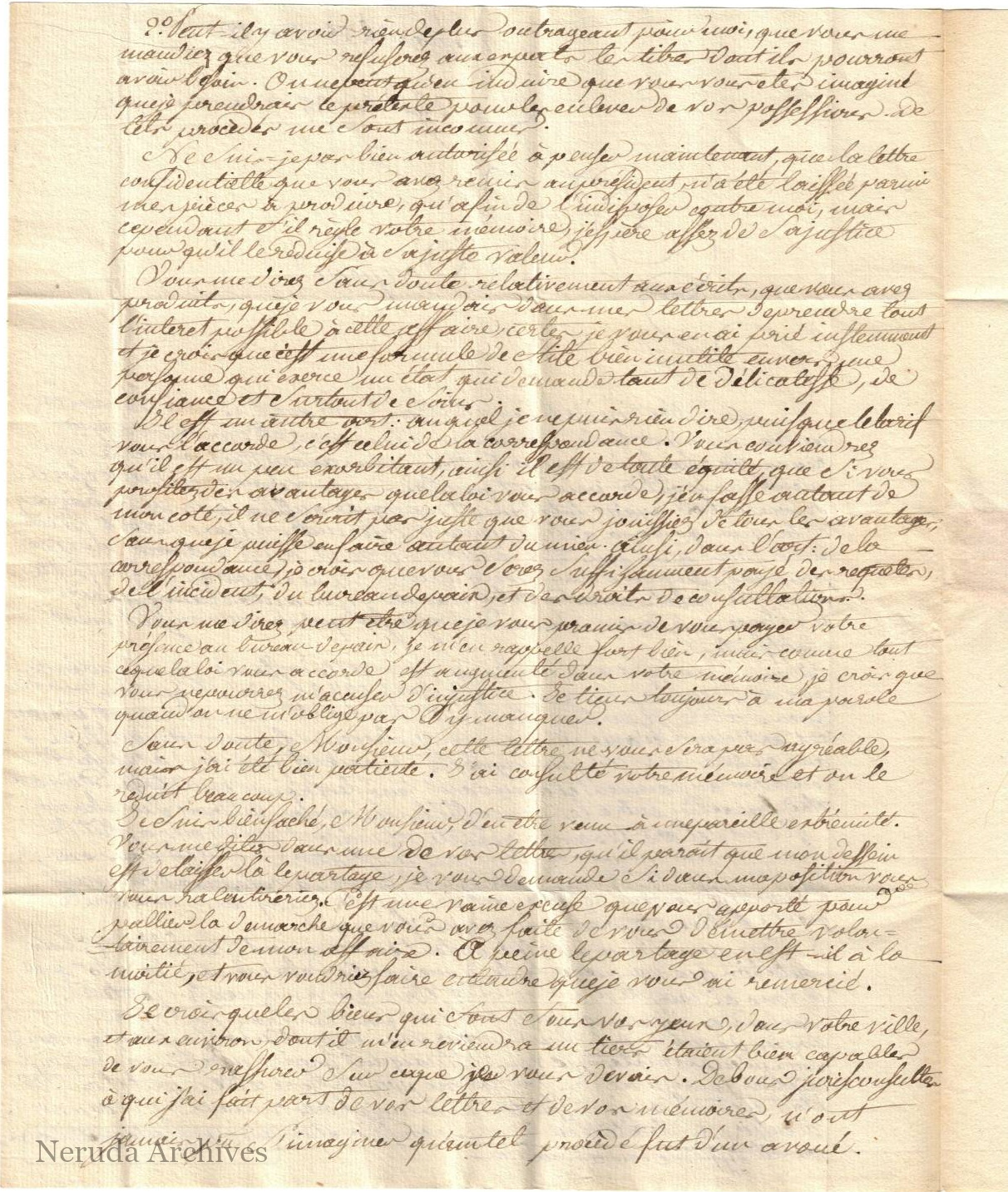
Address Panel

Original transcript

Monsieur
Monsieur Nogues Jeune
Avoué Grand Rue
à Redon

Address Panel

English translation

To Monsieur Nogues Jeune
Avoué, Grand Rue
Redon

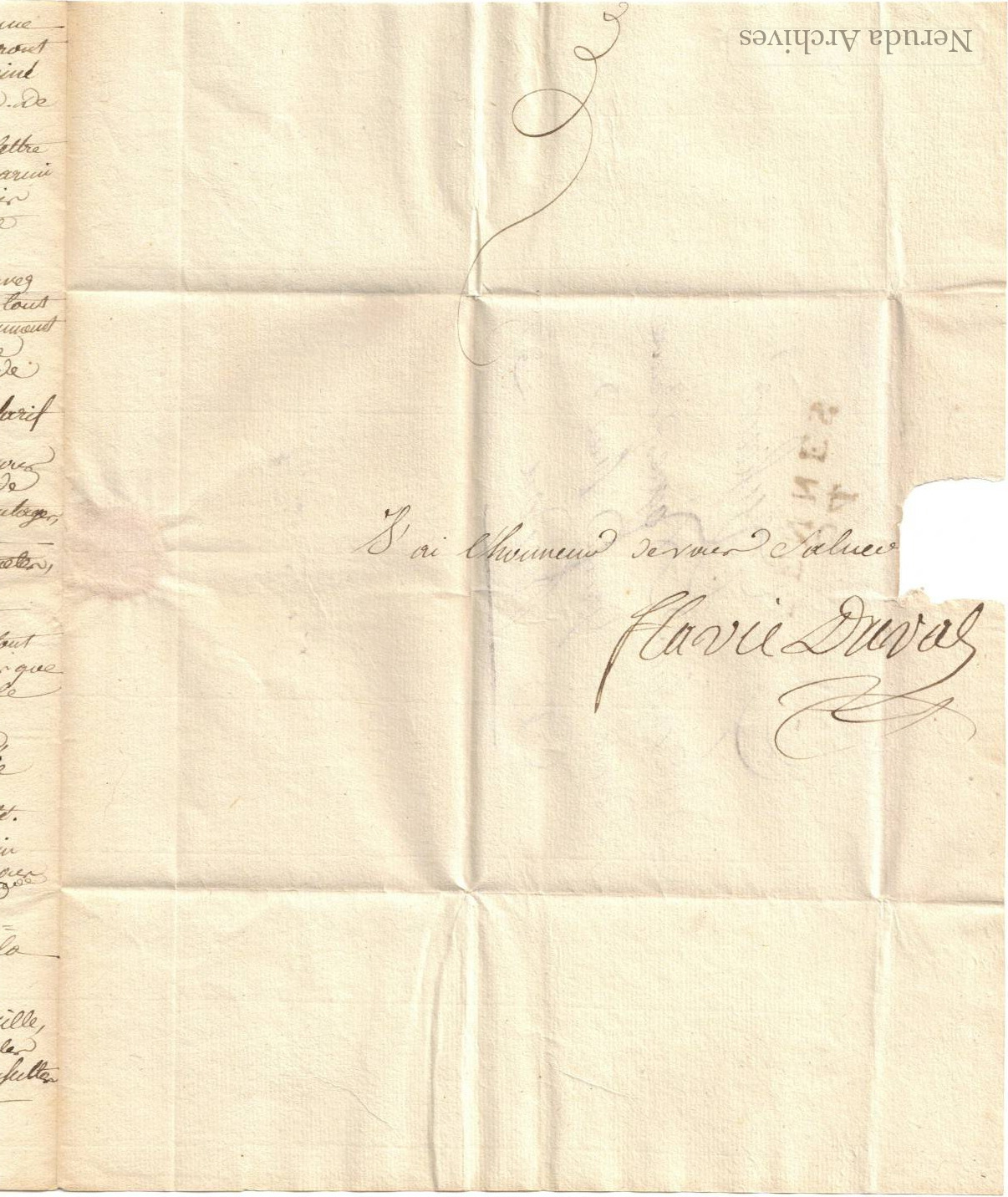
Letter Text - Page 1

Original transcript

Rennes le 28 Mai 1810
Monsieur.
Vos lettres en datte des 1er Mars, 26 avril, 15 mai, 24 mai et
autres, me sont toutes parvenues. Vous aurez été surpris de ne pas
recevoir de réponse de ma part. Mais vous ayant fait connoître moi-
-même ma position pendant que j'étois à mes vendanges, cette espece
de production ayant totalement manqué aussi bien que mes prairies,
et la peine qu'on a à être payée des fermiers, vous seroit facile-
-ment juger que je puis être à court d'argent. ainsi, n'ayant pu et ne
pouvant vous en donner, ou du moins, ce ne seroit qu'un très foible
acompte relativement à votre mémoire, j'ai autant aimé garder
le silence que de vous donner des réponses qui ne vous eussent point
satisfaites.
En vous accordant ma confiance dans cette instance, je m'imaginai
que vous eussiez pris pour regle l'art. 823 du code Napoléon, qui dit
qu'en matiere de partage tout doit être traitté sommairement; d'après
cet art. vous n'avez pu sans y contrevenir fournir des écritures
aux quelles mes co-partageantes seroient fondées à refuser de
concourir au payement et cependant tous les frais de partage doivent
être repartis entre les successibles en raison du droit d'un chacun.
Il suit de l'art. 823 que les requêtes, et incidens qu'il vous a plût de
fournir en mon nom, sont des frais frustratoires. Il est sans exemple,
que dans une instance de partage et avant la consommation, avant
l'expertise, avant le reglement des comptes, les frais d'une seule
partie s'élevent à près de cinq cens francs.
Deux procédés m'ont été sur tout extremement sensibles 1° l'im-
-putation que vous avez faite, d'une partie de la somme de 150 tt que
je vous ai compté, sur un objet étranger à ma cause, j'entends
parler des dépens que vous reclamez pour les frais faits dans le
procès de ma mere. Vous deviez vous rappeller, Monsieur, que quand
vous m'en parlates, je vous témoignai que je n'en ferais pas de pres-
-cription, mais je ne vous autorisai point à faire cette imputation. Il
étoit naturel que je visse terminer un procès ruineux. Si vous ne
m'eussiez pas traitté avec le peu de considération que vous faites, je n'aurois
pas été difficile sur cet examen.

Letter Text - Page 1

English translation

Rennes, 28 May 1810
Sir,
Your letters dated 1 March, 26 April, 15 May, 24 May and others, have all reached me. You will have been surprised not to receive a reply from me.
But I myself made my position known to you during the grape harvest. That crop failed completely, as did the yield from my meadows, and it is difficult to obtain payment from the tenant farmers; you could therefore easily judge that I might be short of money.
Thus, having been and still being unable to send you any money—or at least no more than a very small instalment in relation to your bill—I preferred to remain silent rather than give you replies that would not have satisfied you at all.
When I entrusted this proceeding to you, I assumed that you would take Article 823 of the Code Napoléon as your rule; it states that in matters of partition everything must be dealt with summarily.
Under this article, you could not submit written pleadings without contravening it, and my co-heirs would be justified in refusing to contribute towards their cost. Yet all the costs of partition must be apportioned among the heirs in proportion to each one's entitlement.
It follows from Article 823 that the petitions and incidental applications you chose to submit in my name are wasted costs. It is unheard of for the costs of a single party in partition proceedings to rise to nearly five hundred francs before completion of the partition, before the expert valuation and before the settlement of accounts.
Two aspects of your conduct have been especially painful to me:
First, your allocation of part of the 150 livres tournois I paid you to a matter unrelated to my case; I mean the costs you claim were incurred in my mother's lawsuit.
You should have remembered, Sir, that when you spoke to me about it, I told you I would not invoke the statute of limitations; but I did not authorise you to make this allocation. It was natural that I should wish to see a ruinous lawsuit brought to an end. Had you not treated me with so little consideration, I would not have been difficult over this item.

Notes

Legal terms: Avoué, mémoire, co-partageantes, frais frustratoires, bureau de paix, and jurisconsultes are retained in French because they carry specific legal or institutional meanings. Currency: The abbreviation 150 tt probably denotes livres tournois, although the manuscript symbol remains somewhat uncertain.

Letter Text - Page 2

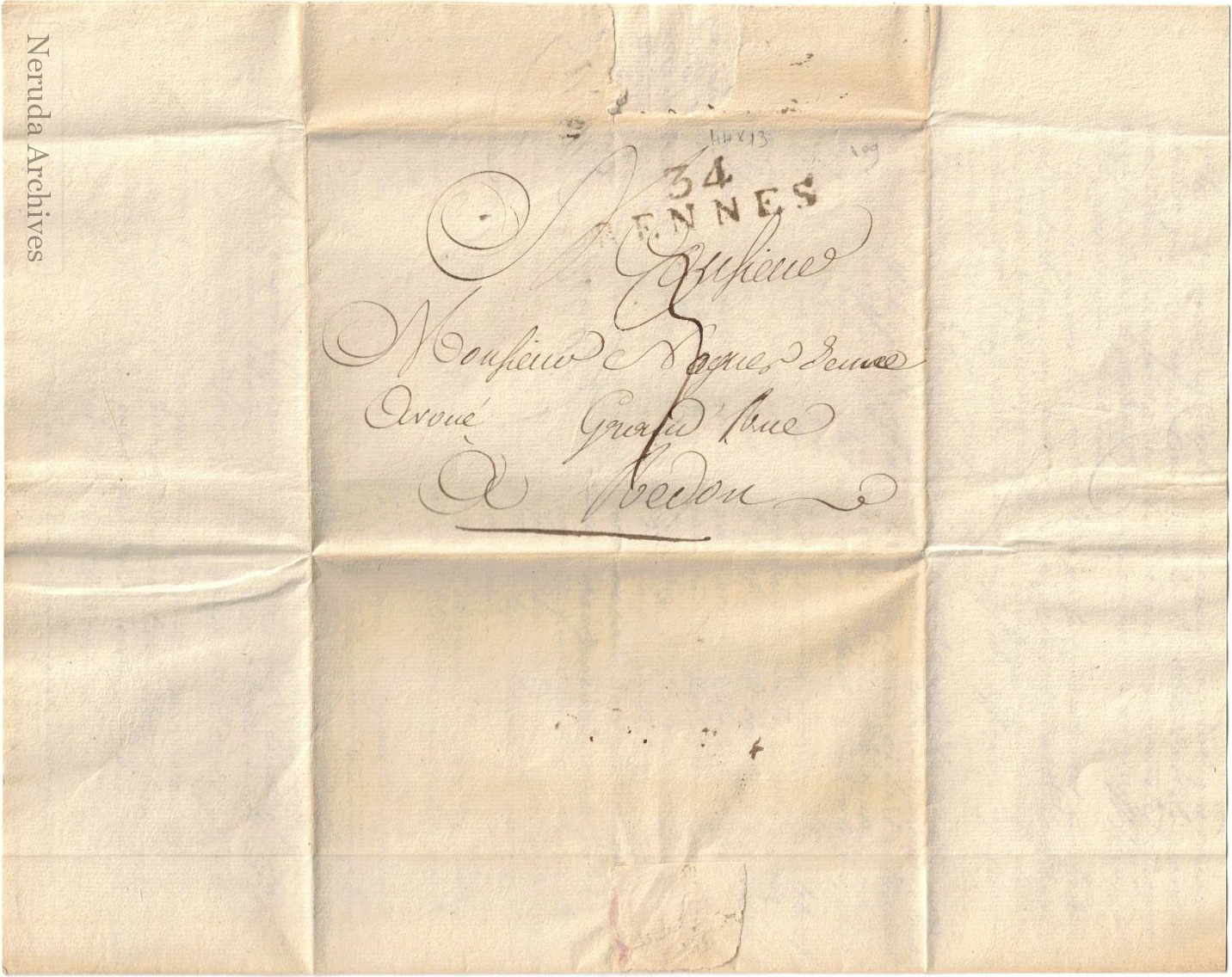
Original transcript

2° Peut il y avoir rien de plus outrageant pour moi, que vous me
mandiez que vous refuserez aux experts les titres dont ils pourront
avoir besoin. On ne peut qu'en déduire que vous vous etes imaginé
que je prendrais le prétexte pour les enlever de vos possessions. de
tels procédés me sont inconnus.
Ne suis-je pas bien autorisée à penser maintenant, que la lettre
confidentielle que vous avez remis au président n'a été laissée parmi
mes pièces à produire, qu'afin de l'indisposer contre moi, mais
cependant s'il règle votre mémoire, j'espère assez de sa justice
pour qu'il le réduise à sa juste valeur.
Vous me direz sans doute relativement aux écrits, que vous avez
produits, que je vous mandais dans mes lettres de prendre tout
l'interet possible à cette affaire, certes je vous en ai prié instamment
et je crois que c'est une formule de stile bien inutile envers une
personne qui exerce un état qui demande tant de délicatesse, de
confiance et surtout de soins.
Il est un autre art. auquel je ne puis rien dire, puisque le tarif
vous l'accorde, c'est celui de la correspondance. Vous conviendrez
qu'il est un peu exorbitant, ainsi il est de toute équité, que si vous
profitez des avantages que la loi vous accorde, j'en fasse autant de
mon coté, il ne serait pas juste que vous jouissiez de tous les avantages,
sans que je puisse en faire autant du mien. Ainsi, dans l'art. de la
correspondance, je crois que vous serez suffisamment payé des requêtes,
de l'incident, du bureau de paix, et des droits de consultations.
Vous me direz peut être que je vous promis de vous payer votre
présence au bureau de paix, je m'en rappelle fort bien, mais comme tout
ce que la loi vous accorde est augmenté dans votre mémoire, je crois que
vous ne pourrez m'accuser d'injustice. Je tiens toujours à ma parole
quand on ne m'oblige pas à y manquer.
Sans doute, Monsieur, cette lettre ne vous sera pas agréable,
mais j'ai été bien patiente. J'ai consulté votre mémoire et on le
réduit beaucoup.
Je suis bien faché, Monsieur, d'en etre venu à une pareille extrémité.
Vous me dites dans une de vos lettres, qu'il parait que mon dessein
est de laisser là le partage, je vous demande si dans ma position vous
vous ralentireriez, c'est une vaine excuse que vous apporté pour
pallier la démarche que vous avez faite de vous démettre volon=
tairement de mon affaire. A peine le partage en est-il à la
moitié, et vous voudriez faire entendre que je vous ai remercié.
Je crois que les biens qui sont sous vos yeux, dans votre ville,
et aux environs, dont il m'en reviendra un tiers étaient bien capables
de vous rassurer sur ce que je vous devais. De bons jurisconsultes
à qui j'ai fait part de vos lettres et de vos mémoires, n'ont
jamais pu s'imaginer qu'un tel procédé fut d'un avoué.

Letter Text - Page 2

English translation

Second, could anything be more insulting to me than your informing me that you will refuse the experts the title deeds they may need? One can only infer that you imagined I would use the pretext to remove them from your possession. Such conduct is unknown to me.
Am I not now justified in thinking that the confidential letter you handed to the president was left among my documents for production solely in order to prejudice him against me? Nevertheless, if he assesses your bill, I have sufficient confidence in his justice to hope that he will reduce it to its proper value.
You will doubtless tell me, regarding the documents you submitted, that in my letters I asked you to take every possible interest in this affair. I certainly urged you earnestly to do so; yet I believe this is a wholly unnecessary conventional phrase when addressed to someone whose profession demands so much delicacy, trust and, above all, care.
There is one other item I cannot dispute, since the tariff allows it to you: the charge for correspondence. You will agree that it is somewhat exorbitant. It is therefore only equitable that, if you take advantage of the benefits granted you by law, I should do the same on my side; it would not be fair for you to enjoy every advantage without my being able to do likewise.
Thus, under the correspondence item, I believe you will be sufficiently paid for the petitions, the incidental application, attendance at the bureau de paix and the consultation fees.
You will perhaps tell me that I promised to pay you for your presence at the bureau de paix; I remember it very well, but since everything the law grants you is increased in your bill, I believe you will not be able to accuse me of injustice. I always keep my word when I am not forced to break it.
No doubt, Sir, this letter will not please you, but I have been very patient. I have had your bill examined, and it is being reduced considerably.
I am very sorry, Sir, to have come to such an extremity. In one of your letters you say that I appear to intend abandoning the partition. I ask you whether, in my position, you would proceed any less urgently.
It is an empty excuse offered to palliate your decision to withdraw voluntarily from my case. The partition is barely halfway complete, and you would have it believed that I dismissed you.
I believe that the properties before your eyes, in your town and the surrounding area, one third of which will come to me, were quite sufficient to reassure you about what I owed you.
Good legal advisers to whom I showed your letters and bills could not believe that an avoué could conduct himself in such a manner.
Closing and Signature

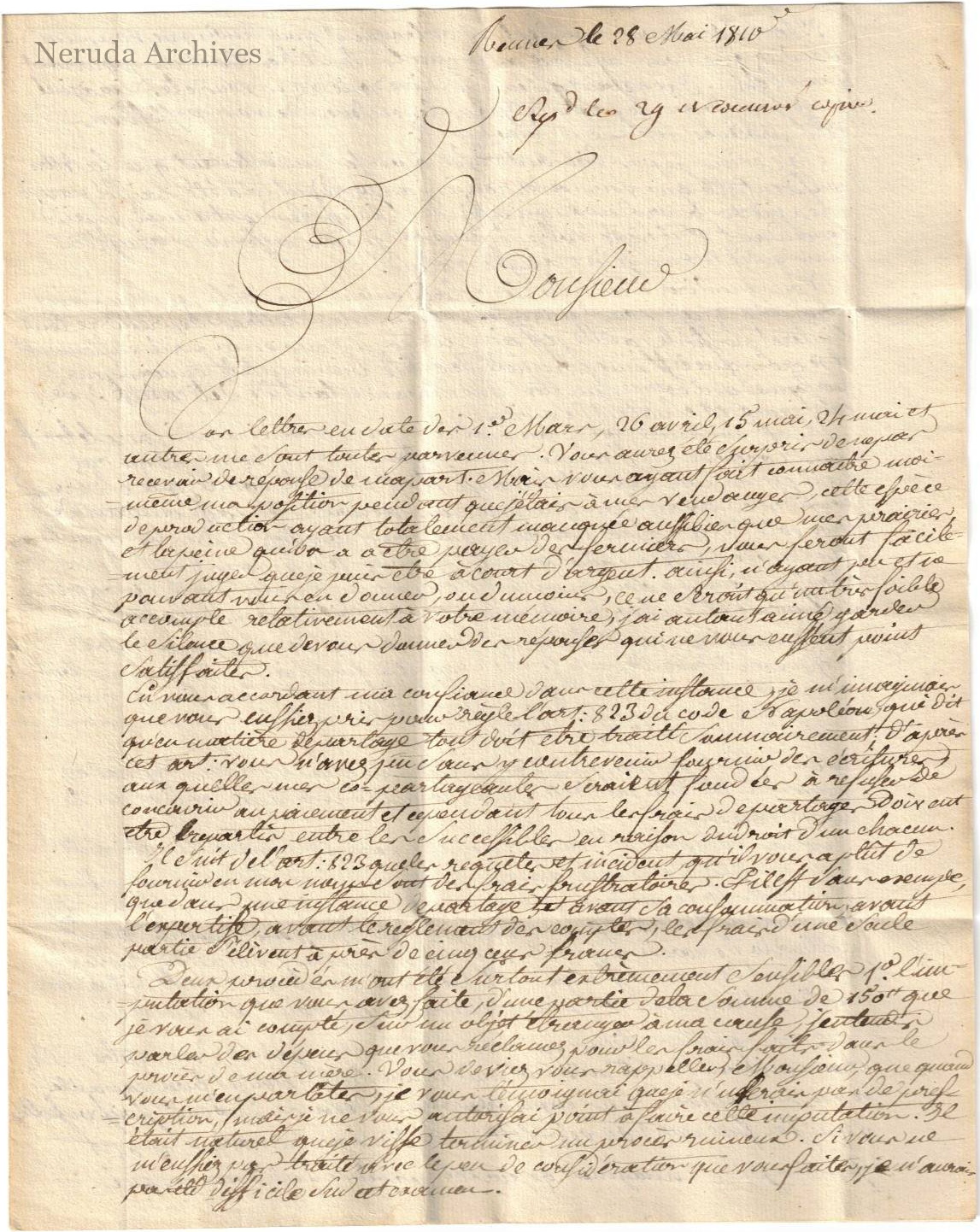
Original transcript

J'ai l'honneur de vous Saluer
Flavie Duval

Closing and Signature

English translation

I have the honour to greet you,
Flavie Duval

Later manuscript record

Original transcript

Repd le 29 et renvoyé copie.

Later manuscript record

English translation

[Replied on the 29th and a copy sent back.]

Discovery Terms

  • Historical correspondence
  • Private collection
  • Letter
  • French language

Historical context

Partition costs, procedure and Article 823

A dispute over the cost of partition

Writing on 28 May 1810, Flavie Duval asks Noguès jeune, an avoué at Redon, about costs approaching 500 francs in proceedings concerning a partition. She describes part of the expense as frais frustratoires, or needless costs, and invokes Article 823 of the Civil Code in support of her complaint.[1, 3]

What Article 823 provided

Article 823 applied when a co-heir refused to consent to a partition or when disputes arose over how it should be conducted or completed. It allowed the court to decide summarily or to appoint a judge to oversee the operation. Duval's letter presents the article more broadly, so her wording should be understood as an interested party's legal argument rather than a verbatim statement of the provision.[1, 2]

The recipient's professional role

An avoué was a legal officer who represented parties and conducted procedural business before a court. That role helps explain why Duval directed her questions about procedure and costs to Noguès jeune.[1, 3]

Evidence and limits

The characterization of the costs as needless is Duval's allegation, not a finding of misconduct. One monetary notation in the manuscript, transcribed as '150 tt', remains unresolved and is not expanded here. No court file or final account has yet been identified to establish how the dispute ended.[1]

Sources & evidence (3)
  1. Primary source · manuscript Neruda Archives, NRA-L-000013, digital images and reviewed transcript of Flavie Duval's letter dated 28 May 1810. View the archive record Supports the parties, amounts, complaint about costs and reference to Article 823.
  2. Primary source · legislation Code civil, Article 823, text in force from 21 March 1804. Read Article 823 Confirms the provision governing refusal or disputes in judicial partition.
  3. Historical dictionary Centre national de ressources textuelles et lexicales, entry 'avoué'. Read the dictionary entry Supports the historical professional meaning of avoué.

Reviewed 2026-07-29 · Context version 1.0

Document image

Loading document viewer...