A small debt followed by much larger costs
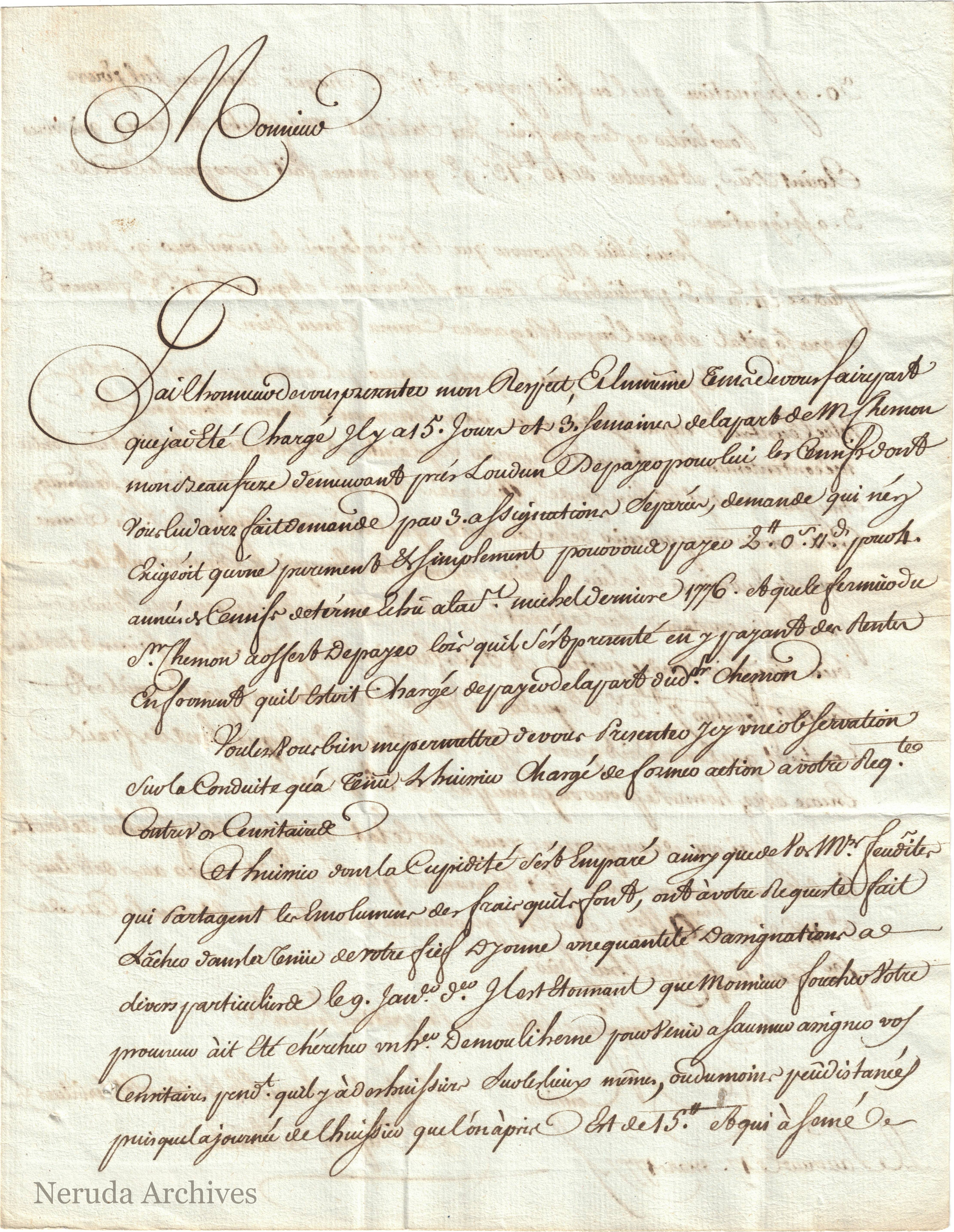
The letter of 17 March 1777 concerns arrears of cens: a principal sum of 2 livres, 5 sols and 11 deniers said to have fallen due at Michaelmas 1776. The writer objects that three summonses were issued where one would have sufficed.[1]
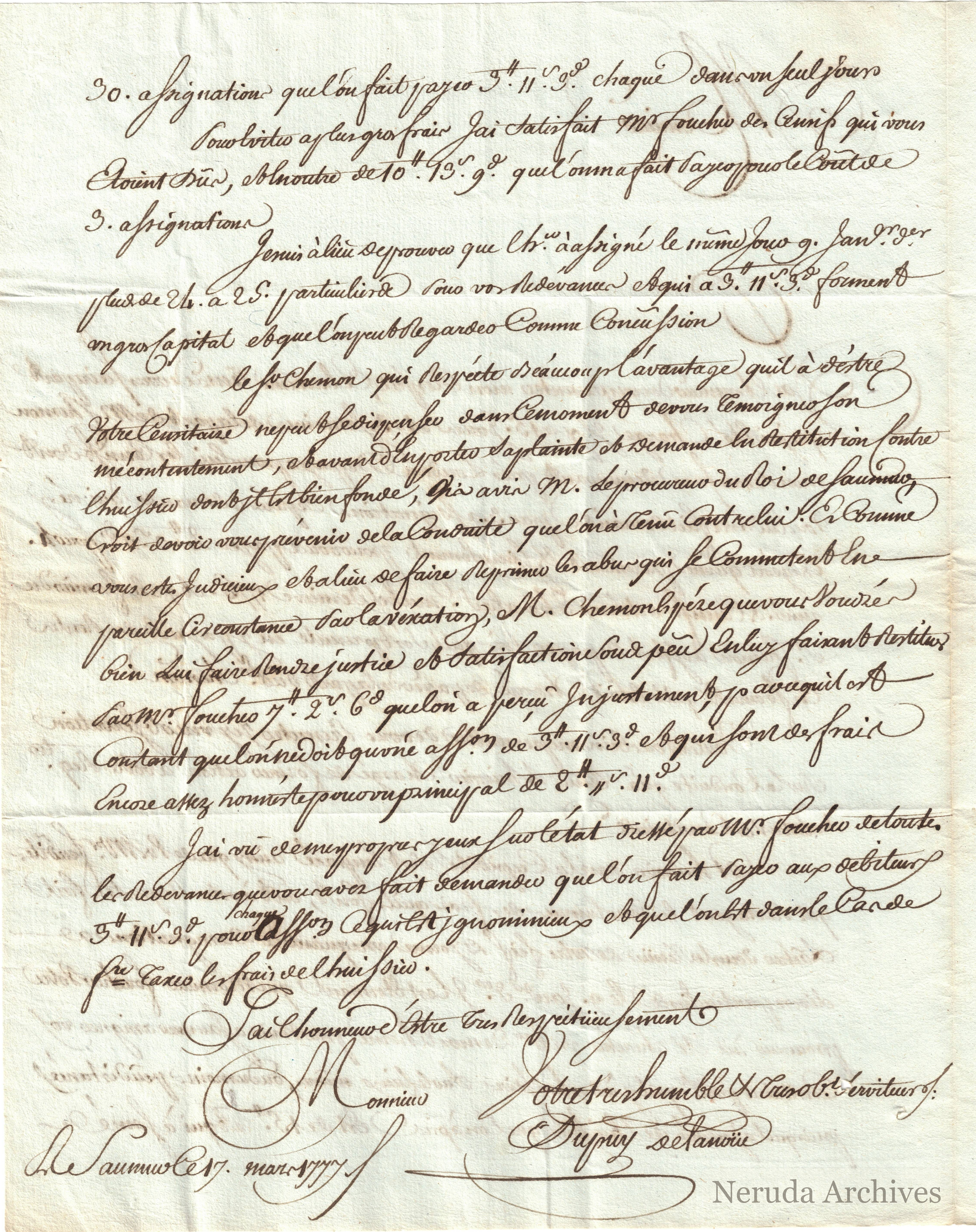
The account gives 3 livres, 11 sols and 3 deniers for one summons. Three such charges total 10 livres, 13 sols and 9 deniers; the requested repayment of two charges is therefore 7 livres, 2 sols and 6 deniers. This arithmetic follows the document's own figures.[1, 3]
The accusation of concussion
The writer calls the conduct concussion. In the 1762 dictionary of the Académie française, the term denoted an unlawful exaction by a public officer beyond what was due. Its use makes the complaint serious, but it remains the writer's accusation rather than a judicial finding.[1, 2]
Currency and scale
Under the accounting system used in the letter, one livre comprised 20 sols and one sol 12 deniers. The writer also reports that a bailiff from Mouliherne received 15 livres a day and issued about thirty summonses; those additional claims are preserved as testimony and have not been independently verified.[1, 3]
The lordship behind the address
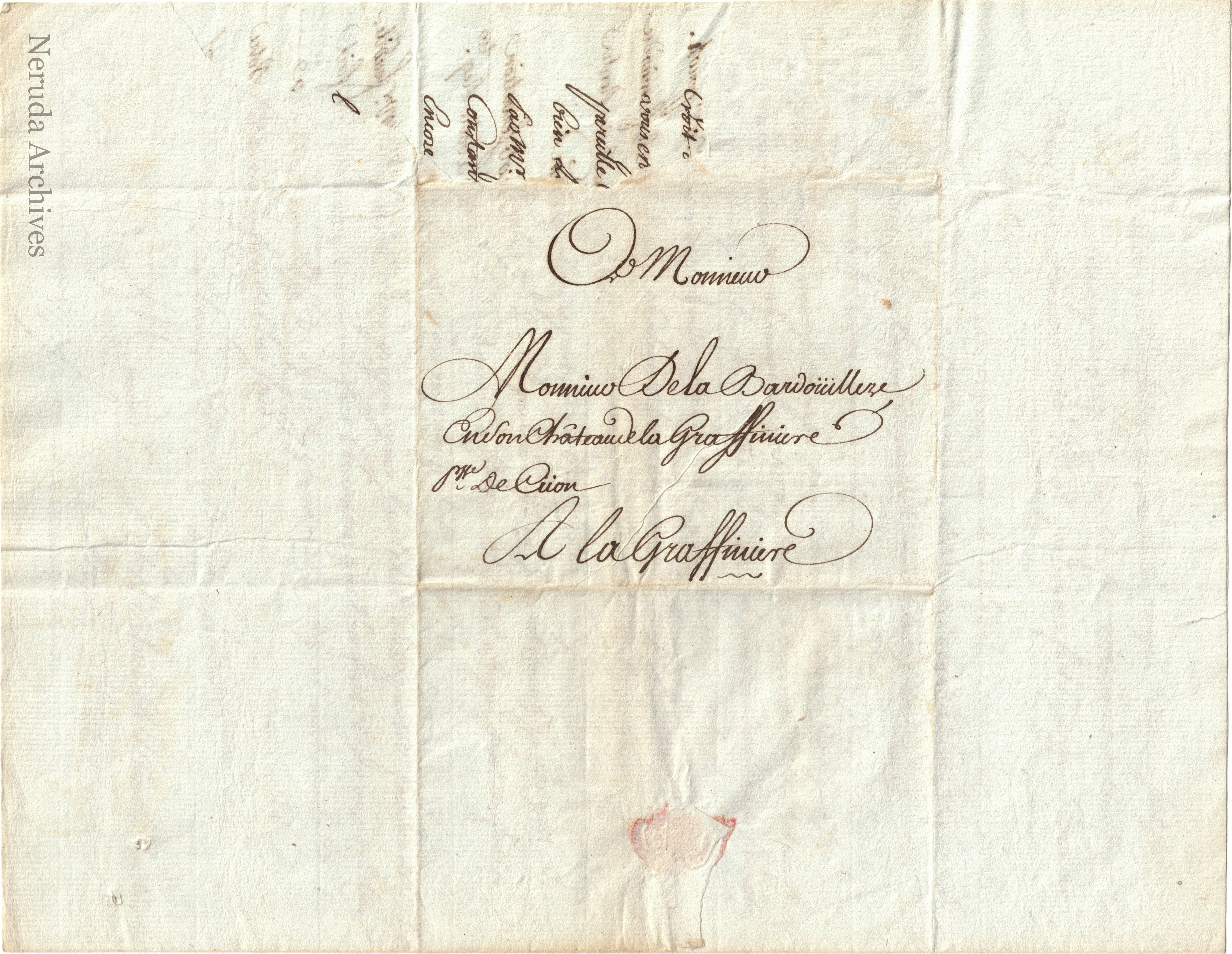
The letter is addressed to Monsieur de la Bardoüillere at La Graffinière, in the parish of Cuon. A notarial deed from 1725 identifies René de Guillot as lord of La Bardouillère and places him at that château. Records from the 1760s also show that the Anjou specialist Auguste Labry was appointed to represent the lord's interests in the local seigneurial court. A letter in Labry's papers, from March 1770, is attributed to La Bardouillère. These records help trace the estate named in the address, but they do not name the person who received the complaint in 1777.[1, 4, 5]
Evidence and limits
The writer's identity remains uncertain, and no related court or estate account has been located. The alleged excess fees, daily rate and number of summonses are not treated as proven facts about the officials involved.[1]
The earlier records do not show that Labry was involved in the disputed summonses or that René de Guillot was the addressee in 1777. The individual who then held the title has not been verified.[1, 4, 5]
Sources & evidence (5)
- Primary source · manuscript Neruda Archives, NRA-L-000020, digital images and reviewed transcript of the letter dated 17 March 1777. View the archive record Supports the debt, fees, arithmetic, reported daily rate and accusation.
- Historical dictionary Dictionnaire de l'Académie française, 4th edition (1762), entry 'concussion'. Read the dictionary entry Supports the contemporary meaning of concussion as an unlawful exaction.
- Historical reference work Encyclopédie ou Dictionnaire raisonné des sciences, des arts et des métiers, entry 'Sol'. Read the reference entry Supports the relationship between livres, sols and deniers.
- Archival reference in the regional heritage inventory Archives départementales de Maine-et-Loire, 5 E 73 794, Jacques Gaudin, notary at Baugé, sale of Les Roches, 28 February 1725; described in Inventaire général du patrimoine culturel, IA72001205, p. 2. See the archival reference to the 1725 deed The description gives René de Guillot's title and residence at the château, spelled Grassinière in the inventory's summary.
- Historical research based on archival records Brigitte Maillard, “Un feudiste de province au travail à la fin de l’Ancien Régime”, Annales de Bretagne et des Pays de l’Ouest 126-1 (2019), pp. 131–132, notes 30 and 36, DOI 10.4000/abpo.4422; Archives départementales de Maine-et-Loire, E 2978 for the 1770 letter. Records Labry's appointments to the lordship's court in 1761 and 1765 and cites correspondence from La Bardouillère in March 1770.