NRA-L-000024 / 1843

Letter from M. G. to Monsieur Evrard, lawyer, 1843-04-20

French family and financial letter signed M G to Evrard, a lawyer at Tarascon, dated in the running text only `le 20 avril`. The catalogue year 1843 is derived from separate docketing and Avignon–Tarascon postal evidence.

Neruda Archives
NRA-L-000024

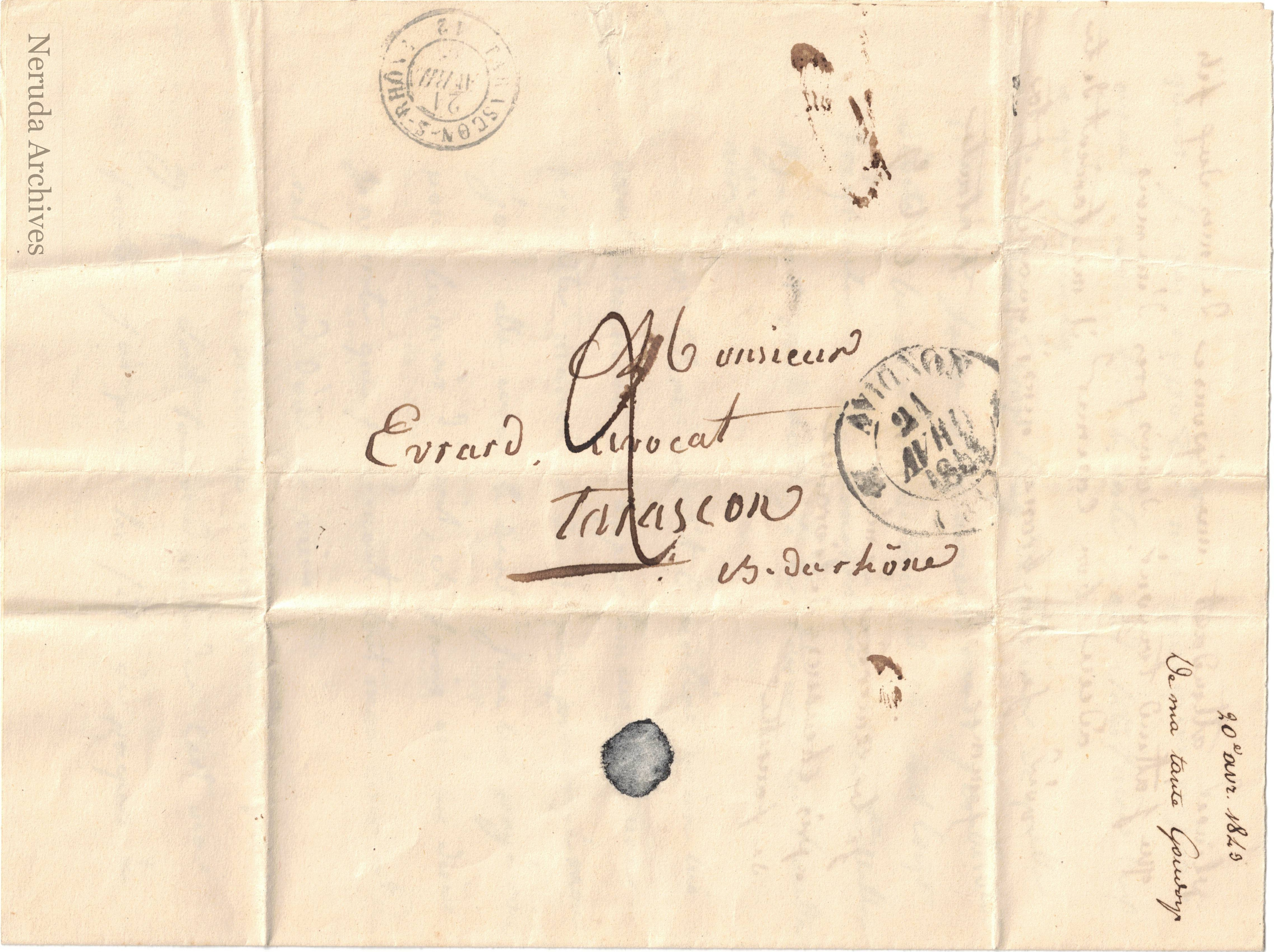
NRA-L-000024 image 1 showing the address panel, docketing and postal marks for M. G.'s letter to Monsieur Evrard in Tarascon.
Image 1Address panel, docketing and postal marks.
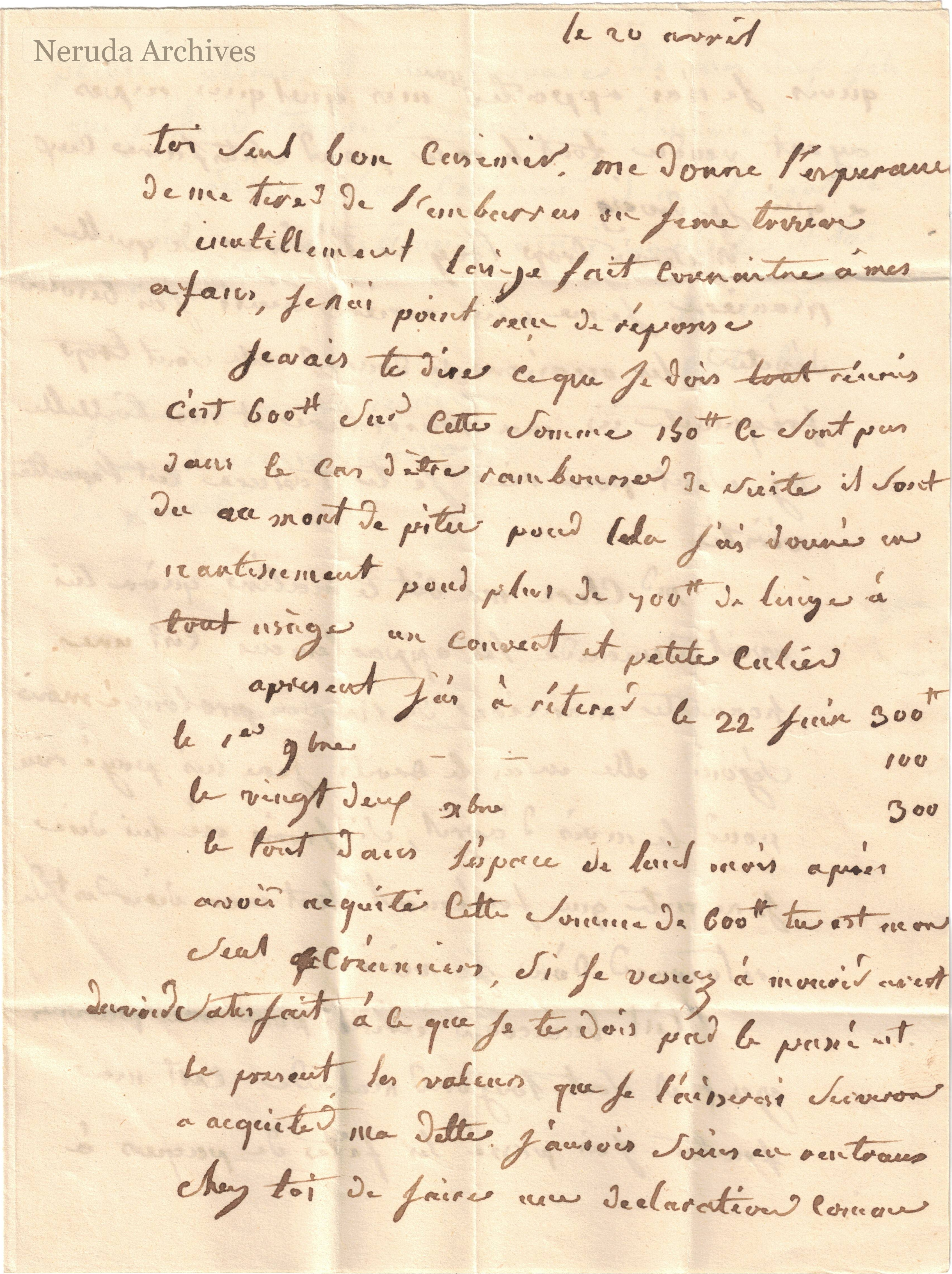
NRA-L-000024 image 2 showing the opening of M. G.'s French letter concerning debt and the Mont-de-Piété.
Image 2Letter text - Page 1.
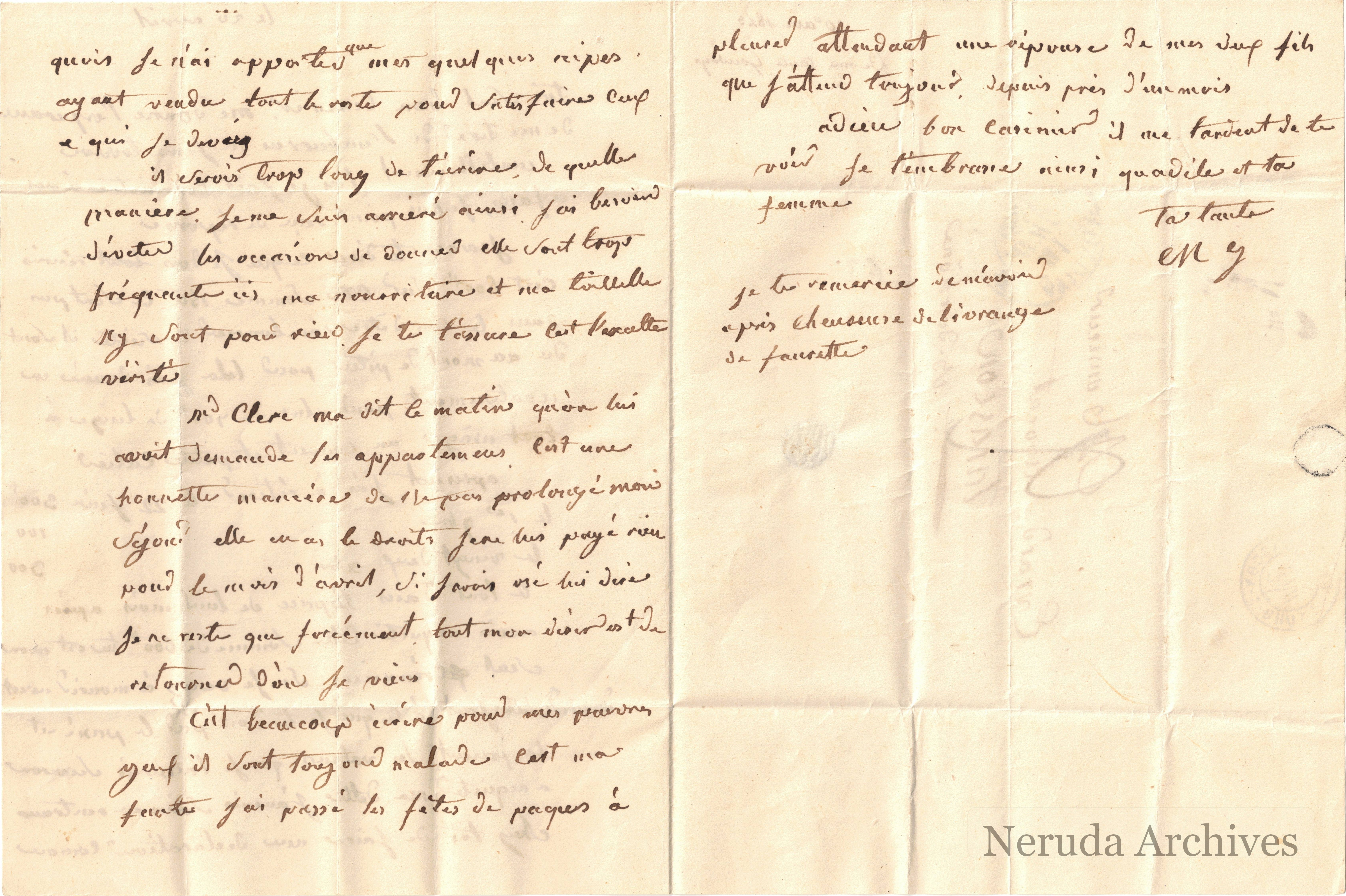
NRA-L-000024 image 3 showing the continuation, closing and docketing of M. G.'s French letter.
Image 3Letter text - Page 2, closing and docketing.

Transcript and English translation

working scholarly aid

Address Panel

Original transcript

A Monsieur
Evrard, avocat
Tarascon
B. du rhône

Address Panel

English translation

To Monsieur
Evrard, lawyer
Tarascon
Bouches-du-Rhône

Letter Text

Original transcript

le 20 avril
toi Seul bon Creancier, me donne l'esperance
de me tirer de l'embarras ou je me trouve
inutilement l'ai-je fait Connoitre a mes
enfans, je n'ai point reçu de réponse
Je vais te dire ce que je dois tout réunis
c'est 600# Sur Cette Somme 150# ne Sont pas
dans le Cas d'etre ramboursés de Suite il Sont
du au mont de pieté pour Cela j'ai donnés en
nantissement pour plus de 700# de linge à
tout usage un Couvert et petites Culiér
apresent j'ai à retirer le 22 juin 300#
le 1er 9bre                                 100
le vingt deux Xbre                          300
le tout dans l'éspace de huit mois après
avoir acquité Cette Somme de 600# tu est mon
Seul Creancier, Si je venois à mourir avant
d'avoir Satisfait à Ce que je te dois par le present
le present les valeurs que je laisserai Serviront
a acquiter ma dette. j'aurois Soins en rentrans
Chez toi de faire une declaration Comme
quois je n'ai apportés que mes quelques nipes
ayant vendu tout le reste pour satisfaire ceux
a qui je devais
il serois trop long de t'écrire de quelle
manière je me suis arriéré ainsi j'ai besoind
d'éviter les occasion de donner elle sont trop
fréquente ici ma nourriture et ma toilette
n'y sont pour rien je te t'assure c'est l'exacte
vérité
[md] Clerc ma dit le matin qu'on lui
avoit demandé les appartemens c'est une
honnette manière de ne pas prolongé mon
séjour elle en as le droits je ne lui payé rien
pour le mois d'avril, si j'avois osé lui dire
je ne reste que forcément tout mon désir est de
retourner d'où je viens
c'est beaucoup écrire pour mes pauvres
yeux ils sont toujour malade c'est ma
feautte j'ai passé les fêtes de paques à
pleurer attendant une réponse de mes deux fils
que j'attend toujour. depuis près d'un mois
adieu bon créancier il me tardent de te
voir je t'embrasse ainsi quadèle et ta
femme
Ta tante
M G
je te remercie de m'avoir
apris l'heureuse délivrance
de fannette

Letter Text

English translation

20 April
You alone, good creditor, give me the hope of getting out of the predicament in which I find myself. I have tried in vain to make it known to my children; I have received no reply.
I am going to tell you what I owe altogether: it is 600#. Of this sum, 150# cannot be repaid immediately; they are owed to the Mont-de-Piété. For this I gave in pledge more than 700# of linen for all uses, a place setting and small spoons.
At present I have to redeem:
22 June 300#
1 November 100
22 December 300
All of it within the space of eight months. After having paid off this sum of 600#, you are my only creditor.
If I were to die before having satisfied what I owe you by the present the present the valuables that I leave behind will serve to pay off my debt.
I would take care upon returning to your home to make a declaration that I brought only my few belongings, having sold all the rest to satisfy those to whom I owed money.
It would take too long to write to you how I fell into arrears, so I need to avoid opportunities for spending, they are too frequent here. My food and my clothing have nothing to do with it, I assure you you; it is the exact truth.
[Mme] Clerc told me this morning that someone had asked her for the apartments. It is a polite way of not prolonging my stay; she has the right to do so, I paid her nothing for the month of April.
If I had dared tell her I remain only because I am forced to, my whole desire is to return whence I came.
This is a great deal of writing for my poor eyes. They are still ill; it is my fault. I spent the Easter holidays weeping, waiting for a reply from my two sons, which I am still waiting for, for almost a month.
Farewell, good creditor. I long to see you. I embrace you, as well as Adèle and your wife.
Your aunt
M G
I thank you for having told me of Fannette's safe delivery.

Docketing Note

Original transcript

20^e avr. 1843
De ma tante [Goudon]

Docketing Note

English translation

Later docket
20 Apr. 1843
From my aunt [Goudon]

Postal Marks

Original transcript

AVIGNON / 21 / AVRIL / 43
TARASCON-S-RHO[NE] / 21 / AVRIL / 43

Postal Marks

English translation

AVIGNON / 21 / APRIL / 43
TARASCON-S-RHO[NE] / 21 / APRIL / 43

Discovery Terms

  • Historical correspondence
  • Private collection
  • Letter
  • French language
Historical context Debt, pledged household goods and the Avignon Mont-de-piété 3 sources

Dating the letter

The writer dated the letter only '20 April'. The year 1843 is inferred from the Avignon-Tarascon postal marks of 21 April and a later docket, rather than from the heading itself.[1]

Debt and pledged possessions

Writing as the recipient's aunt, M. G. describes debts of 600 in the monetary notation represented by the manuscript's # sign. She says that 150 is owed to the Mont-de-piété and that linen, a place setting and small spoons have been pledged there. She values the pledged goods at more than 700.[1]

The three instalments written in the surviving text are 300 for 22 June, 100 for 1 November and 300 for 22 December. They total 700, although the same letter states a debt of 600. The document does not explain the difference, and this context does not silently reconcile it.[1]

The Avignon Mont-de-piété

Avignon's Mont-de-piété opened its doors in 1610. Its role was to advance money against pledged movable property under regulated conditions. A printed set of statutes and rules was issued in Avignon in 1843, the same year assigned to the letter by its postal evidence.[2, 3]

Evidence and limits

The currency name is not written out in the letter, so the # sign is preserved without a modern conversion. The reason why the listed instalments total 700 while the stated debt is 600 remains unresolved. No repayment record or Mont-de-piété account for these particular goods has been located.[1, 2, 3]

Sources & evidence (3)
  1. Primary source · manuscript Neruda Archives, NRA-L-000024, digital images, postal evidence and reviewed transcript. View the archive record Supports the inferred date, relationship, debt, pledged goods, valuation and instalments.
  2. Municipal archive Archives municipales d'Avignon, 'Du Mont-de-piété au crédit municipal', digital exhibition. View the exhibition Supports the institutional history and purpose of the Avignon Mont-de-piété.
  3. Published primary source Règlement et statuts du Mont-de-piété d'Avignon (Avignon: Seguin aîné, 1843), Bibliothèque numérique patrimoniale Odyssée, RES 260098. View the 1843 statutes Confirms a contemporary published regulatory text for the institution.

Reviewed 2026-07-29 · Context version 1.0

Document image

Loading document viewer...