NRA-L-000044 / 1860

Letter to Louis Danet Cléry, 1860-11-29

A French family letter sent from Paris to a sub-lieutenant in Beirut concerning personal shipments, correspondence, and service in Syria.

Neruda Archives
NRA-L-000044

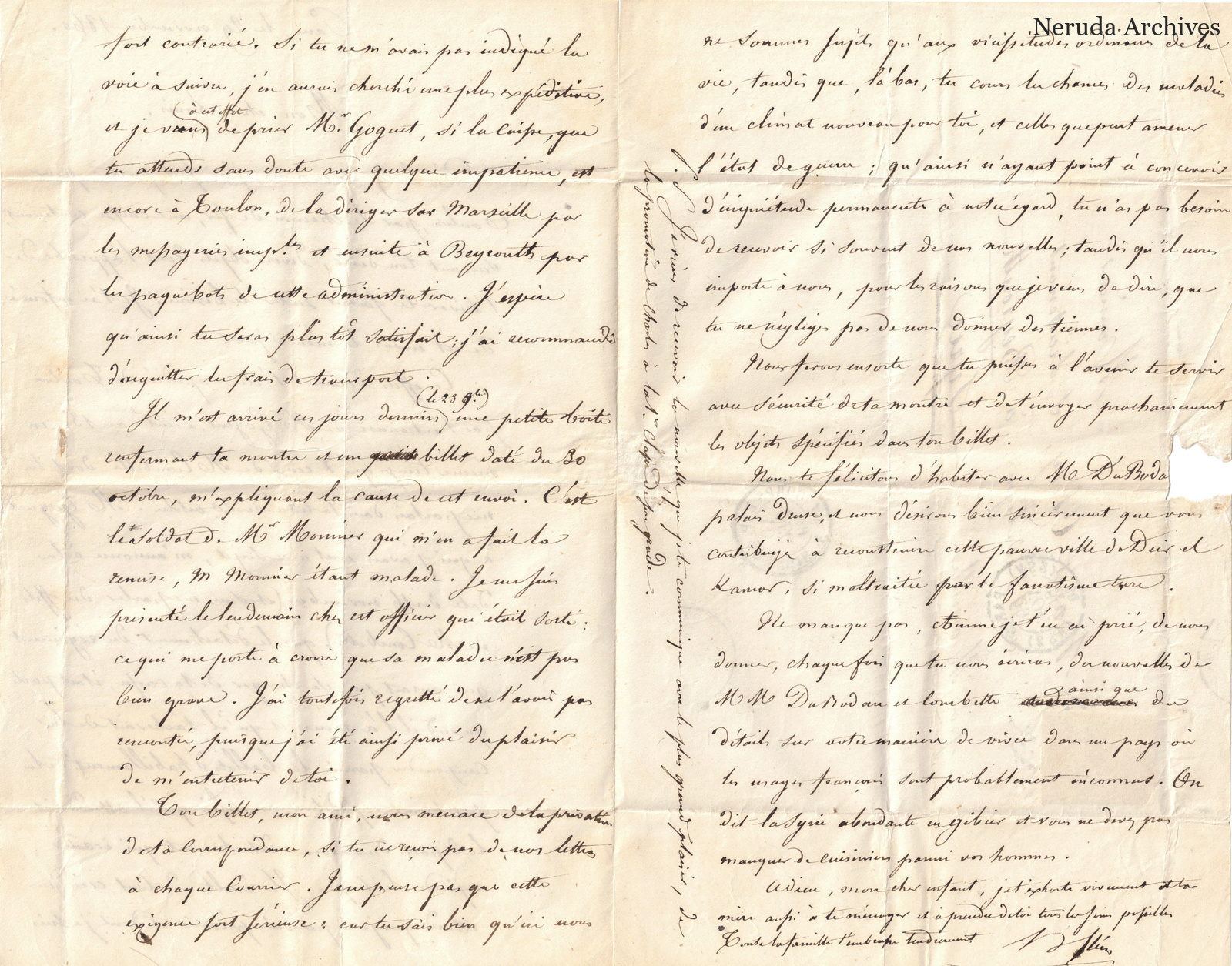
NRA-L-000044 image 1 showing the address to Louis Danet Cléry in Beirut, with stamp and postal evidence.
Image 1Address panel and postal evidence.
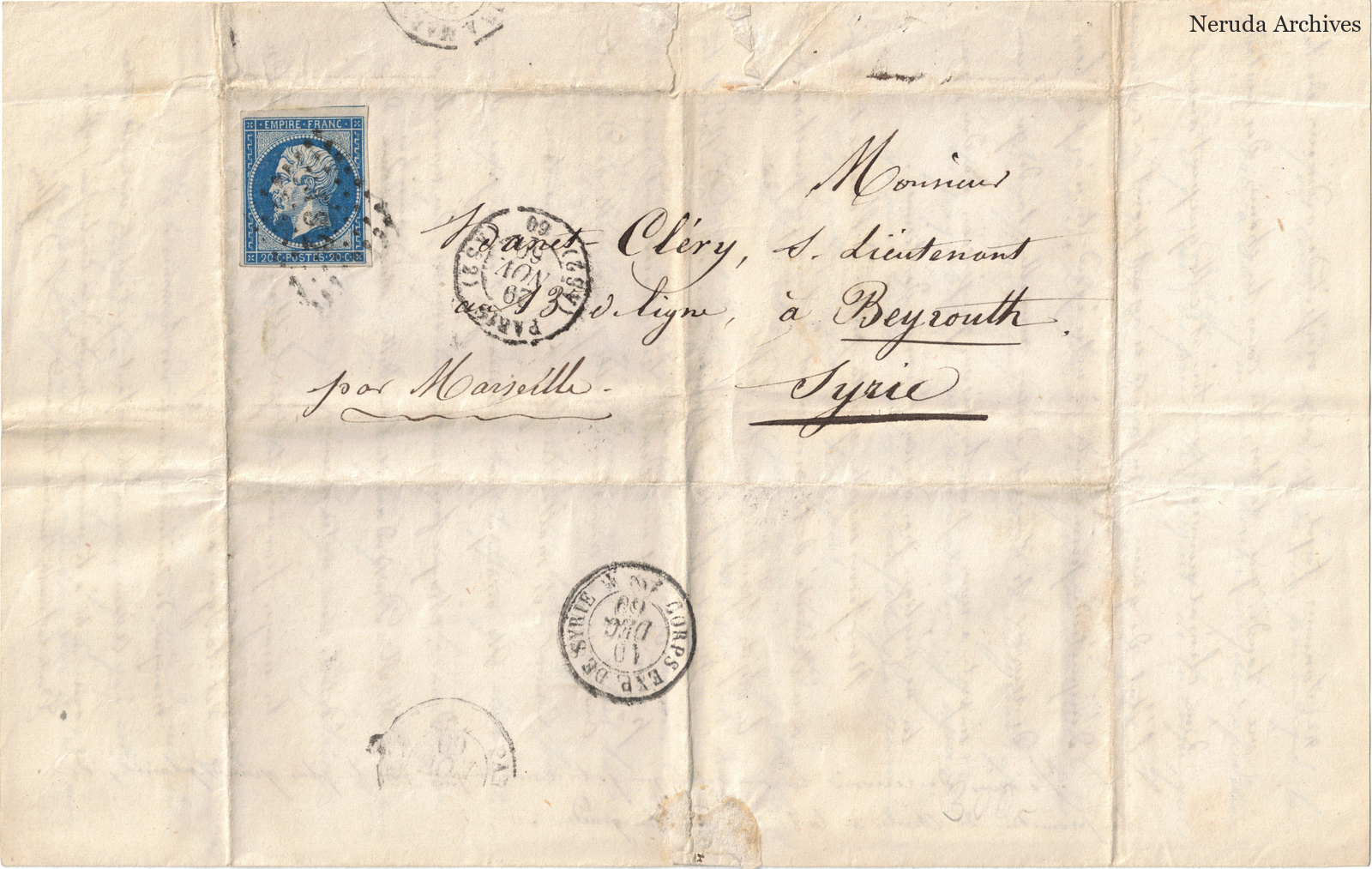
NRA-L-000044 image 2 showing page 1 of the letter from Paris, dated 29 November 1860.
Image 2Letter text - Page 1.
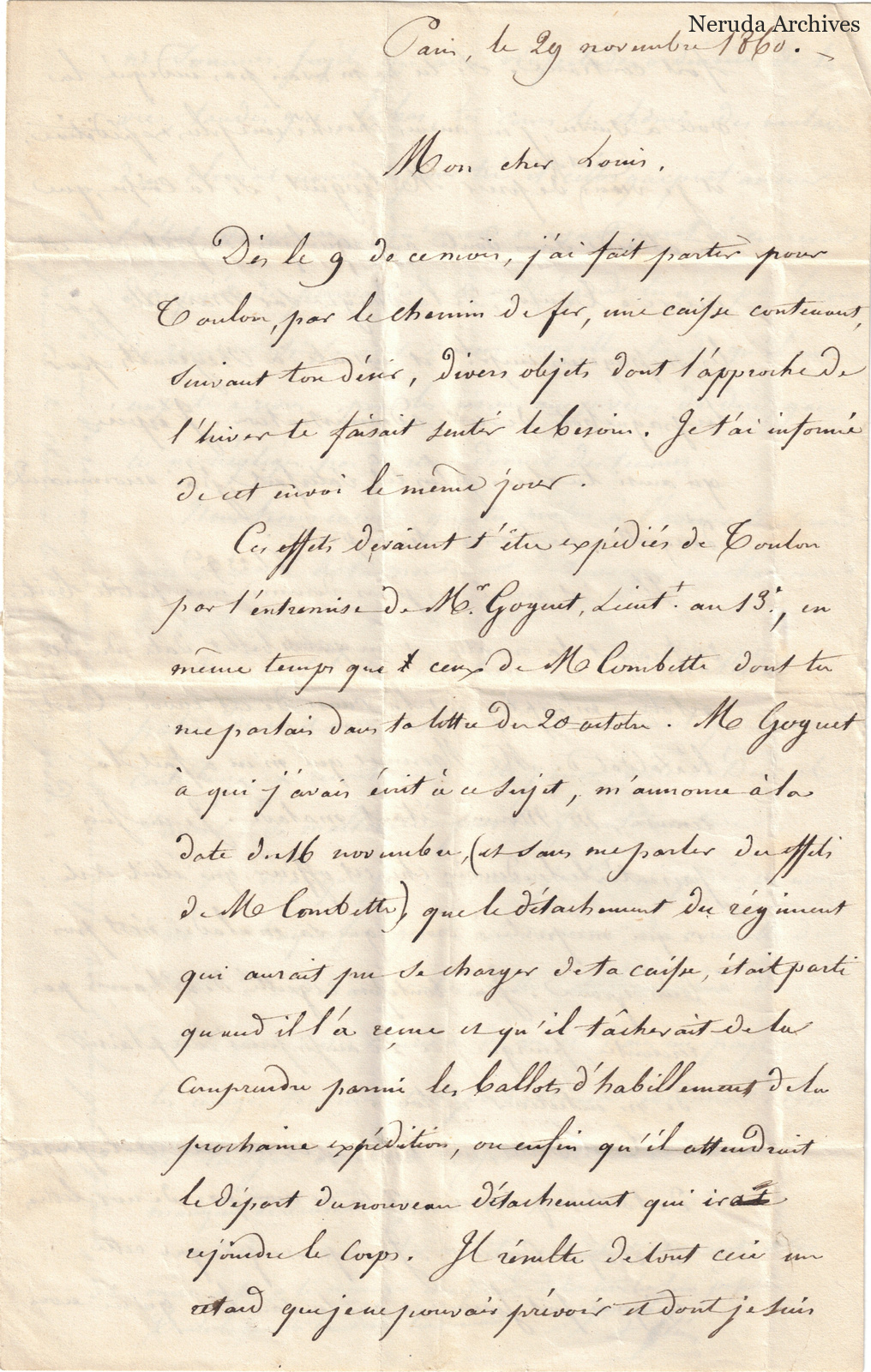
NRA-L-000044 image 3 showing page 2, closing, signature and a marginal note.
Image 3Letter text - Page 2, marginal note and signature.

Transcript and English translation

working scholarly aid

Address Panel

Original transcript

Monsieur
Danet Cléry, S. Lieutenant
au 13e. de ligne, à Beyrouth,
Syrie
par Marseille.

Address Panel

English translation

Monsieur
Danet Cléry, Sub-Lieutenant
in the 13th Line Regiment, in Beirut,
Syria
via Marseille.

Letter Text - Page 1

Original transcript

Paris, le 29 novembre 1860.

Mon cher Louis,

Dès le 9 de ce mois, j'ai fait partir pour
Toulon, par le chemin de fer, une caisse contenant,
suivant ton désir, divers objets dont l'approche de
l'hiver te faisait sentir le besoin. Je t'ai informé
de cet envoi le même jour.
Ces effets devaient t'être expédiés de Toulon
par l'entremise de Mr. Goguet, Lieut.t au 13e., en
même temps que ceux de Mr Combette dont tu
me parlais dans ta lettre du 20 octobre. Mr Goguet
à qui j'avais écrit à ce sujet, m'annonce à la
date du 16 novembre, (et sans me parler des effets
de Mr Combette) que le détachement du régiment
qui aurait pu se charger de ta caisse, était parti
quand il l'a reçue et qu'il tâcherait de la
comprendre parmi les ballots d'habillement de la
prochaine expédition, ou enfin qu'il attendrait
le départ d'un nouveau détachement qui irait
rejoindre le corps. Il résulte de tout ceci un
retard que je ne pouvais prévoir et dont je suis

Letter Text - Page 1

English translation

Paris, 29 November 1860.
My dear Louis,
As early as the 9th of this month, I dispatched to Toulon, by rail, a crate containing, according to your wish, various objects which the approach of winter made you feel the need of. I informed you of this shipment the same day.
These effects were to be sent to you from Toulon through the agency of Mr Goguet, Lieut. in the 13th, at the same time as those of Mr Combette of whom you spoke to me in your letter of 20 October. Mr Goguet, to whom I had written on this subject, announces to me on the date of 16 November (and without speaking to me of the effects of Mr Combette) that the detachment of the regiment which could have taken charge of your crate had left when he received it, and that he would try to include it among the bales of clothing of the next shipment, or finally that he would wait for the departure of a new detachment which would go to join the corps. The result of all this is a delay which I could not foresee and of which I am

Letter Text - Page 2, marginal note and signature

Original transcript

fort contrarié. Si tu ne m'avais pas indiqué la
voie à suivre, j'en aurais cherché une plus expéditive,
et je viens (à cet effet) de prier Mr. Goguet, si la caisse, que
tu attends sans doute avec quelque impatience, est
encore à Toulon, de la diriger sur Marseille par
les messageries imp.les et ensuite à Beyrouth par
les paquebots de cette administration. J'espère
qu'ainsi tu seras plus tôt satisfait; j'ai recommandé
d'acquitter les frais de transport.
Il m'est arrivé ces jours derniers (le 23 9bre) une petite boîte
renfermant ta montre et un petit billet daté du 30
octobre, m'expliquant la cause de cet envoi. C'est
le soldat de Mr Mounier qui m'en a fait la
remise, Mr Mounier étant malade. Je me suis
présenté le lendemain chez cet officier qui était sorti:
ce qui me porte à croire que sa maladie n'est pas
bien grande. J'ai toutefois regretté de ne l'avoir pas
rencontré, puisque j'ai été ainsi privé du plaisir
de m'entretenir de toi.
Ton billet, mon ami, nous menace de la privation
de ta correspondance, si tu ne reçois pas de nos lettres
à chaque courrier. Je ne pense pas que cette
exigence soit sérieuse: car tu sais bien qu'ici nous

ne sommes sujets, qu'aux vicissitudes ordinaires de la
vie, tandis que, là-bas, tu cours les chances des maladies
d'un climat nouveau pour toi, et celles que peut amener
l'état de guerre; qu'ainsi n'ayant point à concevoir
d'inquiétude permanente à notre égard, tu n'as pas besoin
de recevoir si souvent de nos nouvelles, tandis qu'il nous
importe à nous, pour les raisons que je viens de dire, que
tu ne négliges pas de nous donner des tiennes.
Nous ferons en sorte que tu puisses à l'avenir te servir
avec sécurité de ta montre et de t'envoyer prochainement
les objets spécifiés dans ton billet.
Nous te félicitons d'habiter avec Mr Du Broda
un palais druse, et nous désirons bien sincèrement que vous
contribuiez à reconstruire cette pauvre ville de Deir el
Kamar, si maltraitée par le fanatisme turc.
Ne manque pas, comme je t'en ai prié, de nous
donner, chaque fois que tu nous écriras, des nouvelles de
MMrs Du Brodan et Combette ainsi que des
détails sur votre manière de vivre dans un pays où
les usages français sont probablement inconnus. On
dit la Syrie abondante en gibier et vous ne devez pas
manquer de cuisiniers parmi vos hommes.
Adieu, mon cher enfant, je t'exhorte vivement et ta
mère aussi à te ménager et à prendre de toi tous les soins possibles
Toute la famille t'embrasse tendrement
[V. D. Cléry?]

[marginalia]
Je viens de recevoir la nouvelle, que je te communique, avec le plus grand plaisir, de
la promotion de Charles à la 1re classe de son grade.

Letter Text - Page 2, marginal note and signature

English translation

very annoyed. If you had not indicated to me the route to follow, I would have looked for a more expeditious one, and I have just (to this effect) asked Mr Goguet, if the crate, which you are no doubt waiting for with some impatience, is still in Toulon, to direct it to Marseille by the Messageries Impériales and then to Beirut by the steamships of this administration. I hope that thus you will be satisfied sooner; I have given instructions to pay the transport costs.
A small box arrived for me these last few days (the 23rd of Nov.) containing your watch and a short note dated 30 October, explaining to me the cause of this shipment. It is Mr Mounier's soldier who delivered it to me, Mr Mounier being ill. I presented myself the next day at the home of this officer, who had gone out: which leads me to believe that his illness is not very serious. I nevertheless regretted not having met him, since I was thus deprived of the pleasure of talking about you.
Your note, my friend, threatens us with the deprivation of your correspondence, if you do not receive letters from us by every mail. I do not think that this requirement is serious: for you know well that here we are only subject to the ordinary vicissitudes of life, while, over there, you run the risks of diseases of a climate new to you, and those that can be brought about by the state of war; that thus having no reason to conceive permanent anxiety regarding us, you do not need to receive our news so often, while it is important to us, for the reasons I have just stated, that you do not neglect to give us yours.
We will make sure that you can in the future use your watch safely, and will soon send you the objects specified in your note.
We congratulate you on living with Mr Du Broda in a Druze palace, and we very sincerely desire that you contribute to rebuilding this poor town of Deir el Kamar, so mistreated by Turkish fanaticism.
Do not fail, as I have asked you, to give us, every time you write to us, news of Messrs Du Brodan and Combette as well as details on your way of living in a country where French customs are probably unknown. They say Syria is abundant in game and you must not lack cooks among your men.
Farewell, my dear child, I strongly urge you, and your mother too, to spare yourself and to take all possible care of yourself.
The whole family embraces you tenderly.
[V. D. Cléry?]
In the margin:
I have just received the news, which I communicate to you with the greatest pleasure, of the promotion of Charles to the 1st class of his rank.
Discovery Terms

  • Historical correspondence
  • Family correspondence
  • Military life
  • Postal logistics
  • French expedition to Syria (1860–1861)
  • French language
Historical context A parcel route from Paris to Beirut 4 sources

A letter during the 1860-1861 expedition

The letter was sent from Paris on 29 November 1860 to Louis Danet Cléry, a second lieutenant in the 13th Line Regiment at Beirut. It belongs to the period of the French expedition to Syria and Lebanon, mounted in response to the violence of 1860.[1, 2, 3]

Trying to move a crate east

The writer says that a crate left Paris by rail for Toulon on 9 November. It was first intended to travel with Lieutenant Goguet or a regimental shipment, but the relevant detachment had already departed. The letter then considers other routes through Toulon or Marseille, the Messageries impériales and a steamer to Beirut.[1, 4]

These references document a proposed chain of transport, not proof that the crate reached Louis. No dispatch receipt or delivery acknowledgement has been located.[1]

Deir al-Qamar

The writer expresses the hope that Louis and a companion would take part in work connected with Deir al-Qamar. Reconstruction formed part of the wider aftermath of the 1860 violence, but the letter does not prove that either man received an appointment or carried out the proposed work.[1, 2, 3]

Evidence and limits

The writer is Louis's father, but his full identity has not yet been established. Several other people named in the letter have not been securely identified. The shipment route and possible reconstruction work are plans reported in the letter; their completion remains unverified.[1, 2, 3, 4]

Sources & evidence (4)
  1. Primary source · manuscript Neruda Archives, NRA-L-000044, digital images, reviewed transcript and English translation of the letter dated 29 November 1860. View the archive record Supports the recipient, dates, planned shipment routes and reference to Deir al-Qamar.
  2. Historical study Georges Spillmann, 'L'expédition du Liban (1860-1861)', Fondation Napoléon. Read the study Provides historical context for the French expedition and its chronology.
  3. Historical study 'Aux sources de la politique arabe de la France : le Second Empire et le Machrek', Fondation Napoléon. Read the study Provides broader diplomatic and regional context for French activity in the Levant.
  4. Museum collection Musée de La Poste, Collections en ligne, institutional records concerning the Messageries impériales. Search the museum collection Provides institutional context for the transport company named in the letter.

Reviewed 2026-07-29 · Context version 1.0

Document image

Loading document viewer...