NRA-L-000060 / 1834
Letter from Jules Lichtenstein to his grandmother and sister Louise, May 7, 1834
Jules Lichtenstein writes from Berlin to his grandmother and his sister Louise about family portraits, religious instruction, holidays, theatre, the museum, and an encounter with a Prussian princess.
Neruda Archives
NRA-L-000060
Transcript and English translation
working scholarly aid
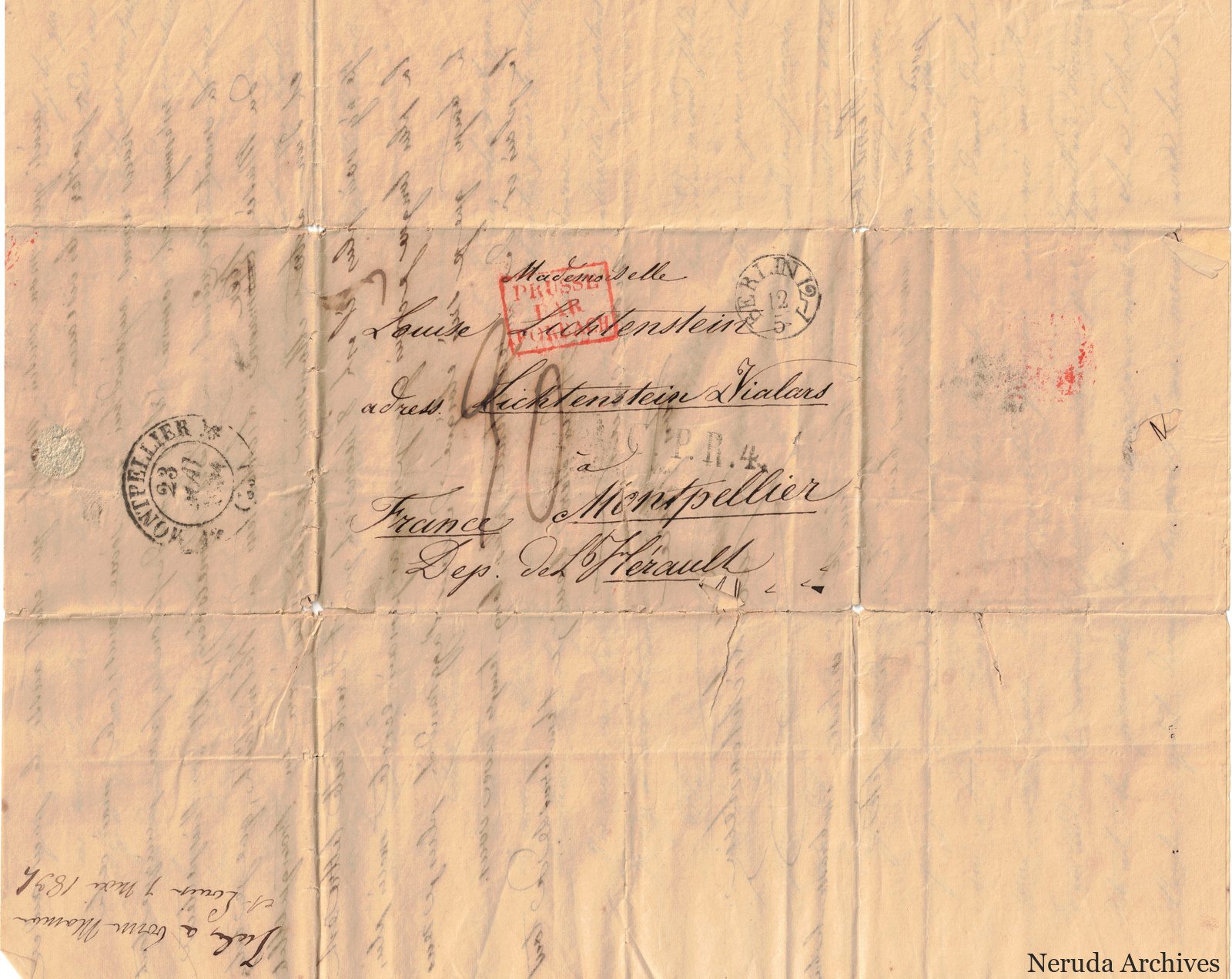
Address panel
Original transcript
Mademoiselle
Louise Lichtenstein
adress. Lichtenstein Vialars
à Montpellier
France
Dep. de l'Herault
Address panel
English translation
Miss
Louise Lichtenstein
address: Lichtenstein Vialars
in Montpellier
France
Department of Hérault
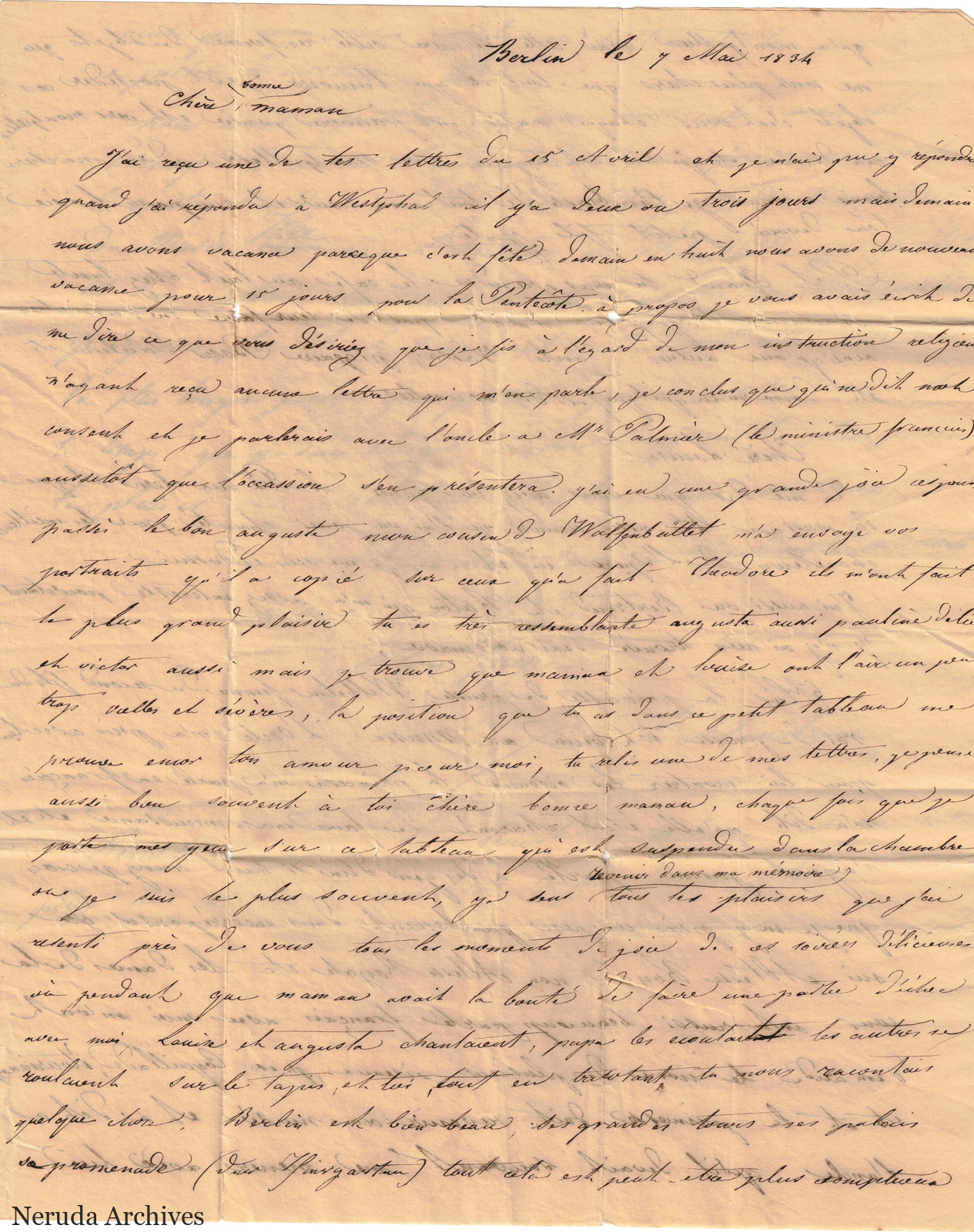
Documentary page 2
Original transcript
Berlin le 7 Mai 1834
Chère ^bonne^ maman
J'ai reçu une de tes lettres du 15 Avril et je n'ai pu y répondre
quand j'ai répondu à Westphal il y'a deux ou trois jours mais demain
nous avons vacance parceque c'est fête demain en huit nous avons de nouveau
vacance pour 15 jours pour la Pentecôte. à propos je vous avais écrit de
me dire ce que vous désiriez que je fis à l'égard de mon instruction religieuse
n'ayant reçu aucune lettre qui m'en parle, je conclus que qui ne dit mot
consent et je parlerais avec l'oncle a Mr Palmier (le ministre français)
aussitôt que l'occassion s'en présentera. j'ai eu une grande joie ce jour
passé le bon auguste mon cousin de Wolfenbüttel m'a envoyé vos
portraits qu'il a copié sur ceux qu'a fait Theodore ils m'ont fait
le plus grand plaisir tu es très ressemblante augusta aussi pauline delia
et victor aussi mais je trouve que maman et louise ont l'air un peu
trop vielles et sévères, la position que tu as dans ce petit tableau me
prouve encor ton amour pour moi, tu relis une de mes lettres, je pense
aussi bien souvent à toi chère bonne maman, chaque fois que je
porte mes yeux sur ce tableau qui est suspendu dans la chambre
que je suis le plus souvent, ^(revenir dans ma mémoire)^ je sens tous les plaisirs que j'ai
ressenti près de vous tous les moments de joie de ces soirées délicieuses
où pendant que maman avait la bonté de faire une partie d'échec
avec moi louise et augusta chantaient, papa les écoutait et les autres se
roulaient sur le tapis, et toi, tout en tricotant tu nous racontais
quelque chose. Berlin est bien beau, ses grandes tours ses palais
sa promenade (der thiergarten) tout cela est peut être plus somptueux
Documentary page 2
English translation
Berlin, 7 May 1834
Dear Grandmother,
I received one of your letters of 15 April and I could not answer it when I answered Westphal two or three days ago, but tomorrow we have a holiday because it is a feast day. A week from tomorrow we have another holiday for 15 days for Pentecost.
By the way, I had written to you to tell me what you wished me to do regarding my religious instruction. Having received no letter speaking to me about it, I conclude that silence gives consent and I will speak with my uncle to Mr Palmier (the French minister) as soon as the opportunity presents itself.
I had a great joy the other day. The good Auguste, my cousin from Wolfenbüttel, sent me your portraits which he copied from those made by Theodore. They gave me the greatest pleasure. You look very much like yourself, Augusta too, Pauline, Delia and Victor too, but I find that Mamma and Louise look a little too old and severe.
The position you have in this little painting proves to me again your love for me: you are rereading one of my letters. I also think very often of you, dear Grandmother. Every time I cast my eyes on this painting which is hung in the room where I am most often, [return to my memory] I feel all the pleasures that I felt near you, all the moments of joy of those delicious evenings where, while Mamma had the goodness to play a game of chess with me, Louise and Augusta sang, Papa listened to them and the others rolled on the rug, and you, while knitting, would tell us something.
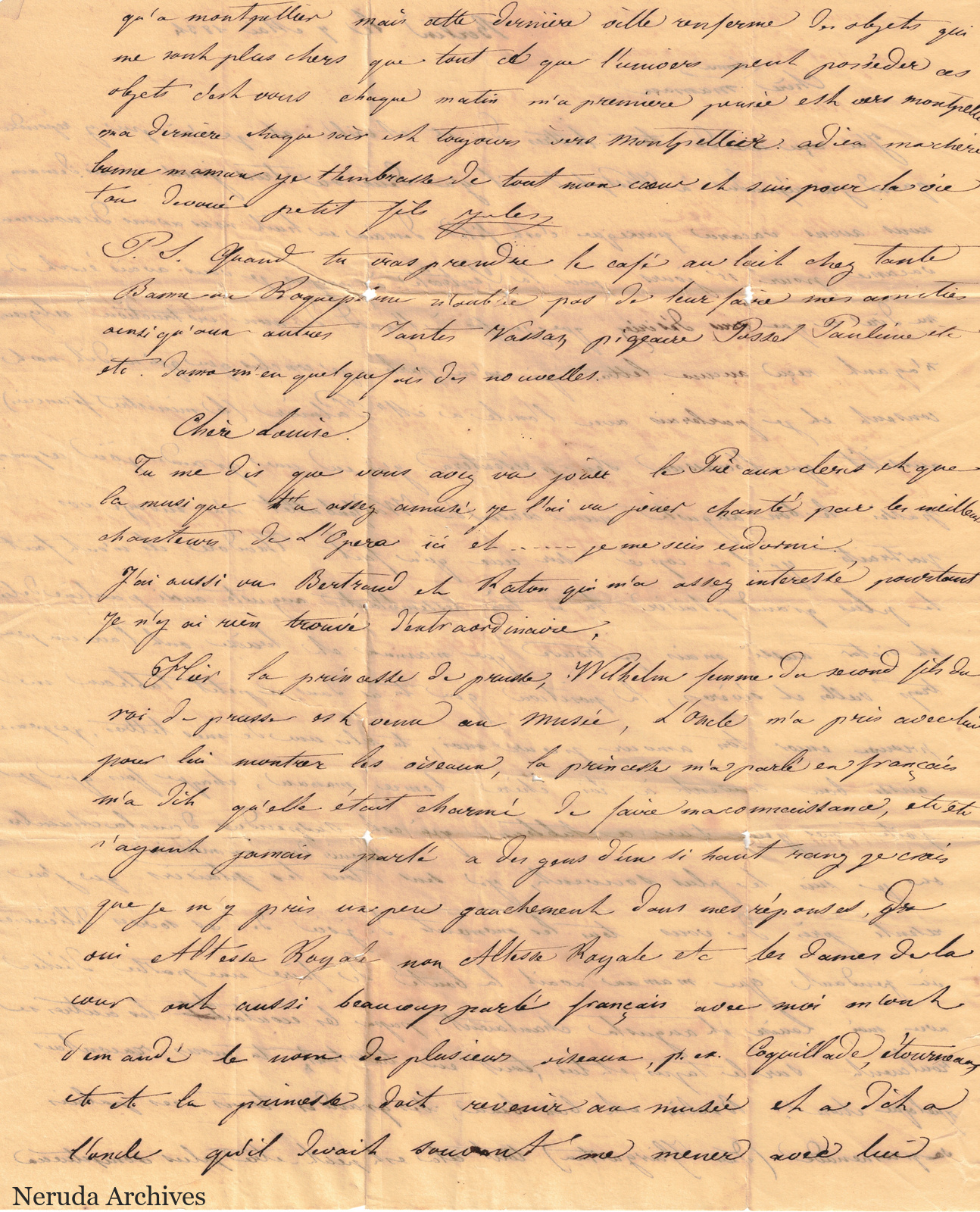
Documentary page 3
Original transcript
qu'a montpellier mais cette dernière ville renferme des objets qui
me sont plus chers que tout ce que l'univers peut posseder ces
objets c'est vous chaque matin m'a premiere pensée est vers montpellier
ma dernière chaque soir est toujours vers montpellier. adieu ma chere
bonne maman je t'embrasse de tout mon cœur et suis pour la vie
ton devoué petit fils jules
P.S. Quand tu iras prendre le café au lait chez tante
Basse ou Roquepine n'oublie pas de leur faire mes amitiés
ainsi qu'aux autres tantes Vassas, pigeaire, Tustel Pauline etc
etc. donne m'en quelques fois des nouvelles.

Chère Louise.
Tu me dis que vous avez vu jouer le Pré aux clercs et que
la musique t'a assez amusé, je l'ai vu jouer chanté par le meilleur
chanteur de l'Opera ici et ..... je me suis endormi.
J'ai aussi vu Bertrand et Raton qui m'a assez interessé pourtant
je n'y ai rien trouvé d'extraordinaire.
Hier la princesse de prusse, Wilhelm femme du second fils du
roi de prusse est venue au musée, l'oncle m'a pris avec lui
pour lui montrer les oiseaux, la princesse m'a parlé en français
m'a dit qu'elle était charmé de faire ma connaissance, et et
n'ayant jamais parlé a des gens d'un si haut rang je crois
que je m'y pris un peu gauchement dans mes réponses, oui
oui Altesse Royale non Altesse Royale etc les dames de la
cour ont aussi beaucoup parlé français avec moi m'ont
demandé le nom de plusieurs oiseaux, p. ex. Coquillade, étourneau,
etc etc la princesse doit revenir au musée et a dit a
l'oncle qu'il devait souvent me mener avec lui
Notes
Editorial notes:
"Le Pré aux clercs" is an 1832 opéra comique by Ferdinand Hérold.
"Bertrand et Raton" is an 1833 play by Eugène Scribe.
Documentary page 3
English translation
Berlin is very beautiful, its great towers, its palaces, its promenade (der Thiergarten), all of this is perhaps more sumptuous than in Montpellier, but this latter city contains objects that are dearer to me than all that the universe can possess. These objects are you.
Every morning my first thought is towards Montpellier, my last every evening is always towards Montpellier.
Farewell, my dear Grandmother. I kiss you with all my heart and am for life your devoted grandson
Jules
P.S. When you go to have café au lait at Aunt Basse's or Roquepine's, do not forget to give them my regards, as well as to the other aunts Vassas, Pigeaire, Tustel, Pauline, etc., etc. Give me news of them sometimes.
Dear Louise,
You tell me that you saw 'Le Pré aux clercs' played and that the music amused you enough. I saw it played, sung by the best male singer of the Opera here, and..... I fell asleep.
I also saw 'Bertrand et Raton', which interested me enough, however I found nothing extraordinary in it.
Yesterday the Princess of Prussia, wife of Wilhelm, the second son of the King of Prussia, came to the museum. Uncle took me with him to show her the birds. The princess spoke to me in French, told me that she was charmed to make my acquaintance, and and having never spoken to people of such high rank I believe that I went about it a little awkwardly in my answers: yes, yes, Royal Highness, no, Royal Highness, etc.
The ladies of the court also spoke a lot of French with me, asked me the name of several birds, e.g. coquillade, starling, etc., etc. The princess is to return to the museum and told Uncle that he should often bring me with him, as well as my cousin Moritz who was also there to help carry the birds.
Notes
Editorial notes:
"Le Pré aux clercs" is an 1832 opéra comique by Ferdinand Hérold.
"Bertrand et Raton" is an 1833 play by Eugène Scribe.
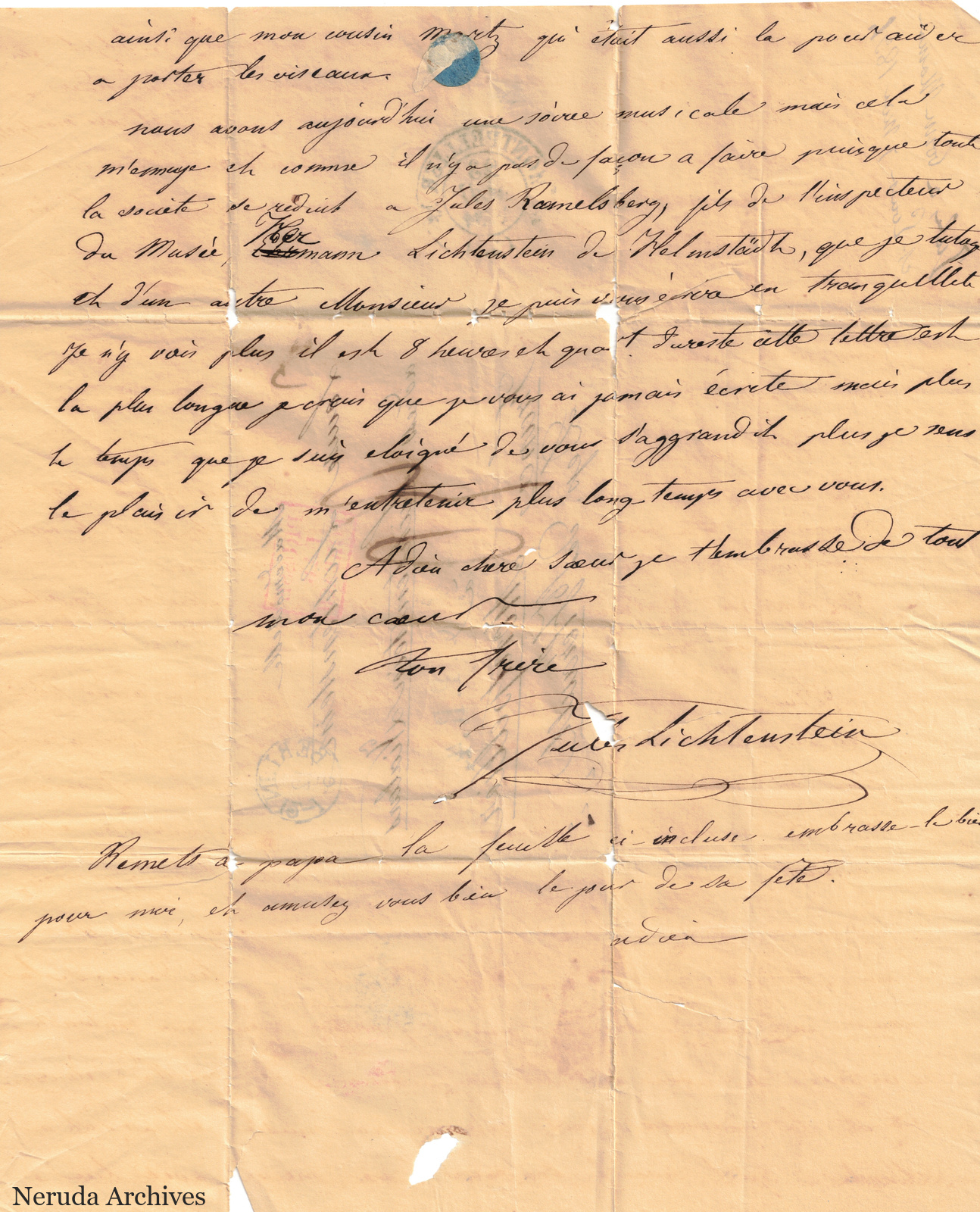
Documentary page 4
Original transcript
ainsi que mon cousin moritz qui était aussi la pour aider
a porter les oiseaux.
nous avons aujourd'hui une soiree musicale mais cela
m'ennuye et comme il n'y a pas de façon a faire puisque toute
la societé se reduit a Jules Ramelsberg, fils de l'inspecteur
du Musée, [crossed out: Mr] Hermann Lichtenstein de Helmstädt, que je tutoye
et d'un autre Monsieur je puis vous écrire en tranquillité
je n'y vois plus il est 8 heures et quart du reste cette lettre est
la plus longue je crois que je vous ai jamais écrite mais plus
le temps que je suis eloigné de vous s'aggrandit plus je sens
le plaisir de m'entretenir plus long temps avec vous.
Adieu chere sœur je t'embrasse de tout
mon cœur
ton frère
Jules Lichtenstein
Remets a papa la feuille ci-incluse. embrasse le bien
pour moi, et amusez vous bien le jour de sa fete.
adieu
Documentary page 4
English translation
We have a musical evening today but it bores me, and as there is no need to stand on ceremony since the whole society is reduced to Jules Rammelsberg, son of the inspector of the Museum, Hermann Lichtenstein of Helmstädt, whom I address familiarly, and another gentleman, I can write to you in peace.
I can no longer see, it is a quarter past eight. Besides, this letter is the longest I believe I have ever written to you, but the longer the time I am away from you grows, the more I feel the pleasure of conversing with you at greater length.
Farewell, dear sister, I kiss you with all my heart.
Your brother
Jules Lichtenstein
Give Papa the enclosed sheet. Kiss him well for me, and have fun on the day of his name day.
Farewell.
Discovery Terms
- Family correspondence
- Education
- Religious instruction
- Berlin
- Montpellier
- Museums
- Music and theatre