NRA-L-000061 / 1843

Letter from Mollie to Monsieur Courdoux, June 5, 1843

Mollie writes from Clermont-Ferrand to his relative and friend Courdoux in Thiers about collecting a payment from Mailhas, reimbursing the stockbroker Groisne, and having 622 francs tied up with the failed banking house Comitis. Mollie's profession and Clermont-Ferrand association are identified from later docketing; the April 1843 failure of Comitis is independently documented in a contemporary legal source.

Neruda Archives
NRA-L-000061

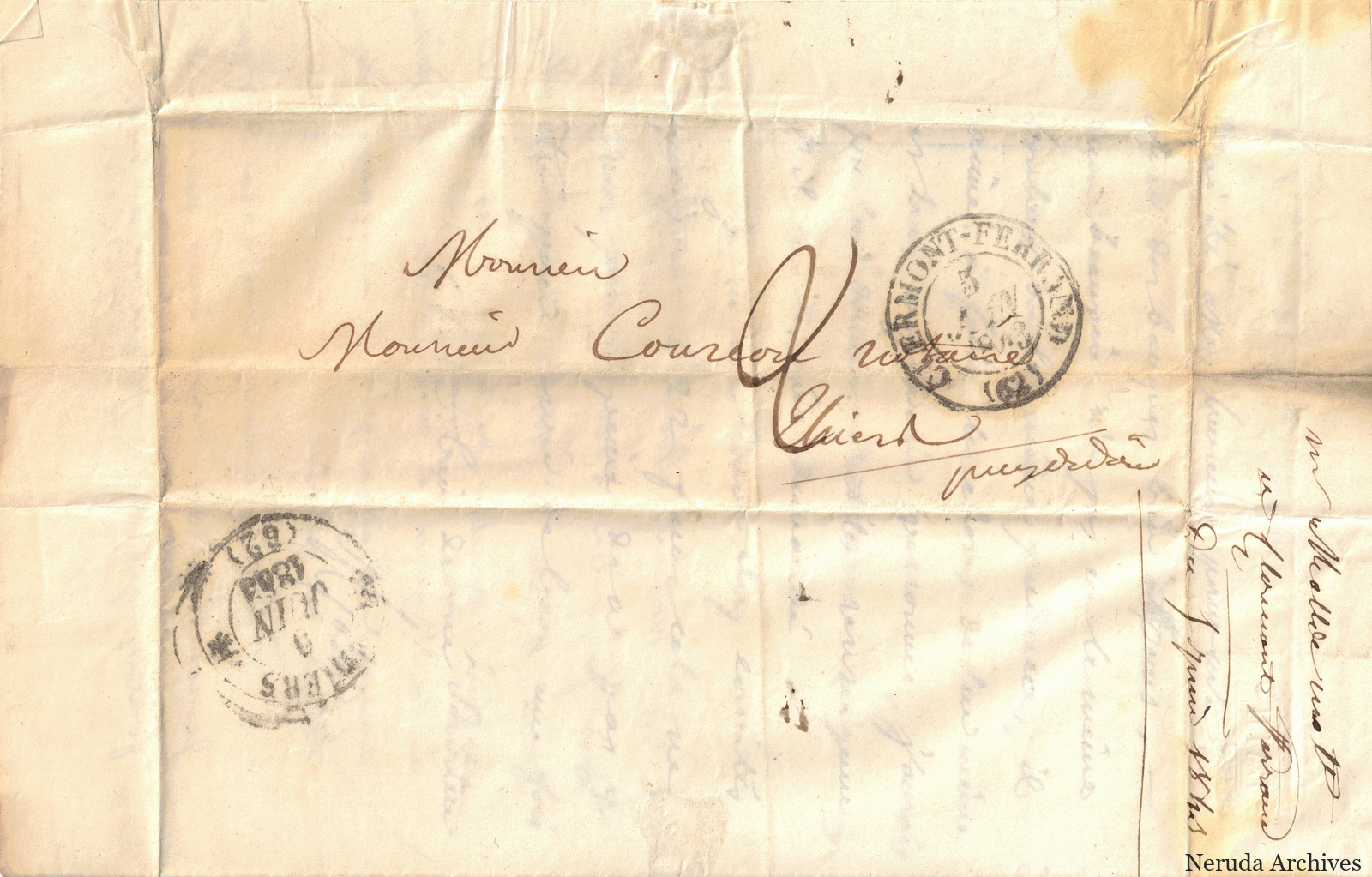
NRA-L-000061 image 1 showing the address panel to Monsieur Courdoux, a notary in Thiers, with two circular postal cancellations, folds and docketing along the right edge.
Image 1Address panel, postal evidence and docketing.
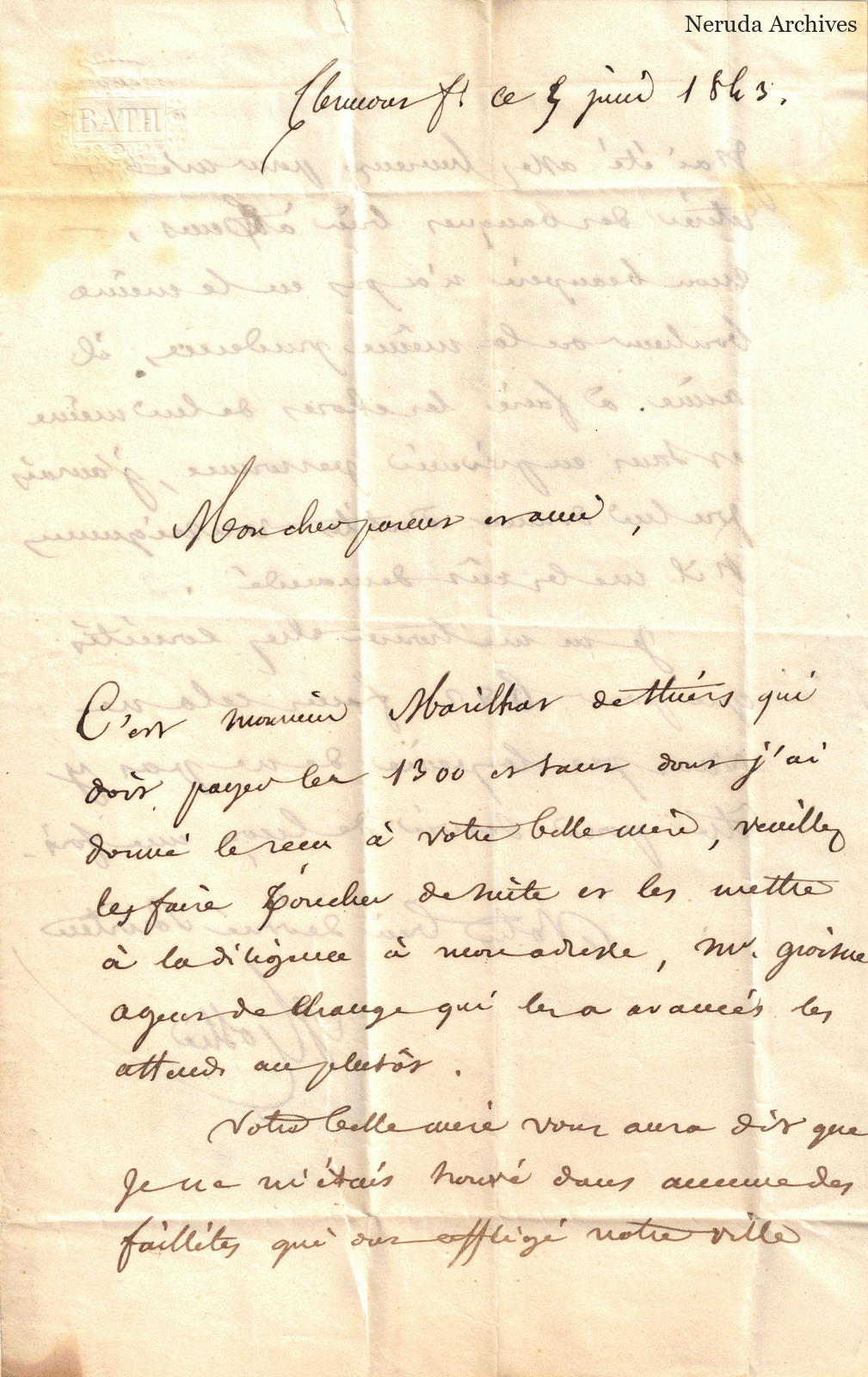
NRA-L-000061 image 2 showing the opening page of a French letter dated 5 June 1843, with an embossed paper mark, folds and writing visible through the sheet.
Image 2Letter text - Page 1.
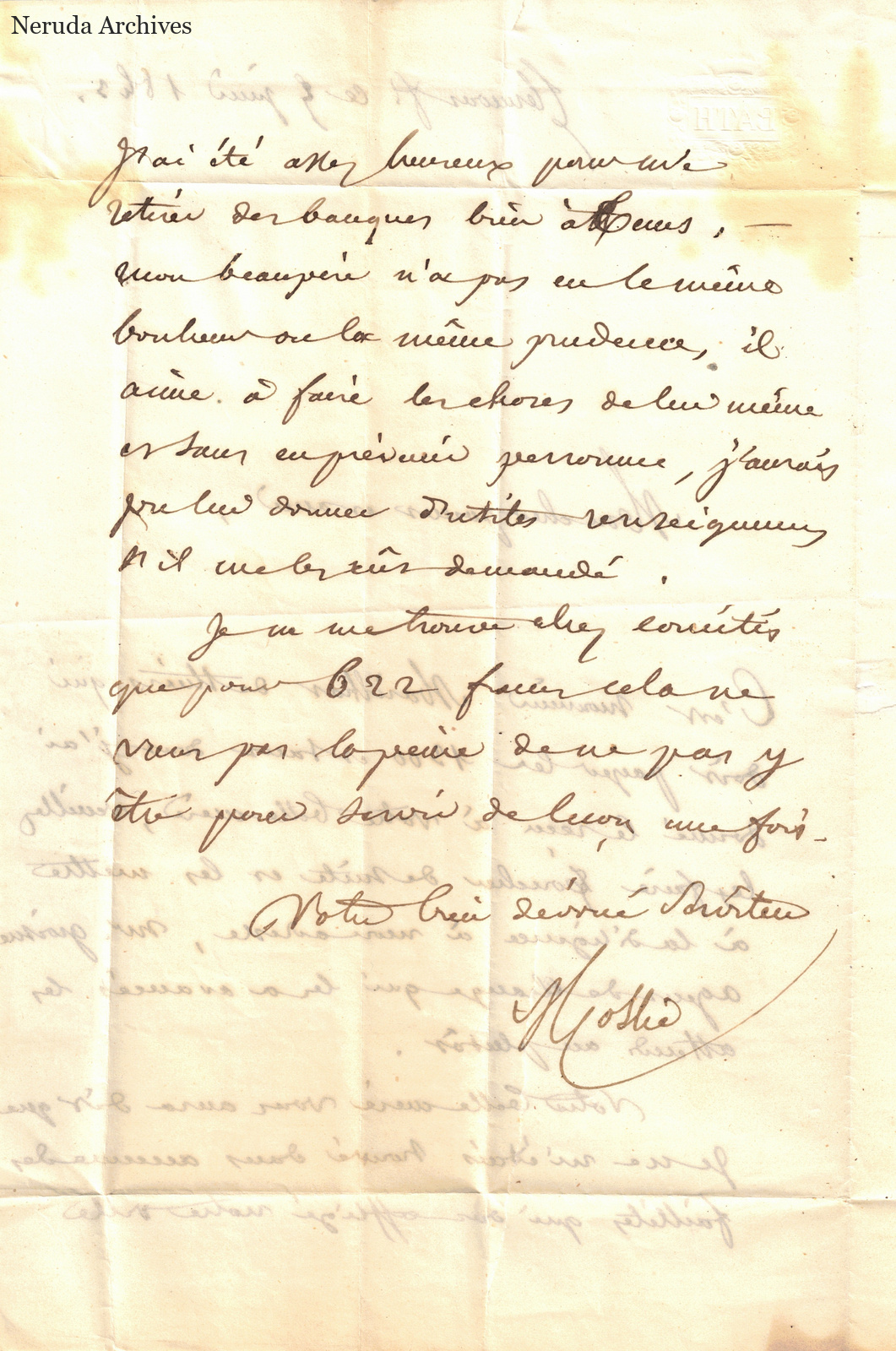
NRA-L-000061 image 3 showing the continuation and signed closing of the French letter, with folds and writing visible through the sheet.
Image 3Letter text - Page 2 and signature.

Transcript and English translation

working scholarly aid

Address panel

Original transcript

Monsieur
Monsieur Courdoux notaire
à Thiers
puy de dôme

Notes

Editorial notes:
In the docketing, 'not.re' is an abbreviation for 'notaire'.

Address panel

English translation

Monsieur
Monsieur Courdoux, notary
in Thiers
Puy-de-Dôme

Notes

Editorial notes:
In the docketing, 'not.re' is an abbreviation for 'notaire'.

Letter page 1

Original transcript

Clermont fd ce 5 juin 1843.

Mon cher parent et ami,

C'est monsieur Mailhas de Thiers qui
doit payer les 1300 et tant dont j'ai
donné le reçu à votre belle mère, veuillez
les faire toucher de suite et les mettre
à la diligence à mon adresse, Mr. groisne
agent de change qui les a avancés les
attend au plutôt.

Votre belle mère vous aura dit que
je ne m'étais trouvé dans aucune des
faillites qui ont affligé notre ville

Letter page 1

English translation

Clermont-Ferrand, 5 June 1843.

My dear relative and friend,

Monsieur Mailhas of Thiers is to pay the 1,300 and some for which I gave your mother-in-law a receipt. Please have the funds collected at once and sent by stagecoach to my address. Mr. Groisne, the stockbroker who advanced them, is expecting them as soon as possible.

Your mother-in-law will have told you that I was not involved in any of the bankruptcies that have afflicted our city

Letter page 2 and closing

Original transcript

J'ai été assez heureux pour me
retirer des banques bien à tems, —
mon beaupère n'a pas eu le même
bonheur ou la même prudence, il
aime à faire les choses de lui même
et sans en prévenir personne, j'aurais
pu lui donner d'utiles renseignemens
s'il me les eût demandé.

Je ne me trouve chez Comitis
que pour 622 francs cela ne
vaut pas la peine de ne pas y
être pour servir de leçon une fois.

Votre bien devoué serviteur
Mollie

Notes

Editorial notes:
The English translation renders the final sentence idiomatically; the French wording is elliptical.

Letter page 2 and closing

English translation

I was fortunate enough to withdraw from the banks in good time. My father-in-law did not have the same good fortune or the same prudence. He likes to handle things himself without telling anyone; I could have given him useful information if he had asked me for it.

I have only 622 francs tied up with Comitis; that is hardly worth regretting, and it will serve as a lesson for once.

Your very devoted servant,
Mollie

Notes

Editorial notes:
The English translation renders the final sentence idiomatically; the French wording is elliptical.

Discovery Terms

  • Family correspondence
  • Financial correspondence
  • Banking
  • Bankruptcy
  • Notaries
  • Comitis
  • Clermont-Ferrand
  • Thiers
Historical context Six hundred and twenty-two francs in a banking crisis 3 sources

A private account from June 1843

Mollie wrote from Clermont-Ferrand on 5 June 1843 to his relative and fellow notary Courdoux in Thiers. He asked Courdoux to collect more than 1,300 francs from Mailhas and send the money by stagecoach so that the stockbroker Groisne, who had advanced it, could be repaid. The request sits beside news of bank failures that had afflicted the city.[1]

The reference to Comitis

Mollie said that he had withdrawn from the banks in good time, while his father-in-law had been less fortunate. He still had 622 francs tied up with Comitis, a loss he treated as small enough to serve as a lesson. A contemporary legal memorandum records that the banking house Comitis et Marche entered bankruptcy in April 1843, only weeks before Mollie's letter.[1, 2]

A wider shock to local credit

A January 1844 report in the Gazette des tribunaux described numerous failures in Auvergne during the previous spring. It named the suspension of payments by Comitis et Marche after the collapse of another Clermont banking house, and reported the alarm among merchants and capital holders as creditors sought repayment. The same report concerned criminal proceedings and allegations of fraudulent and simple bankruptcy; those allegations belong to the later judicial record, not to Mollie's own letter.[2, 3]

Evidence and limits

The identification of the letter's Comitis with the house Comitis et Marche is strongly supported by the exact place, date and bankruptcy context. The surviving evidence reviewed here does not establish what Mollie ultimately recovered, the extent of his father-in-law's losses, or independent identities for Mailhas and Groisne.[1, 2, 3]

Sources & evidence (3)
  1. Primary source · manuscript Neruda Archives, NRA-L-000061, letter from Mollie to Monsieur Courdoux, 5 June 1843. View the archive record Supports the payment request, relationship between the correspondents, references to recent failures and the 622 francs with Comitis.
  2. Contemporary legal publication Mémoire pour la maison Duché-Dumay-Boyer, Bibliothèque numérique de l'Université Clermont Auvergne, BCU_Factums_G3011, p. 8. Open the legal memorandum Records that the house Comitis entered bankruptcy in April 1843 and describes the resulting creditor claims.
  3. Contemporary press Gazette des tribunaux, 9 January 1844, report on the Comitis et Marche bankruptcy proceedings before the Cour d'assises du Puy-de-Dôme. Read the court report Describes the spring 1843 banking failures, suspension of payments by Comitis et Marche and the wider crisis of confidence.

Reviewed 2026-07-30 · Context version 1.0

Document image

Loading document viewer...