NRA-L-000080 / 1860

Letter from the Ministry of Algeria and the Colonies to Pierre-Hippolyte-Célestin Thézé, January 30, 1860

The ministry authorizes transport from Gorée to Brest of the remains of Jean-Baptiste Auguste Thézé, a navy surgeon, explains why the coffin cannot be sent directly to Rochefort, and places the onward transfer in the care of his father, Pierre-Hippolyte-Célestin Thézé, a retired commissaire-adjoint de la Marine. A later note records that a copy was sent to Charles on 1 February 1860.

Neruda Archives
NRA-L-000080

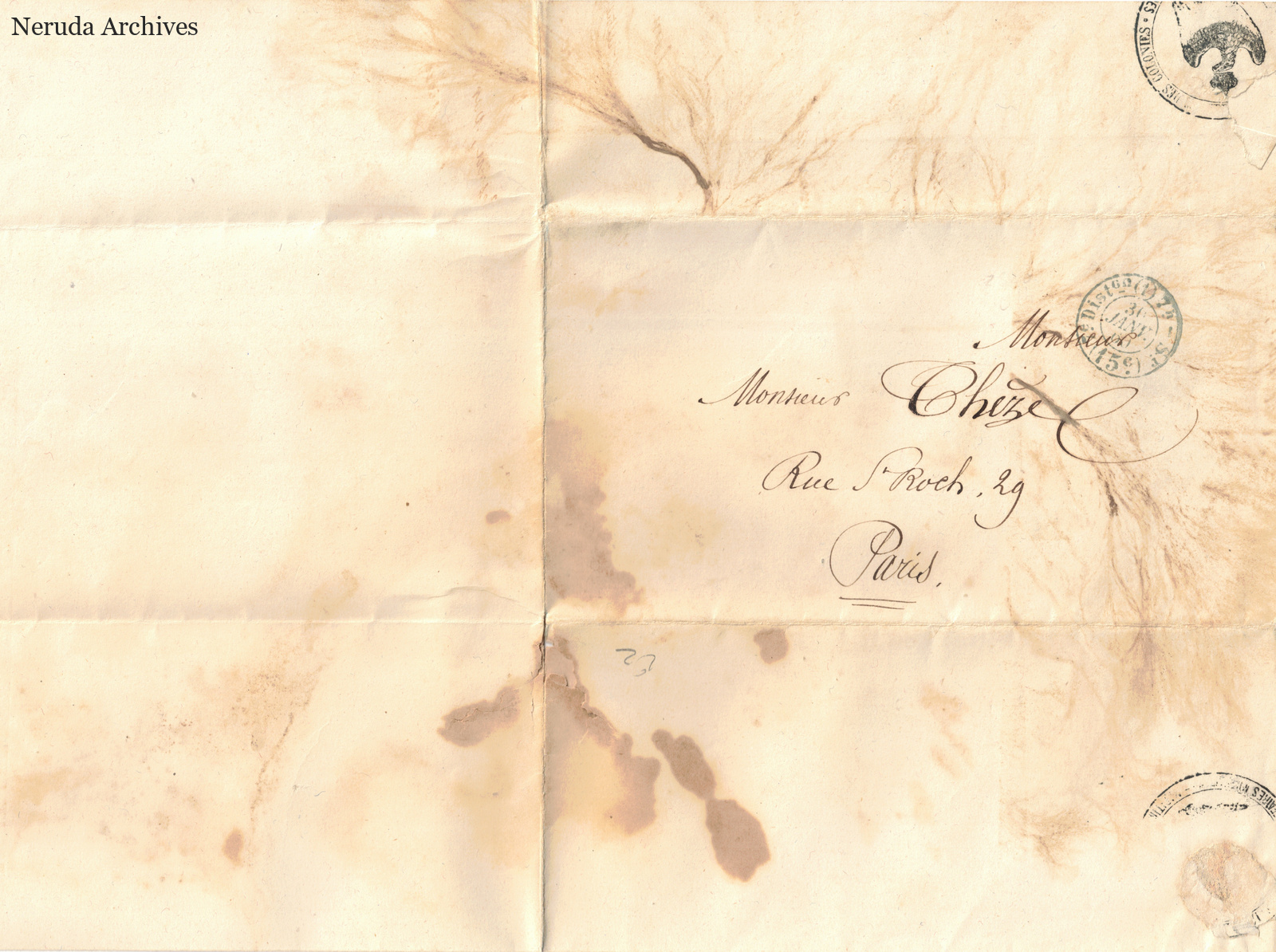
NRA-L-000080 image 1 showing the unfolded outer address side to Monsieur Thézé in Paris with postal marks, folds, and stains.
Image 1Unfolded address and postal side.
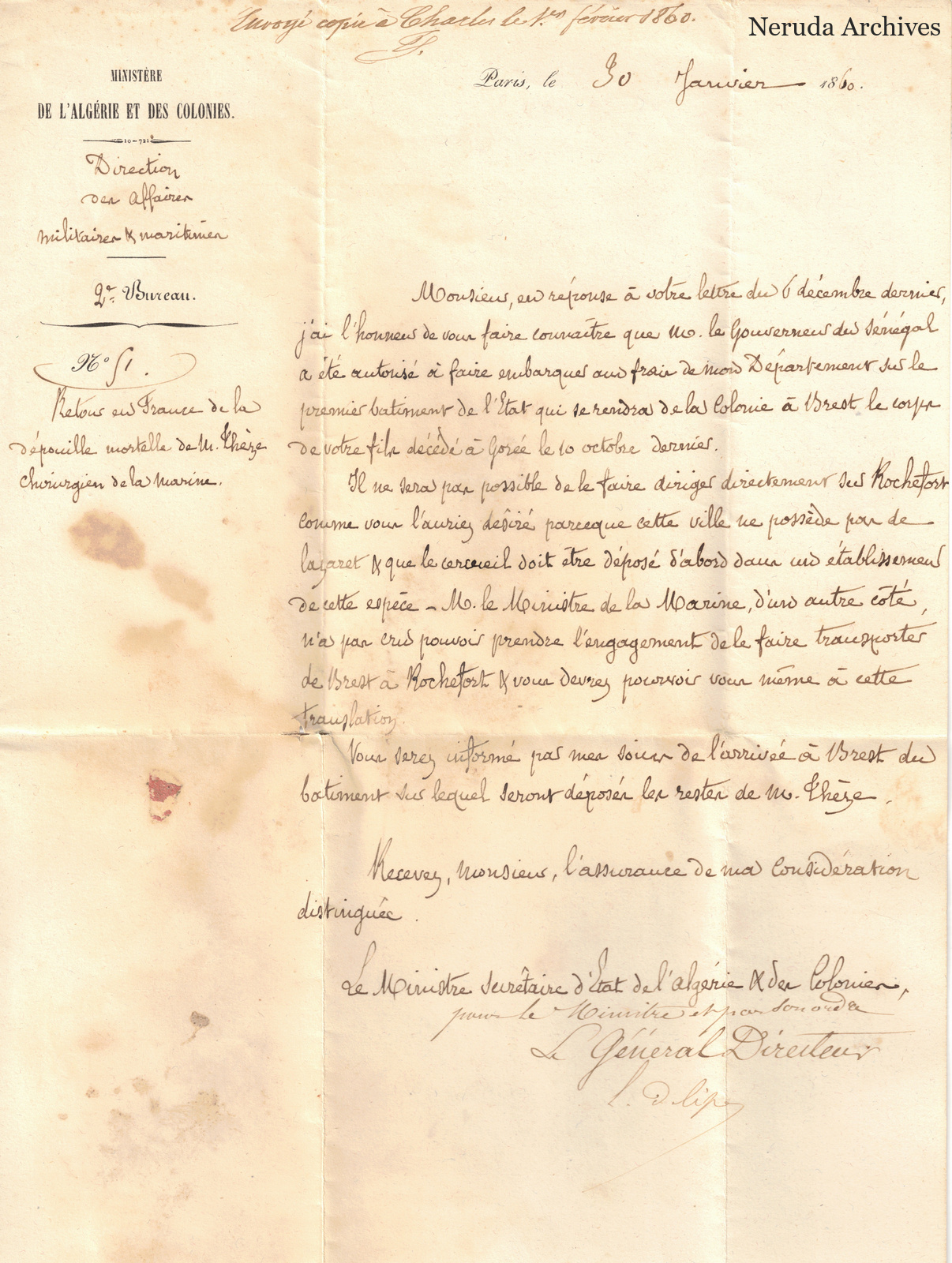
NRA-L-000080 image 2 showing the upper and central sections of a French administrative letter on Ministry of Algeria and Colonies stationery.
Image 2Administrative letter - Upper section.
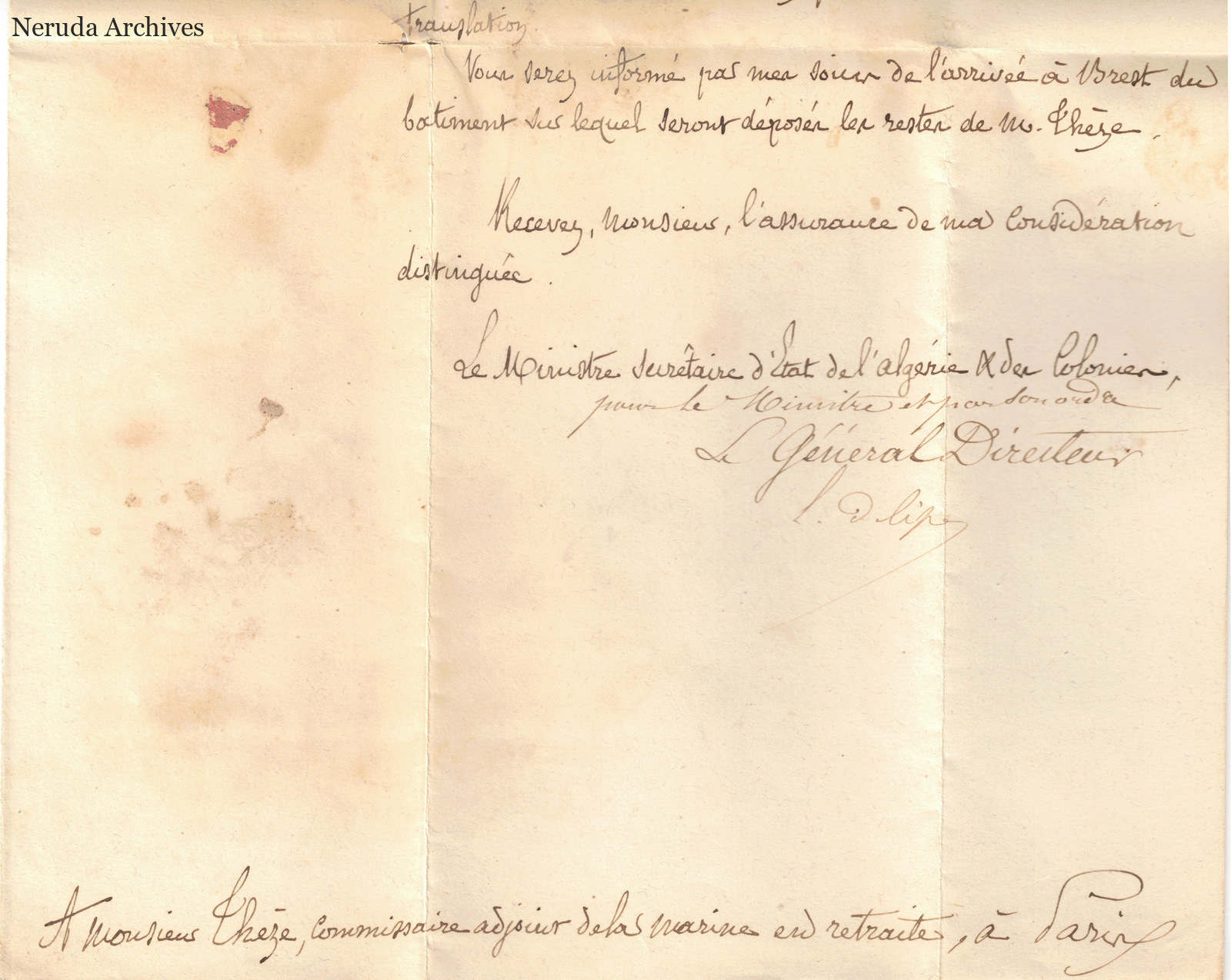
NRA-L-000080 image 3 showing the overlapping lower continuation with the signed closing and recipient routing line.
Image 3Administrative letter - Lower overlapping section.
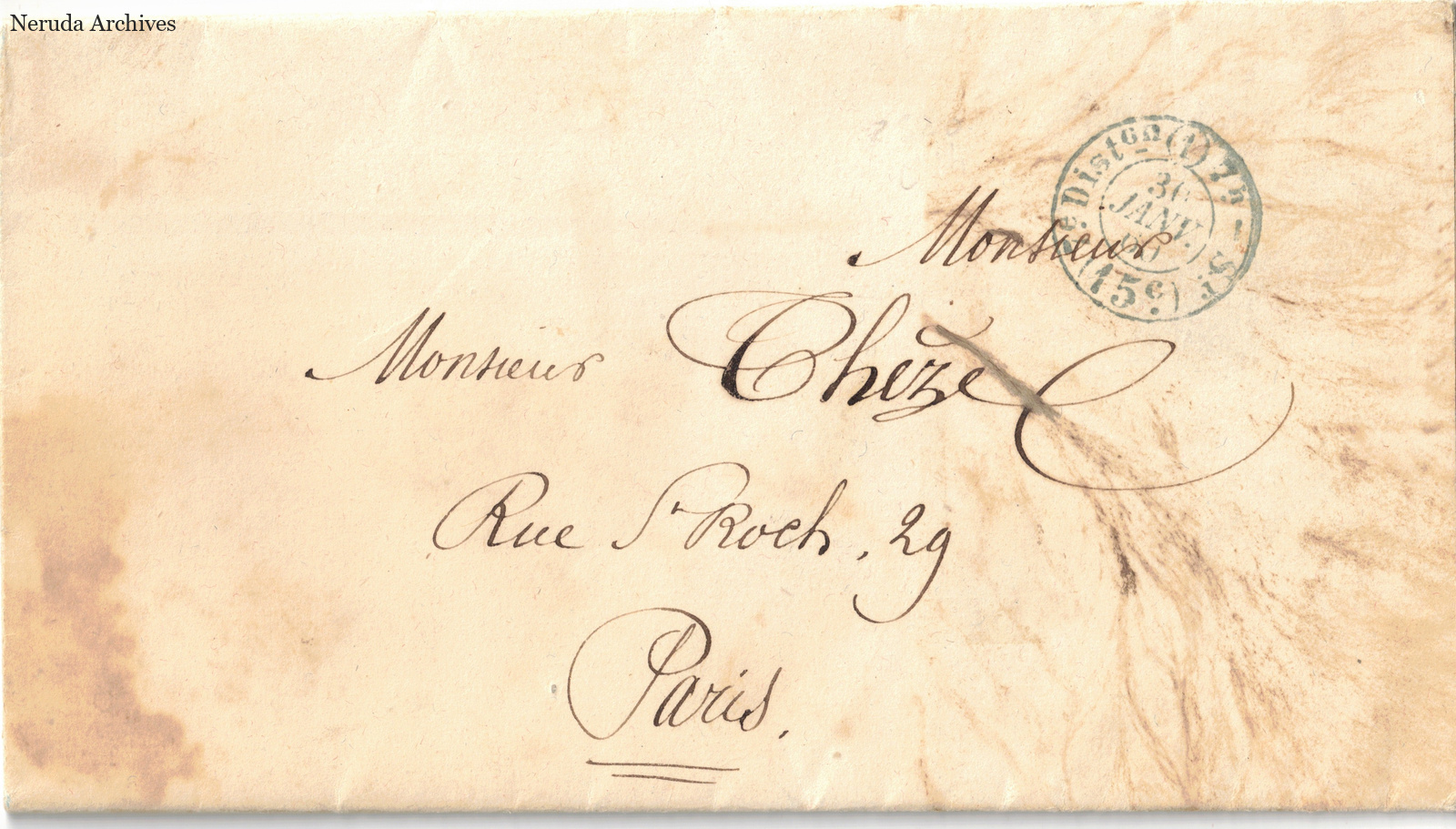
NRA-L-000080 image 4 showing the same wrapper in its folded state with address and circular postal mark.
Image 4Folded address side - Alternate capture.
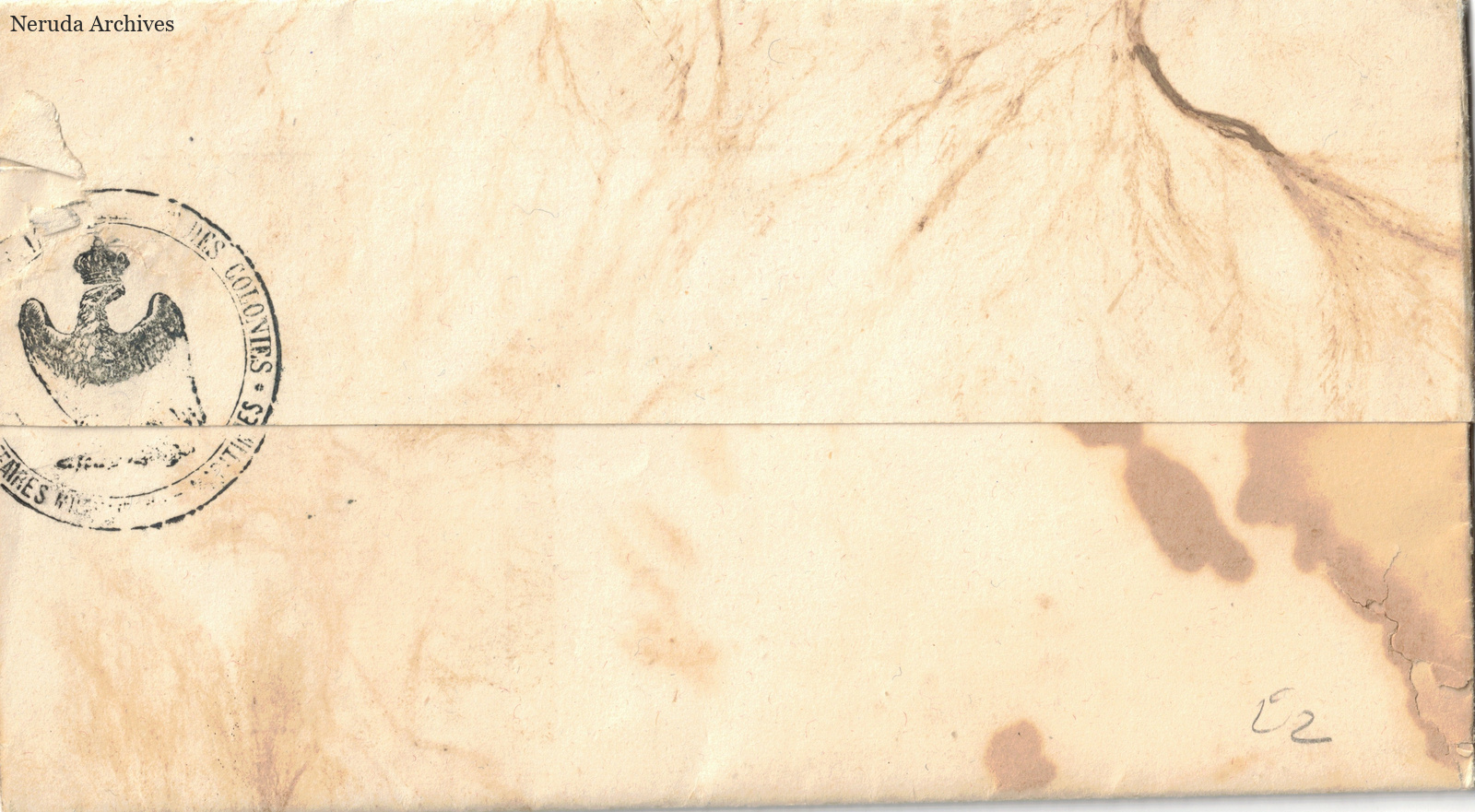
NRA-L-000080 image 5 showing the folded reverse of the wrapper with a circular institutional mark, stains, and a small manuscript number.
Image 5Folded reverse - Alternate capture.

Transcript and English translation

working scholarly aid

Address panel

Original transcript

Monsieur Thézé
Rue St Roch, 29
Paris.

Address panel

English translation

Mr. Thézé
Rue St Roch, 29
Paris.

Administrative letter

Original transcript

MINISTÈRE
DE L'ALGÉRIE ET DES COLONIES.
Direction
des Affaires
militaires & maritimes
2e Bureau.
N° 51.
Retour en France de la
dépouille mortelle de M. Thézé
Chirurgien de la marine.

Paris, le 30 Janvier 1860.

Monsieur, en réponse à votre lettre du 6 décembre dernier,
j'ai l'honneur de vous faire connaître que M. le Gouverneur du Sénégal
a été autorisé à faire embarquer aux frais de mon Département sur le
premier bâtiment de l'Etat qui se rendra de la Colonie à Brest le corps
de votre fils décédé à Gorée le 10 octobre dernier.
Il ne sera pas possible de le faire diriger directement sur Rochefort
comme vous l'auriez désiré parceque cette ville ne possède pas de
lazaret & que le cercueil doit être déposé d'abord dans un établissement
de cette espèce. - M. le Ministre de la Marine, d'un autre côté,
n'a pas cru pouvoir prendre l'engagement de le faire transporter
de Brest à Rochefort & vous devrez pourvoir vous même à cette
translation.
Vous serez informé par mes soins de l'arrivée à Brest du
bâtiment sur lequel seront déposés les restes de M. Thézé.
Recevez, Monsieur, l'assurance de ma considération
distinguée.
Le Ministre Secrétaire d'Etat de l'Algérie & des Colonies,
pour le Ministre et par son ordre
Le Général Directeur
[signature : de Cissey]
A Monsieur Thézé, Commissaire-adjoint de la marine en retraite, à Paris

Administrative letter

English translation

MINISTRY OF ALGERIA AND THE COLONIES
Directorate of Military & Maritime Affairs
2nd Bureau
No. 51
Return to France of the mortal remains of Mr Thézé, Navy Surgeon
Paris, 30 January 1860
Sir,
in reply to your letter of 6 December last, I have the honour to inform you that the Governor of Senegal has been authorised to have the body of your son, who died in Gorée on 10 October last, embarked at the expense of my Department on the first State vessel that will sail from the Colony to Brest.
It will not be possible to have it sent directly to Rochefort as you would have wished, because that town does not possess a lazaret and the coffin must first be deposited in an establishment of this kind.
The Minister of the Navy, on the other hand, did not feel able to undertake the commitment to have it transported from Brest to Rochefort, and you will have to provide for this transfer yourself.
You will be informed by my office of the arrival in Brest of the vessel on which the remains of Mr Thézé will be deposited.
Accept, Sir, the assurance of my distinguished consideration.
The Minister Secretary of State for Algeria & the Colonies,
for the Minister and by his order
The General Director
de Cissey
To Mr. Thézé, retired Deputy Commissary of the Navy, in Paris

Discovery Terms

  • Colonial administration
  • Human remains
  • Naval medicine
  • Gorée
  • Brest
  • Rochefort
  • Family bereavement
  • Jean-Baptiste Auguste Thézé
  • Pierre-Hippolyte-Célestin Thézé
Historical context Bringing a naval surgeon home from Gorée 5 sources

A ministry reply to a father

The Ministry of Algeria and the Colonies was replying to Pierre-Hippolyte-Célestin Thézé's letter of 6 December 1859. It authorized the body of his son, Jean-Baptiste Auguste Thézé, to travel at the department's expense on the first state vessel sailing from Senegal to Brest. The son had died at Gorée on 10 October 1859.[1, 2]

The route and its limits

The coffin could not be sent directly to Rochefort because, according to the ministry, the city had no lazaretto and the coffin first had to be deposited in such an establishment. The Navy would not undertake the onward journey from Brest. The state accepted the colonial sea passage, but the father was required to arrange the final transfer himself.[1]

The two Thézé careers

The French naval personnel index independently confirms Jean-Baptiste Auguste Thézé, born at Rochefort on 5 March 1824, as a surgeon who died on 10 October 1859. The same index records Pierre-Hippolyte-Célestin Thézé, born in 1798, as a deputy commissary. These entries support the corrected identification of the deceased son and the retired naval administrator addressed by the ministry.[1, 2]

Gorée in the yellow-fever epidemic

Two later naval-history sources identify Jean-Baptiste Auguste Thézé as head of the health service at Gorée and attribute his death to the yellow-fever epidemic of 1859. A municipal memorial record at Rochefort also lists THEZE 1859 among naval doctors and pharmacists who died in service. The ministry's own letter, however, gives only the place and date of death and does not state its cause.[1, 3, 4, 5]

Evidence and limits

The family relationship, official route, date of death and naval occupations are directly documented or independently confirmed. Yellow fever is supported by later specialist sources but is not named in the ministry letter. The later note that a copy was sent to Charles does not identify Charles, and the sources reviewed do not yet document the coffin's eventual arrival or final burial.[1, 2, 3, 4, 5]

Sources & evidence (5)
  1. Primary source · official letter Neruda Archives, NRA-L-000080, Ministry of Algeria and the Colonies to Pierre-Hippolyte-Célestin Thézé, 30 January 1860. View the archive record Supports the father-son relationship, death at Gorée, proposed transport, lazaretto requirement, onward responsibility and later copy note.
  2. Military archival index Service historique de la Défense, Marine personnel alphabetical index, MV CC 7 ALPHA 2353, entries for Jean-Baptiste Auguste Thézé and Pierre-Hippolyte-Célestin Thézé. Open the personnel index Confirms both full identities, birth details, occupations and Jean-Baptiste Auguste's death date.
  3. Naval biographical reference Parcours de vies dans la Royale, “Jean Baptiste Auguste Thézé (1824-1859).” Read the naval biography Identifies Thézé as head of the health service at Gorée and attributes his death to yellow fever.
  4. Specialist historical publication Images & Mémoires, Bulletin no. 64, spring 2020, p. 30. Open the bulletin Documents Thézé's grave, role at Gorée and attribution to the 1859 yellow-fever epidemic.
  5. Municipal memorial record Ville de Rochefort, “Plaque en hommage aux pharmaciens et médecins de l'école de médecine navale décédés en service.” View the memorial record Lists THEZE 1859 among naval medical personnel remembered as having died in service.

Reviewed 2026-07-30 · Context version 1.0

Document image

Loading document viewer...