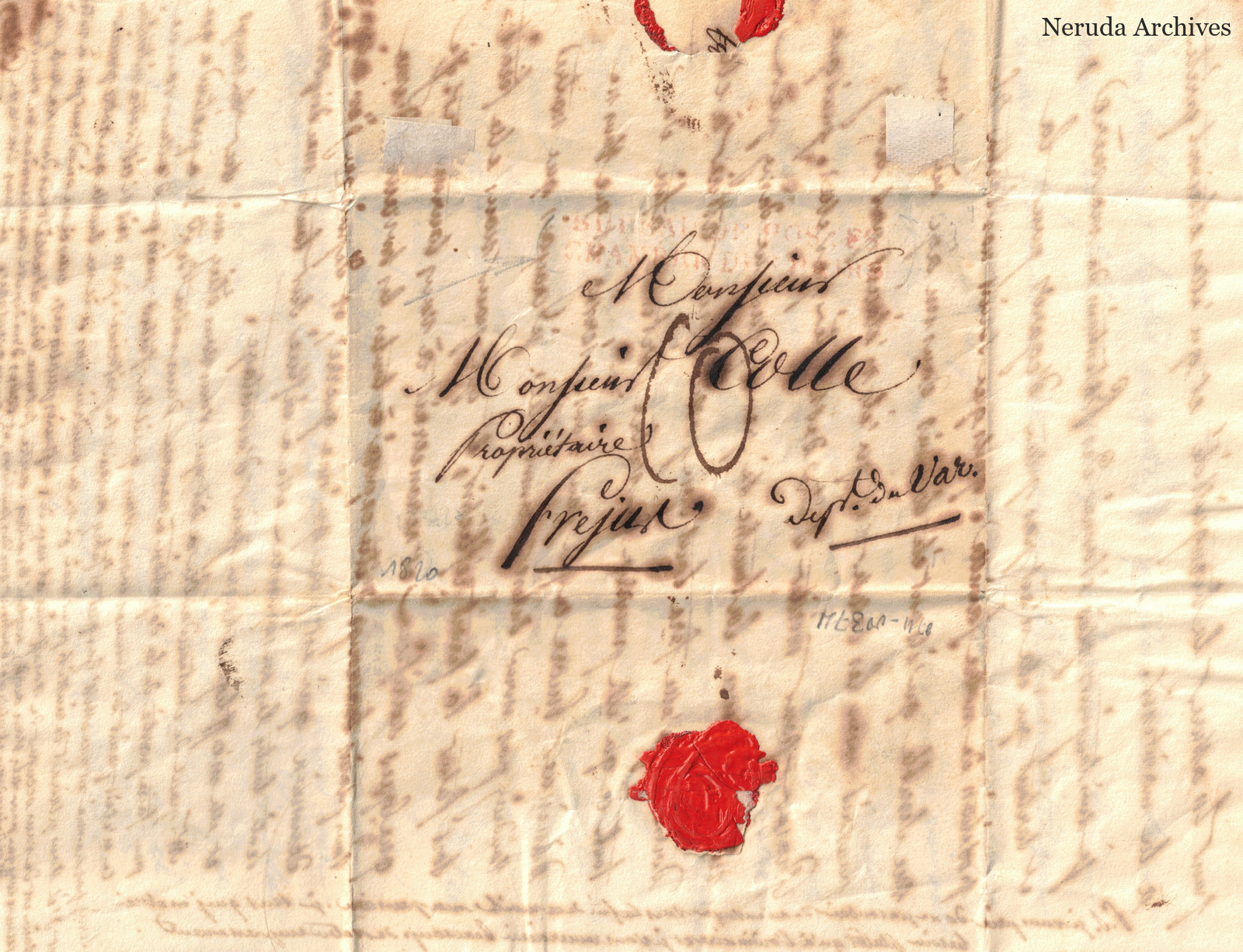
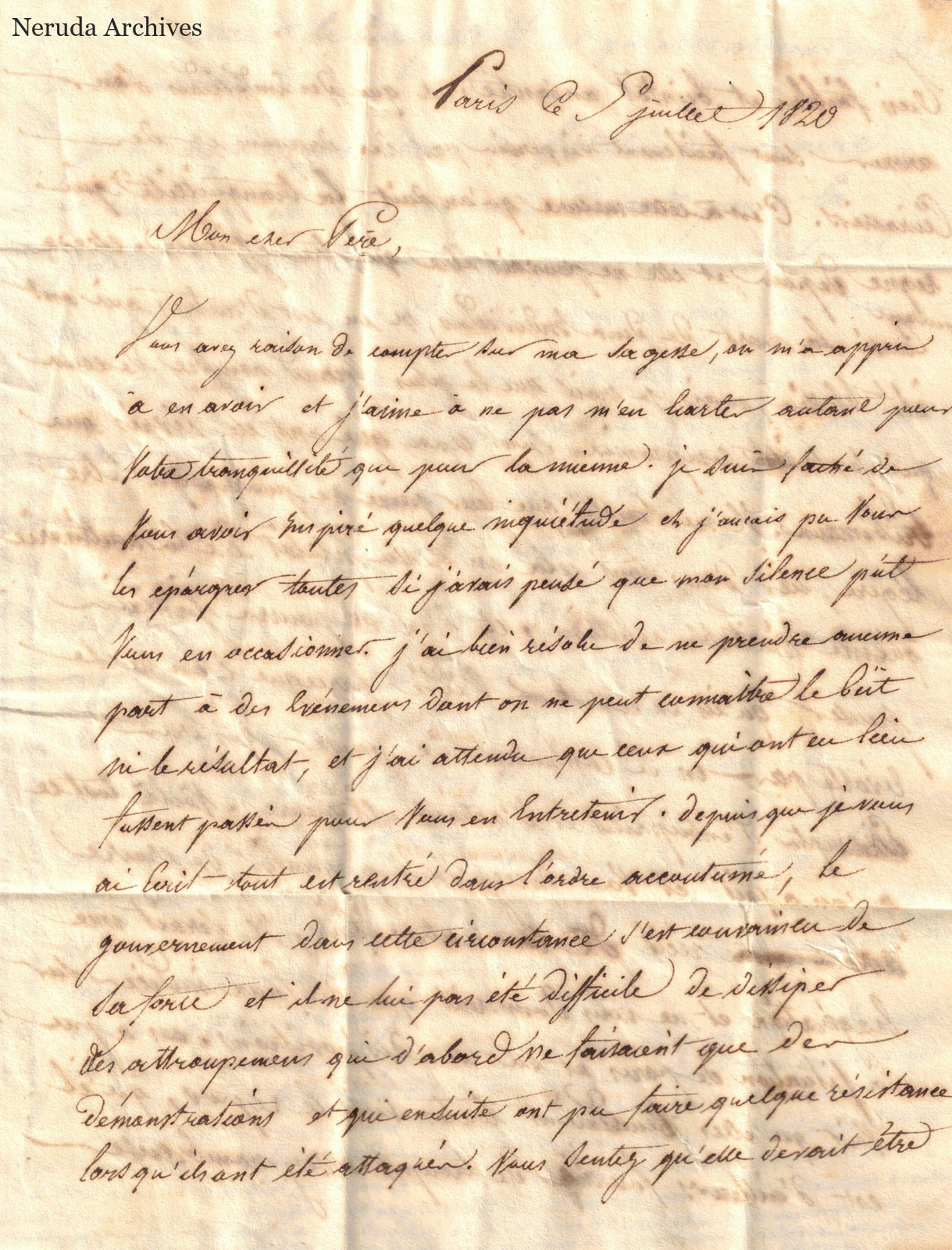
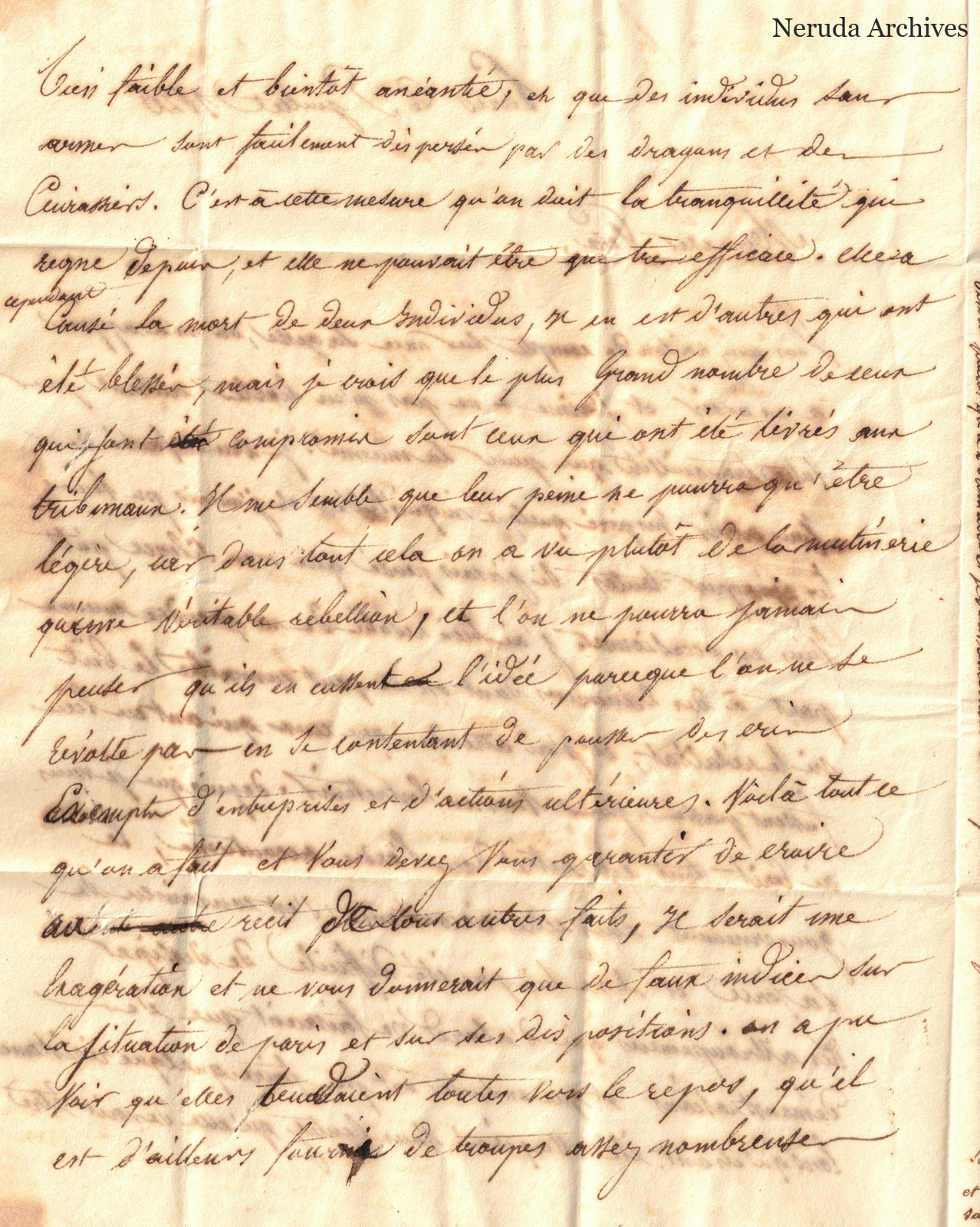
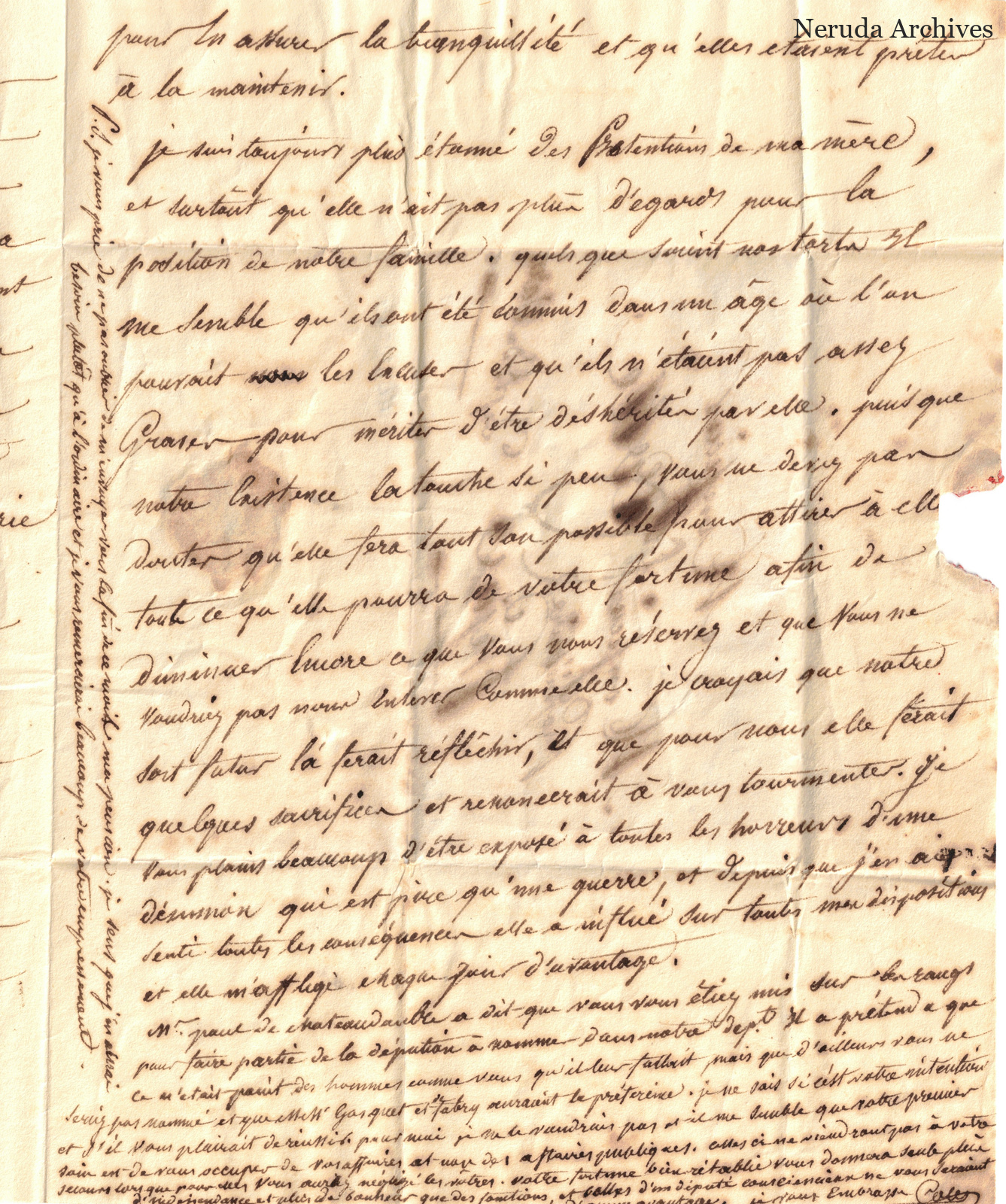
The June disturbances behind the letter
Writing from Paris on 5 July 1820, Colle looked back on gatherings dispersed by dragoons and cuirassiers, with deaths, injuries, arrests and prosecutions. The timing and details align closely with the Paris demonstrations of 2-9 June against the electoral bill known as the law of the double vote. Enacted at the end of June, the law strengthened property-based voting by allowing the wealthiest electors to vote in a second departmental college.[1, 2, 3, 4]
The two deaths reported by Colle
Colle wrote that the use of force had caused the deaths of two people. Historical research documents two fatalities within the same sequence: the law student Nicolas Lallemand, killed during the demonstration of 3 June, and an unnamed worker killed while taking part in Lallemand's funeral demonstration on 9 June. These deaths closely fit Colle's total, although the letter itself names neither victim.[1, 3, 4]
An election discussed inside a family
The letter then turns from the streets of Paris to the writer's father's possible candidacy in the Var. The three political names are independently identifiable. Jean Antoine Emmanuel de Paul de Châteaudouble was then a deputy for the Var; François Henry de Gasquet entered the Chamber for the department on 12 November 1820; and Pierre Marc Antoine Bruno de Fabry, a former Var deputy, returned in 1821. Colle's account therefore captures a real local contest unfolding alongside the national dispute over electoral law.[1, 5, 6, 7]
Evidence and limits
The identification of the June demonstrations is strongly supported by date, place, military response, casualties and the electoral subject, but Colle does not date the individual incidents. The two documented fatalities correspond closely to his reported total without proving whom he personally had in mind. The full identities of the writer and recipient, the father's candidacy and the pension mentioned in the postscript remain unresolved.[1, 2, 3, 4, 5, 6, 7]
Sources & evidence (7)
- Primary source · manuscript Neruda Archives, NRA-L-000150, letter from Colle to his father, 5 July 1820. View the archive record Supports the writer's account of the Paris disturbances, two deaths, injuries, arrests, family conflict, electoral discussion and named Var figures.
- Official institutional history Assemblée nationale, 'La Restauration (1814-1830)', historical account of the censitary franchise and the 1820 law of the double vote. Read the historical overview Explains the restricted franchise and the electoral mechanism introduced in 1820.
- Scholarly study Jean-Claude Caron, 'Extrémisme parlementaire et extrémisme politique sous la Restauration', in Extrême? Identités partisanes et stigmatisation des gauches en Europe, Presses universitaires de Rennes, pp. 175-185. Read the scholarly chapter Documents the deaths of Nicolas Lallemand on 3 June 1820 and an unnamed worker during the funeral demonstration of 9 June.
- Scholarly study Jean-Claude Caron, 'Aux origines du mythe: l'étudiant sur la barricade dans la France romantique (1827-1851)', in La barricade, Éditions de la Sorbonne. Read the scholarly chapter Places Lallemand's death in the demonstrations against the new double-vote electoral law and characterizes the opposition movement.
- Official parliamentary biography Assemblée nationale, 'Jean Antoine Emmanuel de Paul de Châteaudouble', Sycomore database of French deputies since 1789. View the parliamentary record Confirms Châteaudouble's identity and service as a deputy for the Var during the period of the letter.
- Official parliamentary biography Assemblée nationale, 'François Henry de Gasquet', Sycomore database of French deputies since 1789. View the parliamentary record Confirms Gasquet's election for the Var on 12 November 1820 and his political alignment.
- Official parliamentary biography Assemblée nationale, 'Pierre Marc Antoine Bruno de Fabry', Sycomore database of French deputies since 1789. View the parliamentary record Confirms Fabry's earlier and later mandates for the Var and identifies the political figure named in the letter.