A share in the name-day gift
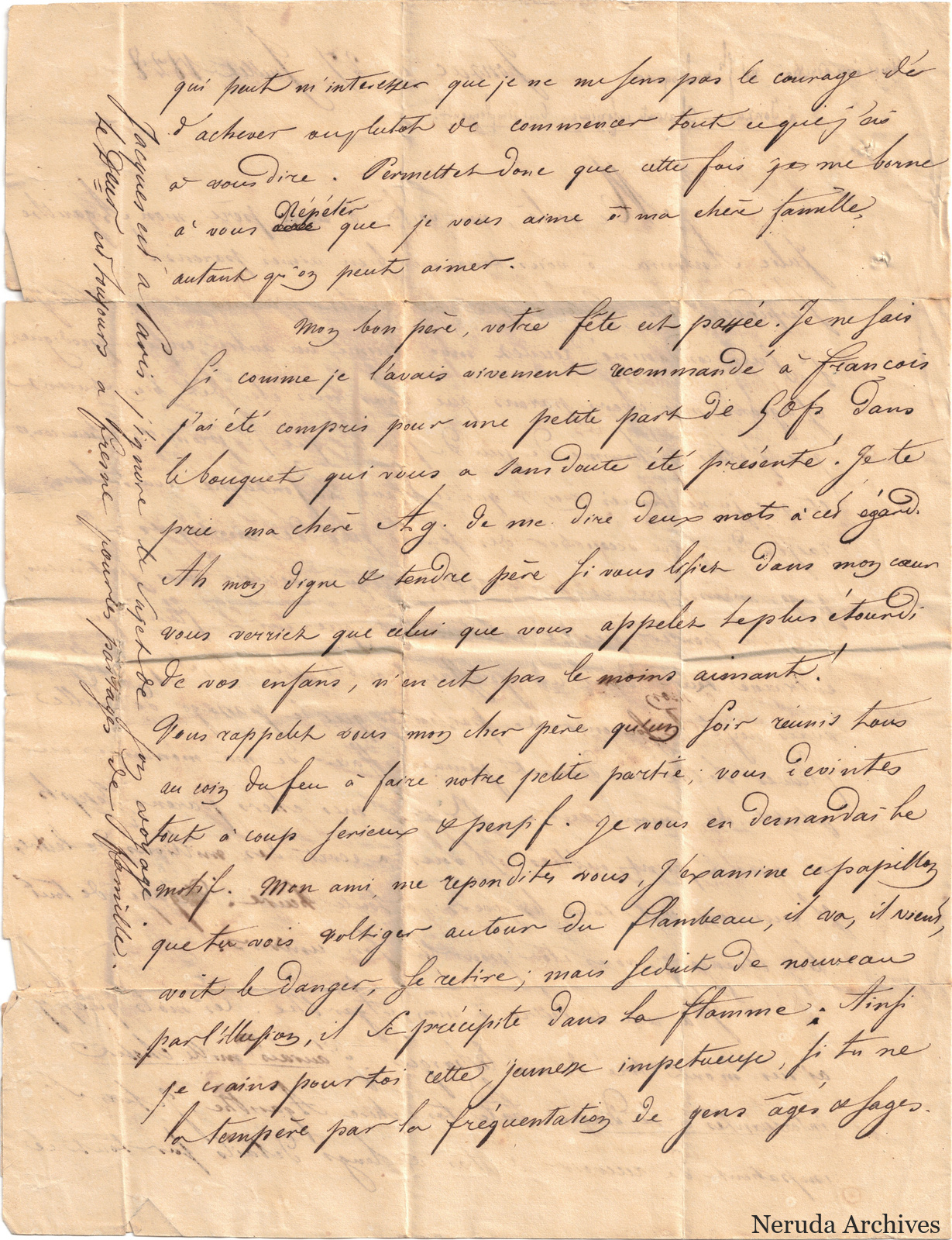
Joseph asks whether François included his contribution of 50 francs in his father's bouquet. Here bouquet need not mean flowers. The Académie française's 1835 dictionary records the word for a name-day gift as well as a bunch of flowers or a short poem. Joseph was asking whether he had been counted among the contributors. He does not say what his father received or whether the money was paid.[1, 2]
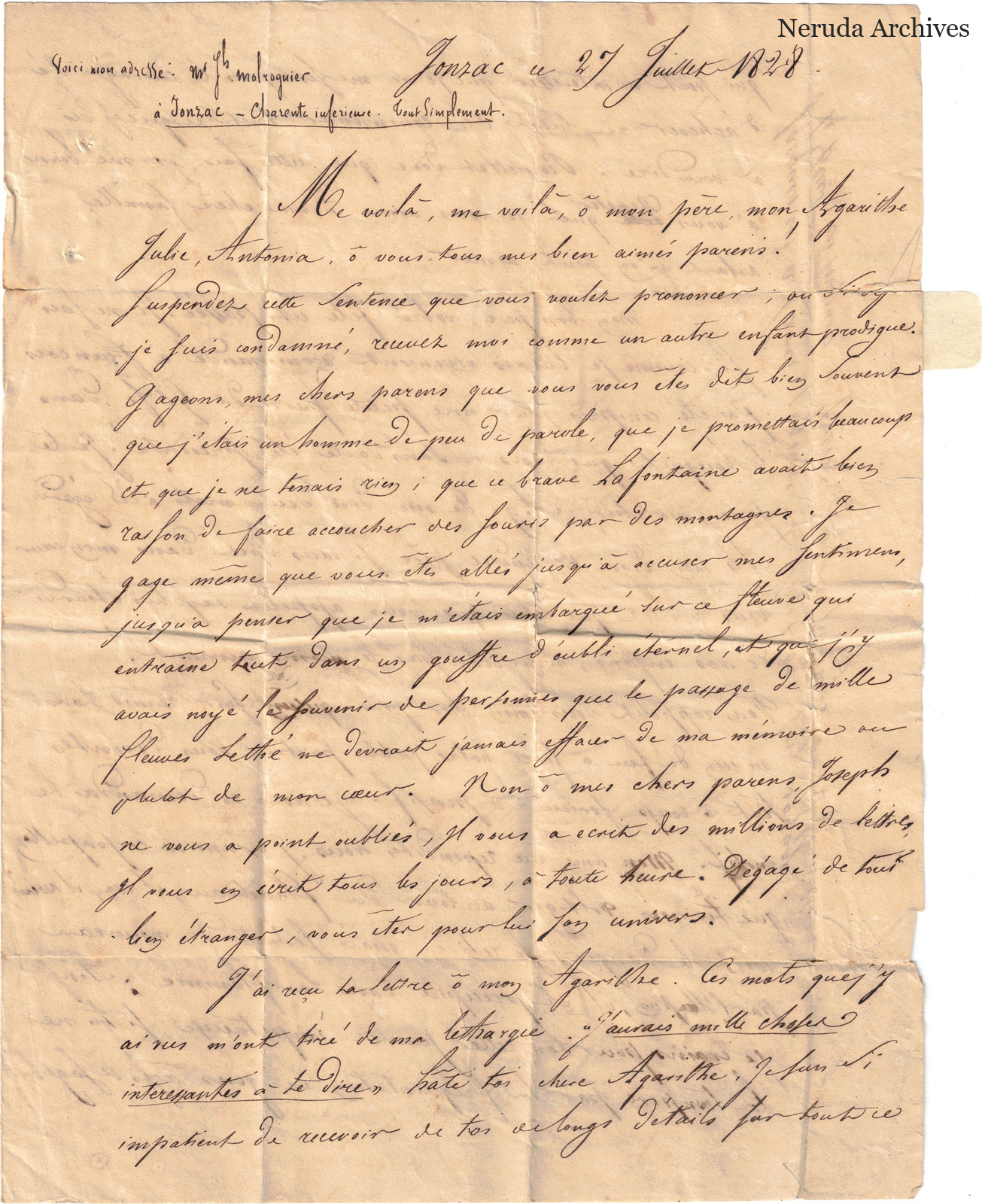
The apology has a literary joke with a precise source. La Fontaine's mountain raises expectations of something enormous and produces a mouse; the fable ends by asking what comes of promising so much. Joseph puts that joke in his family's mouths before asking to be received like the prodigal son. The allusion calls for the father's welcome without implying that Joseph had squandered an inheritance.[1, 3, 4]
Two men named Joseph Molroguier
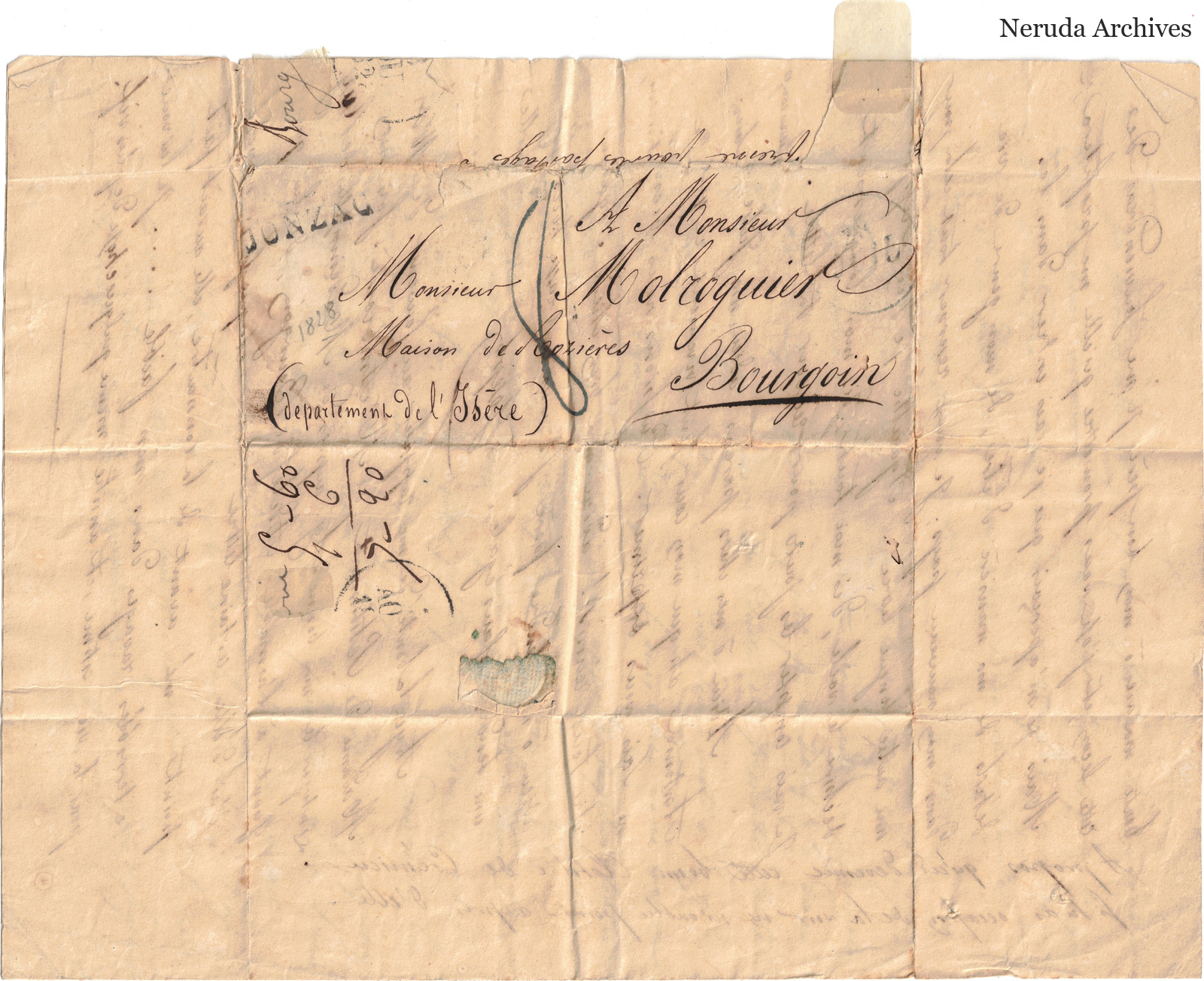
Joseph gives Jonzac as his return address and addresses his father at the Maison des carrières in Bourgoin. The French National Archives document two men born in Bourgoin who bore the name Joseph Molroguier. Joseph Pierre's service record places him in charge of indirect taxes at La Rochelle, in the same department as Jonzac, from 1822 until his transfer to Quimper in 1831. Napoléon Joseph, who was nineteen when the letter was written, is documented in the same administration much later, at Évreux. Neither file places its subject in Jonzac in July 1828.[1, 5, 6]
Evidence and limits
The writer and his father have not been securely identified. The Bourgoin cadastral inventory lists an alphabetical index of property owners for the register begun in 1833; the inventory itself does not identify the house in the address.[1, 5, 6, 7]
Sources & evidence (7)
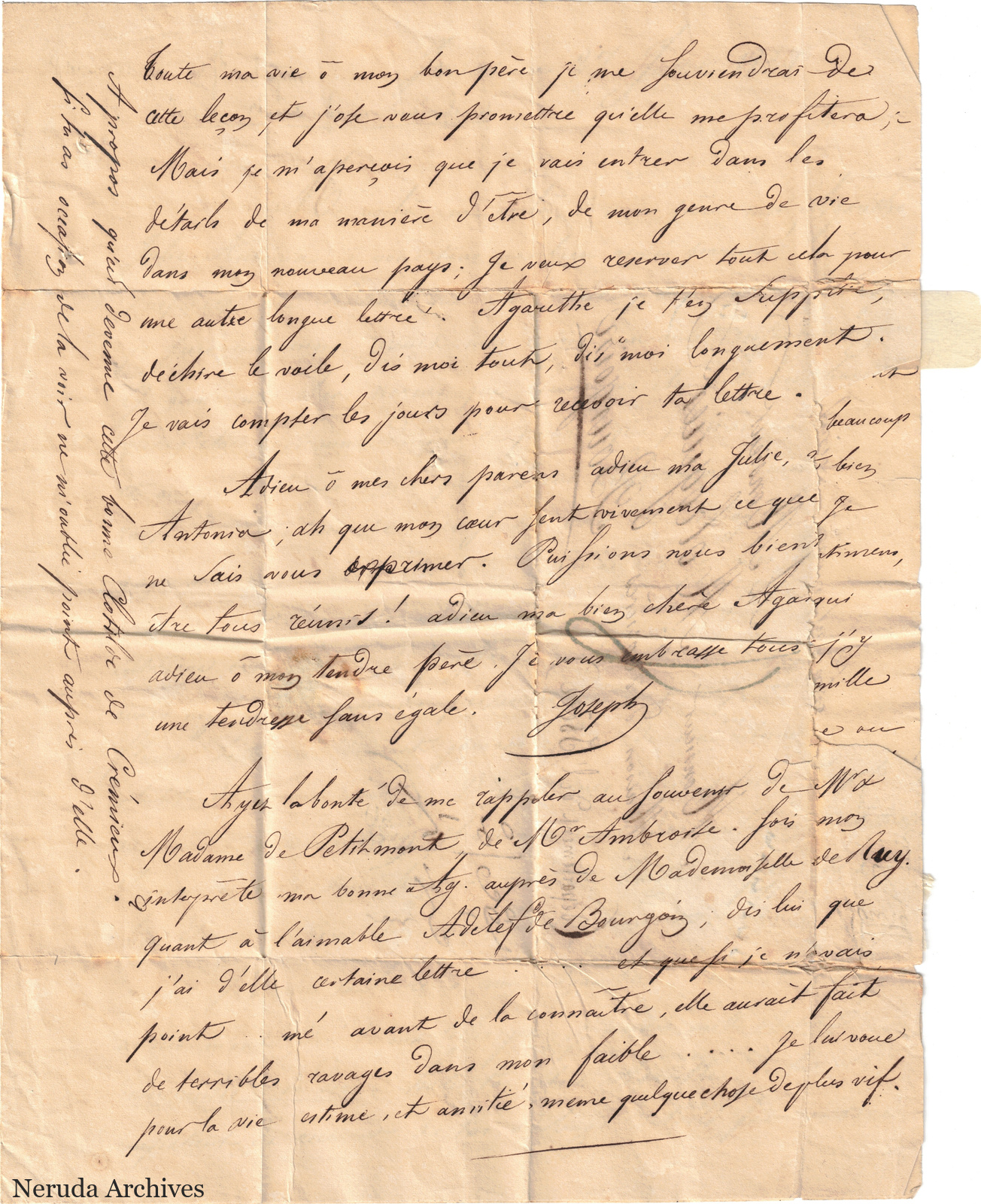
- Primary source: manuscript Neruda Archives, NRA-L-000673, Joseph Molroguier to his father and family, Jonzac, 27 July 1828, address panel and letter pages 1–3. Read the letter and both addresses Gives the two addresses, the name-day contribution, the writer's signature and the allusions in the opening.
- Primary source: historical dictionary Académie française, Dictionnaire de l'Académie française, 6th ed. (1835), vol. 1, p. 215, s.v. bouquet. Read the 1835 entry for bouquet Includes a name-day gift and a short name-day poem among the historical meanings.
- Primary source: literary text Jean de La Fontaine, Fables, book V, no. 10, « La Montagne qui accouche », Bernardin-Béchet ed. (1874), pp. 164–165. Read La Fontaine's fable The mountain gives birth to a mouse; the closing lines compare it to an author who promises much and produces nothing of substance.
- Primary source: biblical text Gospel of Luke 15:11–32, French liturgical translation, Association Épiscopale Liturgique pour les pays Francophones. Read the parable in Luke 15 The father welcomes the returning son; the parable, not the letter, describes a squandered share of the father's property.
- Primary source: personnel records Archives nationales (France), Base Léonore, LH//1901/10, Joseph Pierre Molroguier, images 2–3: état des services (1831) and procès-verbal d'individualité (La Rochelle, 28 December 1827). Open Joseph Pierre Molroguier's file Confirms his Bourgoin birth in 1788, appointments at La Rochelle and Quimper, and his residence in La Rochelle in December 1827.
- Primary source: personnel records Archives nationales (France), Base Léonore, LH//1901/11, Napoléon Joseph Molroguier, images 1–2: Légion d'honneur register sheet and Évreux certification (1872). Open Napoléon Joseph Molroguier's file Confirms his Bourgoin birth on 27 August 1808 and his later role directing indirect taxation at Évreux; the file records his award in 1870.
- Official archival finding aid Archives départementales de l'Isère, Bourgoin-Jallieu cadastral inventory, p. 1, Bourgoin: 3585 W 7–9 and 6100 W 66. Find the Bourgoin property registers Identifies the town's nineteenth-century property registers, the alphabetical owners' index and the 1833 statement of parcels. It does not identify the address in the letter.