NRA-L-000676

Letter from Julie to her mother about Gustave's re-enlistment

Julie tells her mother that Gustave has re-enlisted, describes his distress at receiving no letter from her, and writes about hardship and her own long penance. A postscript says that he re-enlisted out of spite after learning of their respective circumstances.

Neruda Archives
NRA-L-000676

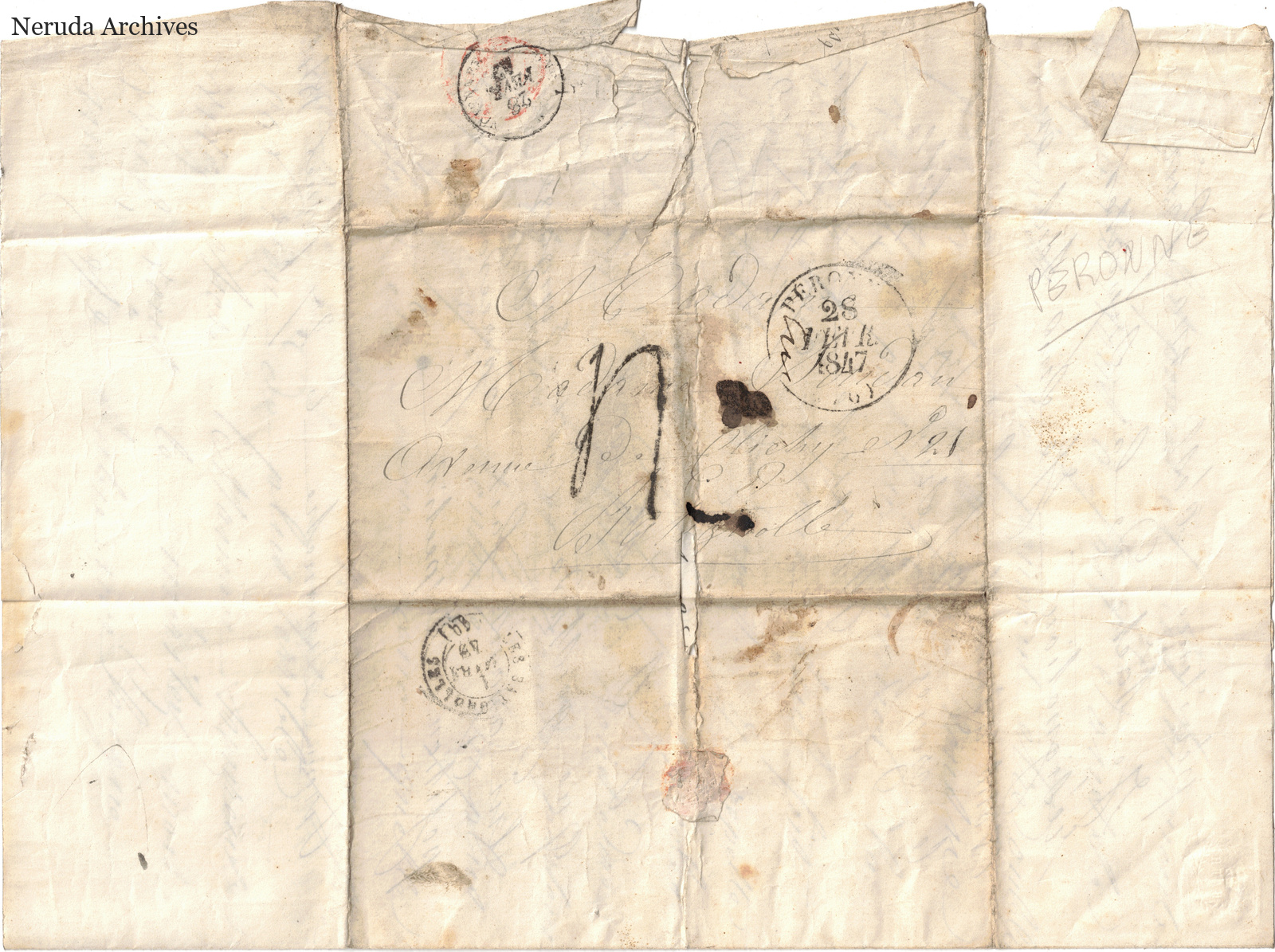
NRA-L-000676 image 1 showing a folded address side with several postal marks and seal remnants.
Image 1Address panel and postal evidence.
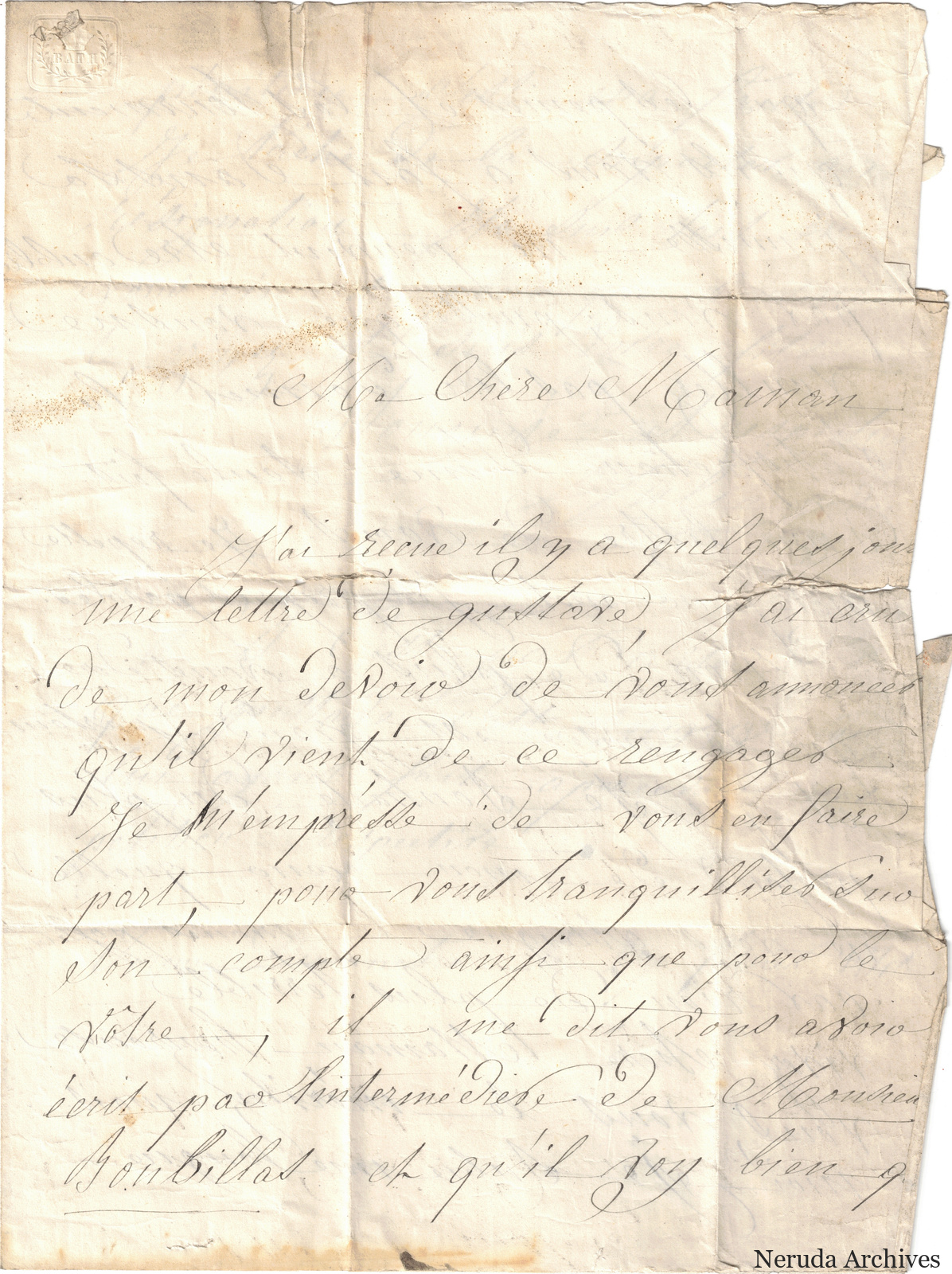
NRA-L-000676 image 2 showing a French handwritten letter on a worn folded sheet, text side 1.
Image 2Letter text - Page 1.
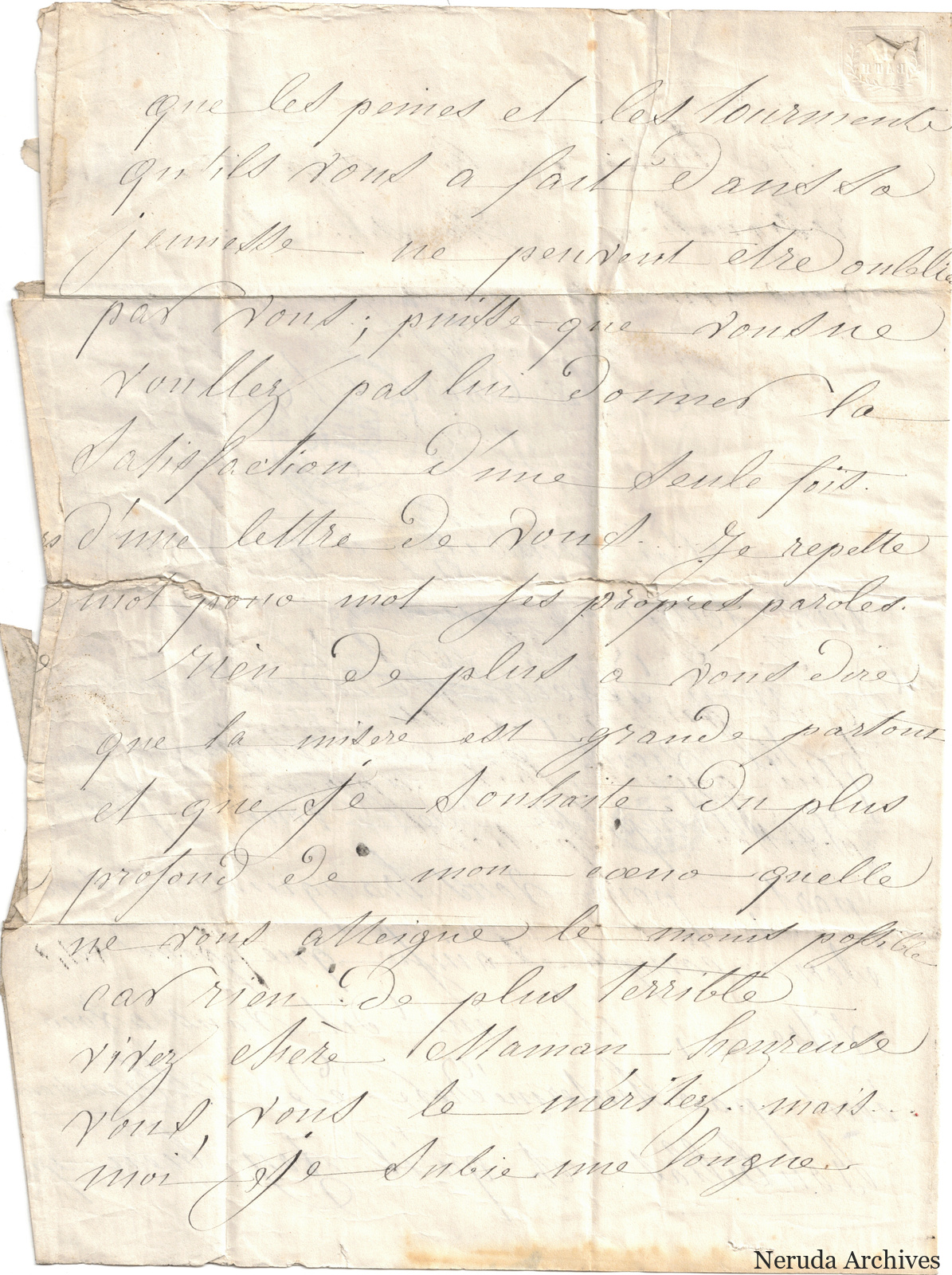
NRA-L-000676 image 3 showing a French handwritten letter on a worn folded sheet, text side 2.
Image 3Letter text - Page 2.
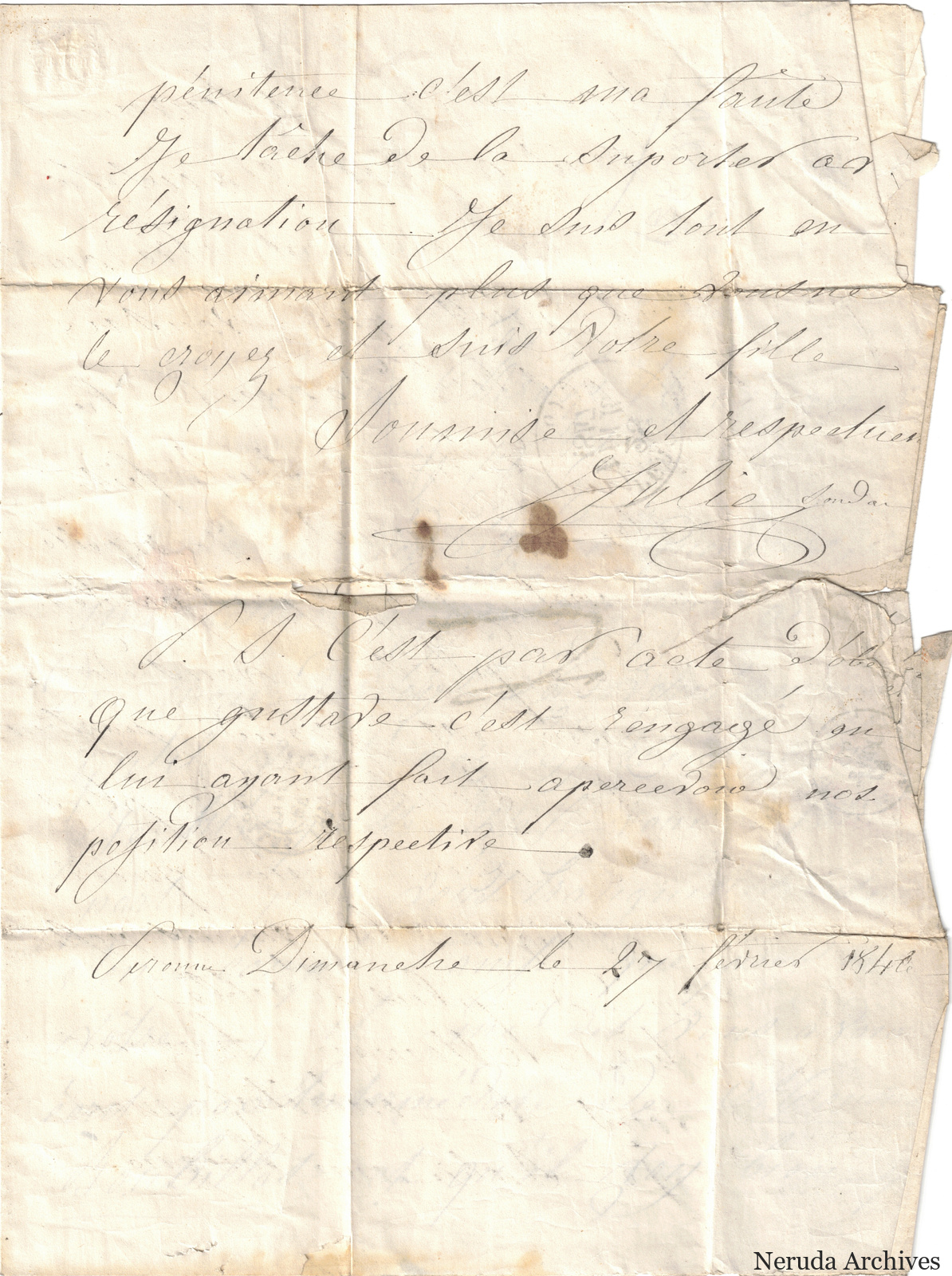
NRA-L-000676 image 4 showing a French handwritten letter on a worn folded sheet, text side 3.
Image 4Letter text - Page 3.

Transcript and English translation

working scholarly aid

Letter page 1

Original transcript

Ma Chère Maman

J'ai [reçue?] il y a quelques jours
une lettre de Gustave, j'ai cru
de mon devoir de vous annoncer
qu'il vient de ce rengager.
Je m'empresse de vous en faire
part, pour vous tranquilliser sur
son compte ainsi que pour le
vôtre, il me dit vous avoir
écrit par l'intermédiaire de Monsieur
[Boubillat?] et qu'il voit bien

Letter page 1

English translation

My dear Mother,

I received a letter from Gustave a few days ago. I thought it my duty to tell you that he has just re-enlisted. I hasten to let you know, to set your mind at ease about him and about yourself. He tells me that he has written to you through Monsieur [Boubillat?], and that he sees clearly

Letter page 2

Original transcript

que les peines et les tourmens
qu'il[s?] vous a fait dans sa
jeunesse ne peuvent être oublié[s?]
par vous ; puisque vous ne
voullez pas lui donner la
satisfaction d'une seule fois
d'une lettre de vous. Je répète
mot pour mot ses propres paroles.
Rien de plus à vous dire
que la misère est grande partout
et que je souhaite du plus
profond de mon âme qu'elle
ne vous atteigne le moins possible
car rien de plus terrible.
Vivez chère Maman heureuse,
vous, vous le méritez ; mais
moi je subis une longue

Letter page 2

English translation

that you cannot forget the sorrows and torments he caused you in his youth, since you will not give him the satisfaction of even a single letter from you. I repeat his own words exactly.

I have nothing more to tell you except that hardship is widespread, and that I wish from the depths of my soul that it affect you as little as possible, for nothing is more dreadful. Live happily, dear Mother; you deserve it. But I am enduring a long

Letter page 3

Original transcript

pénitence. C'est ma faute.
Je tâche de la supporter en
résignation. Je suis tout en
vous aimant plus que vous ne
le croyez et suis votre fille
Soumise et respectueuse
Julie [nom ou ajout illisible]

P. S. C'est par acte de dépit
que Gustave c'est rengagé, on
lui ayant fait apercevoir nos
position[s?] respective[s?].

Péronne Dimanche le 27 février 184[7/8?].

Notes

Editorial notes:
The last digit of the writer's year is unresolved. A separate Péronne postal strike on P001 reads 28 February 1847; 27 February fell on a Sunday in 1848, not 1847. The reason for the disagreement is unknown.

Letter page 3

English translation

penance. It is my fault. I try to bear it with resignation. I am, while loving you more than you think, your obedient and respectful daughter,
Julie [surname or addition unreadable].

P.S. It was out of spite that Gustave re-enlisted, after someone made him aware of our respective positions.

Péronne, Sunday, 27 February 184[7/8?].

Notes

Editorial notes:
The last digit of the writer's year is unresolved. A separate Péronne postal strike on P001 reads 28 February 1847; 27 February fell on a Sunday in 1848, not 1847. The reason for the disagreement is unknown.

Address panel

Original transcript

A M[adame?] [nom incertain : Soudan/Joudan?]
Avenue de Clichy n° 21 [?]
à Batignolles [?]

Notes

Editorial notes:
The recipient's name and parts of the address are faint and crossed by postal marks. The postal year and the writer's year must be assessed separately.

Address panel

English translation

To M[adame?] [name uncertain: Soudan/Joudan?]
21 Avenue de Clichy [?]
at Batignolles [?]

Notes

Editorial notes:
The recipient's name and parts of the address are faint and crossed by postal marks. The postal year and the writer's year must be assessed separately.

Discovery Terms

  • Family correspondence
  • Military service
  • Hardship

Historical context

Julie’s letter to Batignolles

Two dates on the folded letter

The folded address panel carries a Péronne postmark dated 28 February 1847 and a second stamp from Les Batignolles dated 1 March 1847. Together they date the letter's postal journey. Julie's closing line gives Sunday, 27 February, but its last year digit is unclear. In 1847, 27 February was a Saturday and 28 February was a Sunday. The postal dates do not tell us which day Julie wrote the letter or how the discrepancy arose.[1]

No. 21, avenue de Clichy

Julie addressed her letter to no. 21, avenue de Clichy, in Batignolles-Monceaux, then a separate commune. A sale notice in January 1836 distinguishes a house to be numbered 21 from the corner lot at the proposed rue de Chartres, to be numbered 23. A notice in May 1851 describes no. 21 itself as being on that corner. The city now calls the cross street rue Jacquemont. The notices point to the vicinity of that junction, but their different numbers make it unsafe to identify the exact property from the letter alone.[1, 2, 3, 4]

Evidence and limits

No independent record has established Julie's or her mother's full name, their connection to the property, or Gustave's unit and terms of service. What the letter gives is Julie's account of his decision to re-enlist.[1, 2]

Sources & evidence (4)
  1. Primary source: manuscript and postal marks Neruda Archives, NRA-L-000676, Julie to her mother, image 1 (address panel and postmarks) and image 4 (closing date). Read the letter and inspect the two postmarks The address gives avenue de Clichy, no. 21; the stamps date the passage through Péronne and Les Batignolles in 1847.
  2. Primary source: judicial sale notices Gazette des tribunaux, 2 January 1836, p. 218, Étude de Me Lambert, lots 2–3; and 1 May 1851, legal notices, Batignolles-Monceaux, lot 3. Find scanned issues in the ENAP collection The 1836 notice gives the proposed numbers 21 and 23 near rue de Chartres. In 1851 the corner property is described as no. 21. Neither notice identifies the family in the letter.
  3. Official street register Ville de Paris, Dénominations des emprises des voies actuelles, rue Jacquemont, record 11383. Find rue Jacquemont in the Paris street register Records the former name rue de Chartres, the renaming decree of 11 September 1869 and the present junction with avenue de Clichy.
  4. National Archives place authority Archives nationales (France), Batignolles-Monceau (Paris, France), FRAN_RI_020, historical place authority. Read the history of the former commune Identifies the independent commune created in 1830 and its division when Paris expanded in 1860.

Reviewed 2026-11-22 · Context version 1.0

Document image

Loading document viewer...