NRA-L-000679 / 1818

Letter to a cousin in Tours about family news and waterproof cloth

An unnamed writer tells a cousin about a planned return to town, an aunt's solitude, a request for waterproof cloth, and news of relatives.

Neruda Archives
NRA-L-000679

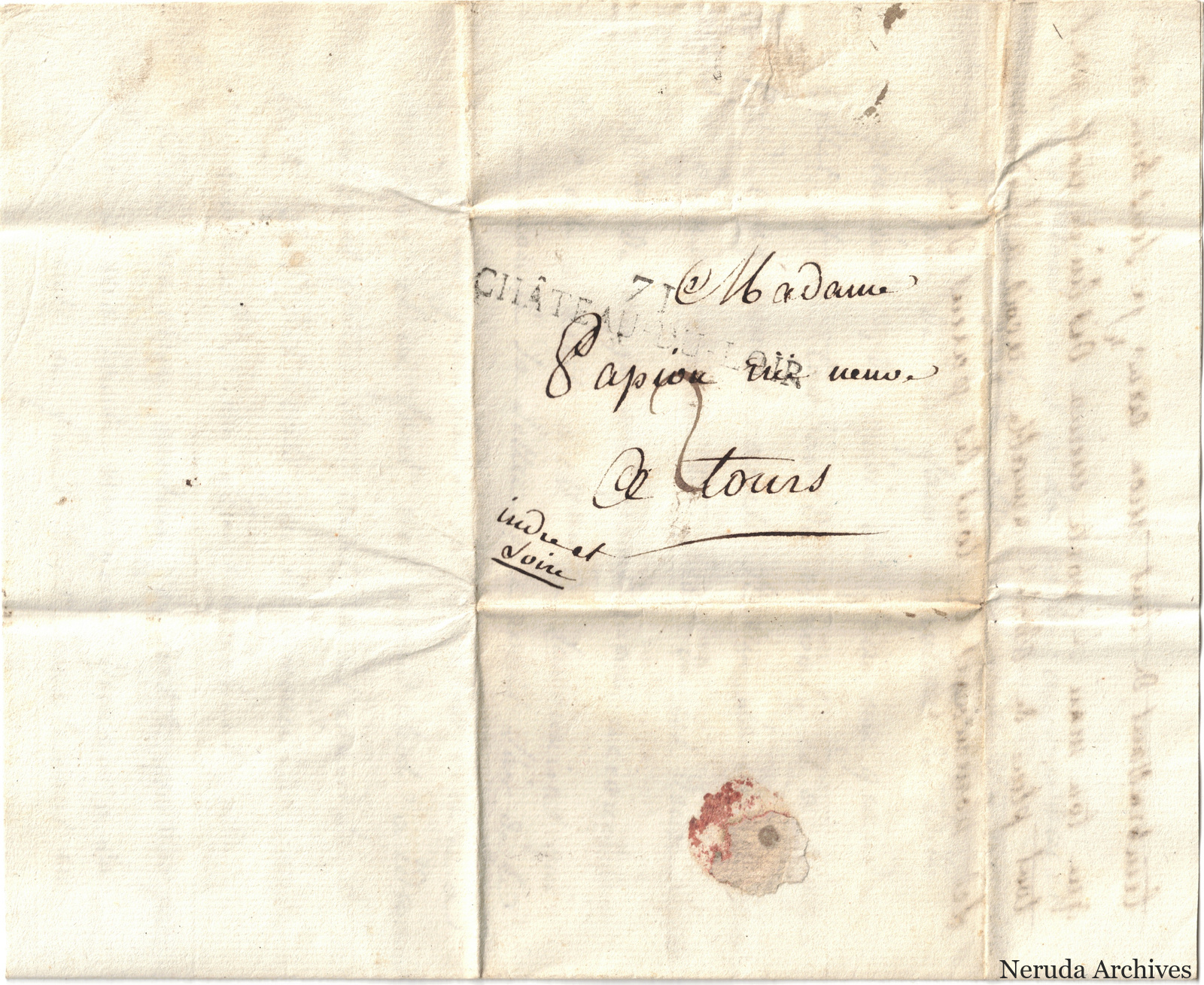
NRA-L-000679 image 1 showing an address to Tours with a wax-seal remnant.
Image 1Address panel and postal evidence.
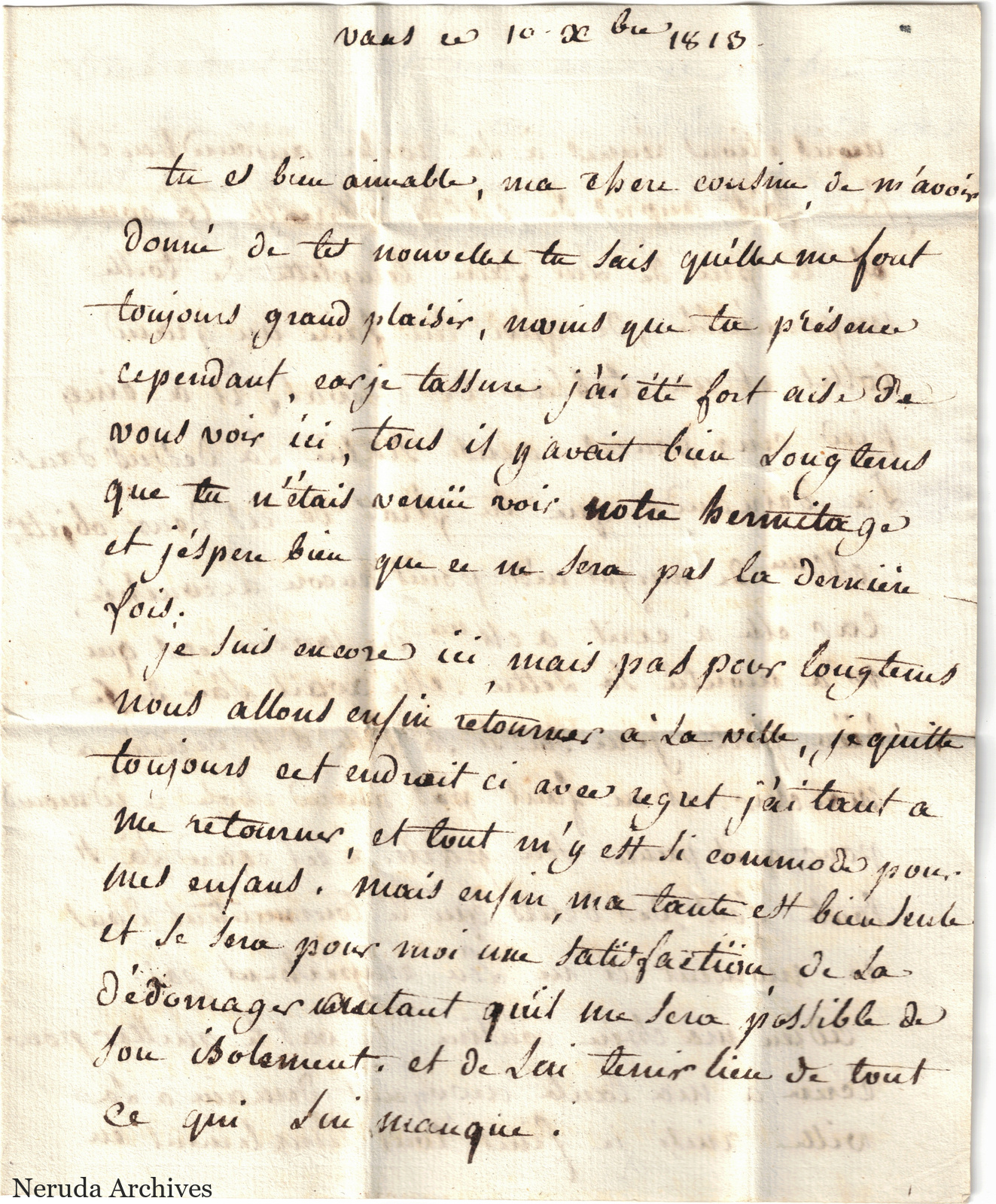
NRA-L-000679 image 2 showing a French personal letter across several folded sides, text side 1.
Image 2Letter text - Page 1.
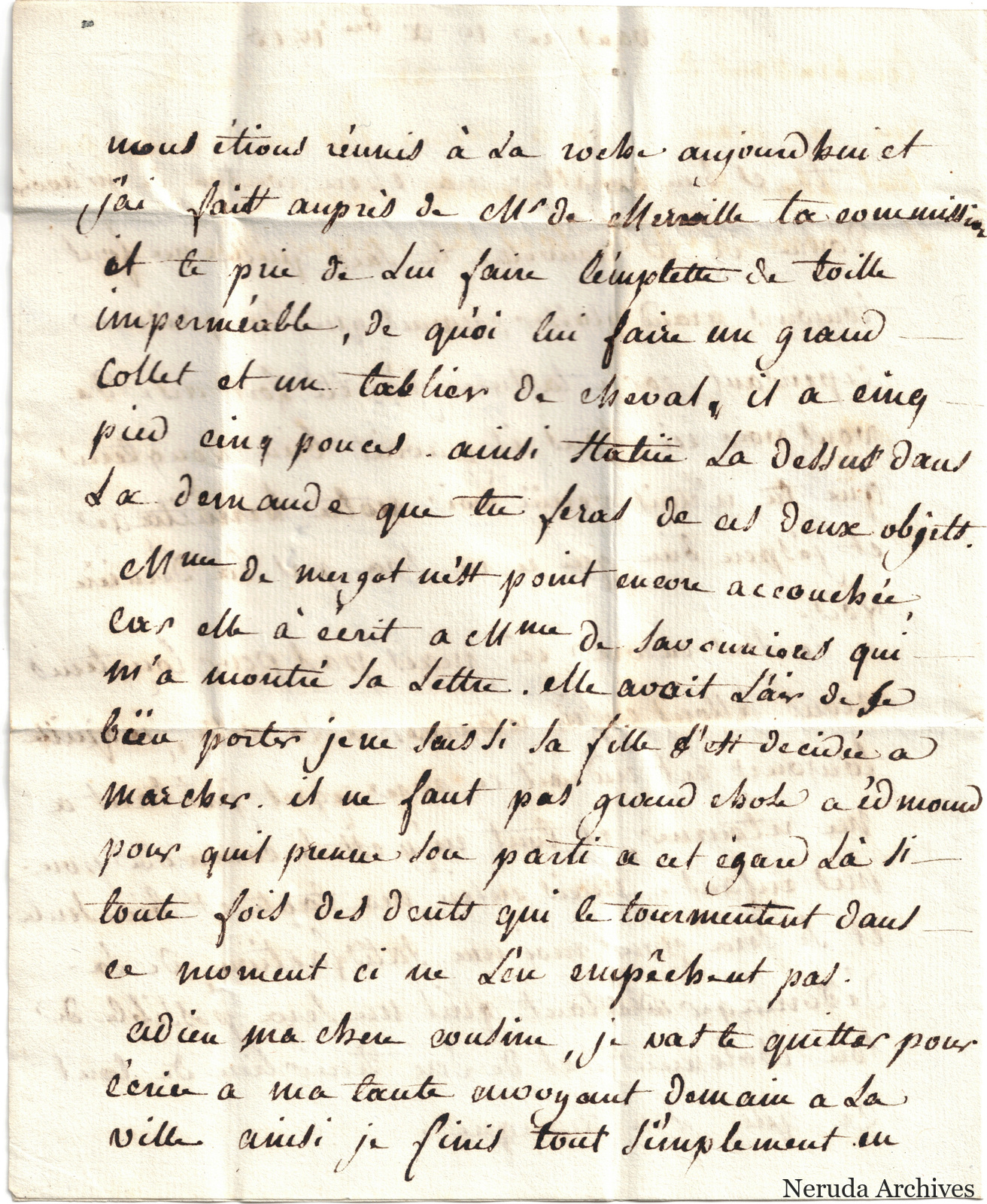
NRA-L-000679 image 3 showing a French personal letter across several folded sides, text side 2.
Image 3Letter text - Page 2.
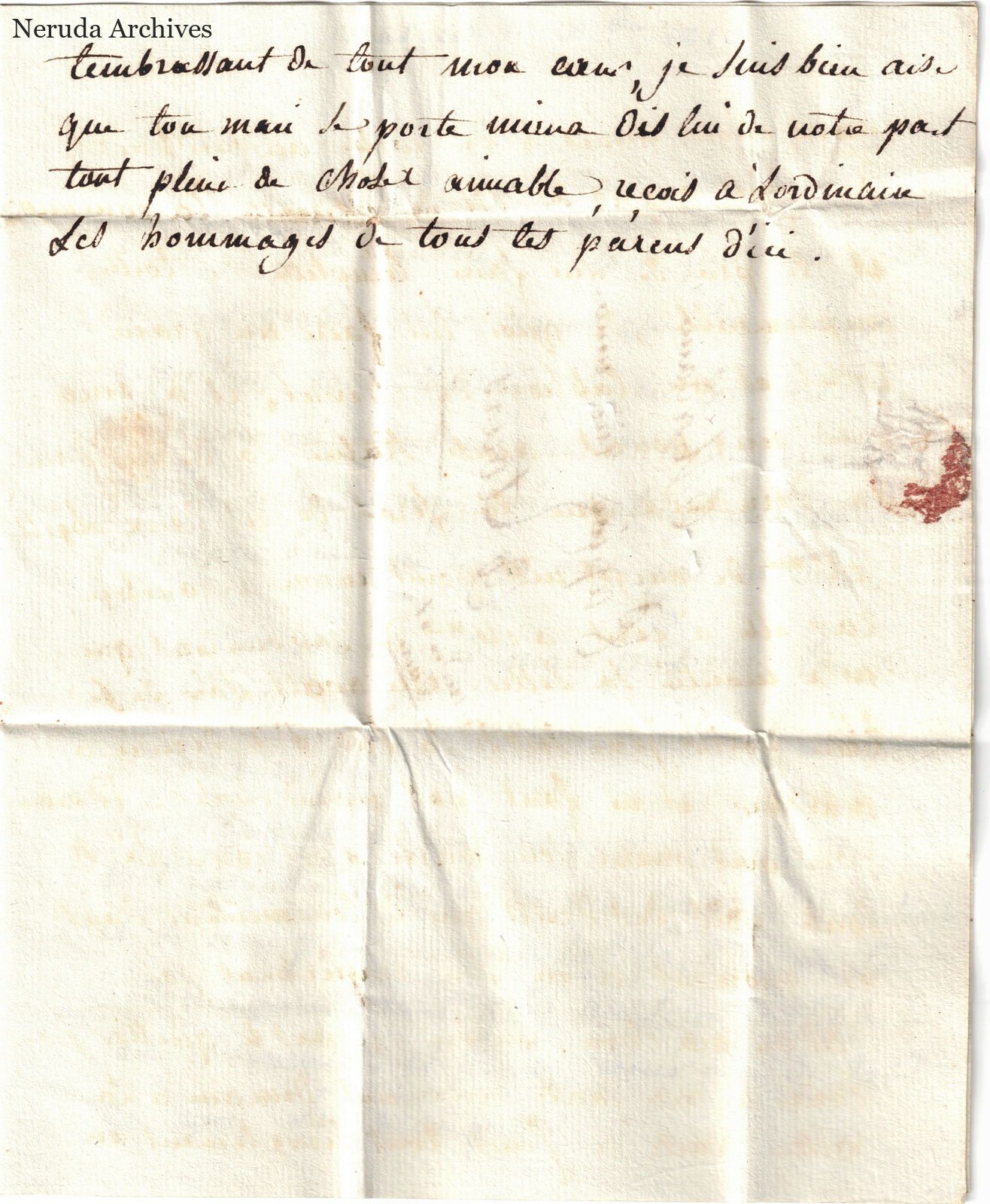
NRA-L-000679 image 4 showing a French personal letter across several folded sides, text side 3.
Image 4Letter text - Page 3.

Transcript and English translation

working scholarly aid

Letter page 1

Original transcript

[Vans?] ce 10 Xbre 1818.

tu es bien aimable, ma chere cousine de m'avoir
donné de tes nouvelles tu Sais qu'elles me font
toujours grand plaisir, moins que ta présence
cependant, car je t'assure j'ai été fort aise de
vous voir ici, tous il y avoit bien longtems
que tu n'étois venue voir notre hermitage
et j'espere bien que ce ne Sera pas la derniere
fois.

je Suis encore ici, mais pas pour longtems
nous allons enfin retourner à la ville, je quitte
toujours cet endroit ci avec regret j'ai tant à
[me retourner?], et tout m'y est Si commode pour
mes enfans. mais enfin, ma tante est bien Seule
et ce Sera pour moi une Satisfaction de la
dédomager autant qu'il me Sera possible de
Son isolement. et de lui tenir lieu de tout
ce qui lui manque.

Notes

Editorial notes:
Xbre is a historical abbreviation for December; the place named in the dateline is uncertain.
The writer contrasts the pleasure of receiving news with the greater pleasure of the cousin's presence.
The phrase following 'j'ai tant à' is difficult to read and its meaning remains uncertain.

Letter page 1

English translation

[Vans?], 10 December 1818.

You are very kind, my dear cousin, to have sent me news of yourself. You know it always gives me great pleasure, though less than your presence; for I assure you I was very glad to see you all here. It had been a very long time since you had come to visit our hermitage, and I very much hope it will not be the last time.

I am still here, but not for long. We are finally going back to town. I always leave this place with regret; I have so much [the following expression is uncertain], and everything here is so convenient for my children. But my aunt is very much alone, and it will be a pleasure for me to make up for her isolation as far as I can and to supply all that she lacks.

Notes

Editorial notes:
Xbre is a historical abbreviation for December; the place named in the dateline is uncertain.
The writer contrasts the pleasure of receiving news with the greater pleasure of the cousin's presence.
The phrase following 'j'ai tant à' is difficult to read and its meaning remains uncertain.

Letter page 2

Original transcript

nous étions réunis à la roche aujourdhui et
j'ai fait auprès de Mr de [Merville?] ta commission
et te prie de lui faire l'emplette de toile
imperméable, de quoi lui faire un grand
collet et un tablier de cheval, il a cinq
pied cinq pouces. aussi [statue?] là dessus dans
la demande que tu feras de ces deux objets.
Mme de [Margot?] n'est point encore accouchée,
car elle a écrit à Mme de [Savouniers?] qui
m'a montré la lettre. elle avoit l'air de se
bien porter je ne sais si sa fille s'est décidée à
marcher. il ne faut pas grand chose à Edmond
pour qu'il prenne son parti à cet égard là si
toutefois des doutes qui le tourmentent dans
ce moment ci ne l'en empêchent pas.

adieu ma chere cousine, je vas te quitter pour
écrire à ma tante [envoyant?] demain à la
ville aussi je finis tout Simplement en

Notes

Editorial notes:
The word 'doutes' refers to the doubts troubling Edmond.
Several names are uncertain; 'marcher' may be used figuratively, but its precise meaning here is unclear.
The wording after 'aussi' and the closing reference to the aunt and a journey or dispatch to town remain uncertain.
The final 'en' continues directly to 't'embrassant' on P004; P004 is a continuation, not a separate letter.

Letter page 2

English translation

We were gathered at [La Roche?] today, and I carried out your errand with Mr de [Merville?]. I ask you to buy him waterproof cloth, enough to make a large collar and a horse apron; he is five feet five inches [the reference of this measurement is not certain]. [Please settle?] that in the request you make for these two items. Madame de [Margot?] has not yet given birth, for she wrote to Madame de [Savouniers?], who showed me the letter. She seemed to be in good health. I do not know whether her daughter has decided to take that step [literally, 'to walk']. It would not take much for Edmond to make up his mind about it, provided the doubts troubling him at present do not prevent him.

Goodbye, my dear cousin. I shall leave you now to write to my aunt; [the clause concerning something being sent to town tomorrow is unclear]. So I shall simply end by

Notes

Editorial notes:
The word 'doutes' refers to the doubts troubling Edmond.
Several names are uncertain; 'marcher' may be used figuratively, but its precise meaning here is unclear.
The wording after 'aussi' and the closing reference to the aunt and a journey or dispatch to town remain uncertain.
The final 'en' continues directly to 't'embrassant' on P004; P004 is a continuation, not a separate letter.

Letter page 3

Original transcript

t'embrassant de tout mon cœur, je Suis bien aise
que ton mari Se porte mieux dis lui de notre part
tout plein de choses aimables, reçois à l'ordinaire
les hommages de tous les parens d'ici.

Notes

Editorial notes:
Opening 't'embrassant' completes the final 'en' on P003. No signature is visible on this page. The page also carries a wax-seal trace away from the text.

Letter page 3

English translation

embracing you with all my heart. I am very glad that your husband is doing better. Say many affectionate things to him on our behalf, and receive, as usual, the regards of all the relatives here.

Notes

Editorial notes:
Opening 't'embrassant' completes the final 'en' on P003. No signature is visible on this page. The page also carries a wax-seal trace away from the text.

Address panel

Original transcript

Madame
[Papion?] rue neuve
à Tours
indre et Loire

Notes

Editorial notes:
The second address line appears to give a surname followed by 'rue neuve'; the surname is uncertain.
'Indre et Loire' is written separately below the principal address lines but belongs to the destination. The postal mark, rate and wax-seal remnant are separate physical/postal evidence, not additional letter prose. No secure letter continuation is visible on this side.

Address panel

English translation

Madam
[Papion?], Rue Neuve
at Tours
Indre-et-Loire

Notes

Editorial notes:
The second address line appears to give a surname followed by 'rue neuve'; the surname is uncertain.
'Indre et Loire' is written separately below the principal address lines but belongs to the destination. The postal mark, rate and wax-seal remnant are separate physical/postal evidence, not additional letter prose. No secure letter continuation is visible on this side.

Discovery Terms

  • Family correspondence
  • Domestic life
  • Textiles

Historical context

Vaas and the Papion address in Tours

Where the letter was written

The place at the head of the letter, dated 10 December 1818, appears to read Vaas. The writer says the group met at La Roche and mentions a Monsieur de Merville. A notarial deed records a property called La Roche in the parish of Vaas, and the local register index lists Nicolas Joseph de Herte de Merville as mayor of Vaas at the date of the letter. Together these clues support Vaas as the place of writing and make the mayor a likely candidate for Monsieur de Merville.[1, 2, 3]

Where the letter was sent

The cover is addressed to Madame Papion on rue Neuve in Tours. The Papion du Château family had a house on that street, now rue Nationale. Work on the building began in 1749 for a royal damask and velvet works, and the king transferred it to Pierre Papion in 1760. The name and street together point to this house, although the cover gives no house number or given name for the recipient.[1, 4, 5]

Evidence and limits

Neither the writer nor Madame Papion has been identified by given name. The evidence does not establish whether the meeting took place at the particular property named in the deed, or whether the man in the letter was the mayor rather than another member of his family.[1, 2, 3, 5]

Sources & evidence (5)
  1. Primary source: manuscript Neruda Archives, NRA-L-000679, 10 December 1818; image 2 (dateline), image 3 (La Roche and de Merville) and image 1 (cover). Read the letter and inspect the dateline and cover Preserves the manuscript place reading, the names of La Roche and de Merville, and the rue Neuve address.
  2. Primary source transcribed in a regional inventory Vente de la Grifferie, 30 December 1632, annex 1 to the Inventaire général des Pays de la Loire, IA72000890; transcription by Christine Toulier. Read the deed naming La Roche in Vaas Establishes the name of the property in the parish, not the location of the meeting in 1818.
  3. Local historical index citing municipal minutes Centre de recherche généalogique du Perche-Gouët, Vaas, entry for Nicolas Joseph de Herte de Merville, citing procès-verbaux. Find de Merville in the Vaas historical index Lists de Merville as mayor during the period in which the letter was written.
  4. Official architectural inventory Inventaire général du patrimoine culturel, Hôtel Papion du Château, IA00071323, Tours. See the inventory entry for the Papion house Locates the property on rue Nationale and documents the textile works, construction from 1749 and transfer in 1760.
  5. Museum research Jacques Olivier Bouffier, ‘The Tours Sketchbook of Eugène Delacroix’, Metropolitan Museum Journal 29 (1994), p. 135 and note 4. Read Bouffier on the Papion house on rue Neuve (PDF) Identifies Maison Papion on rue Neuve, now rue Nationale, with the Papion du Château family; it does not identify the letter’s recipient.

Reviewed 2026-11-22 · Context version 1.0

Document image

Loading document viewer...