NRA-L-000918 / 1828

Witnesses for a brother held in Niort — Férolle, 31 March 1828

From Férolle, Jean writes to a lawyer named Giraut in Niort seeking the summons of witnesses for his brother Louis Roulleau, who is held in the town’s prison. A numbered list in the left margin supplies additional information about the witnesses.

Neruda Archives
NRA-L-000918

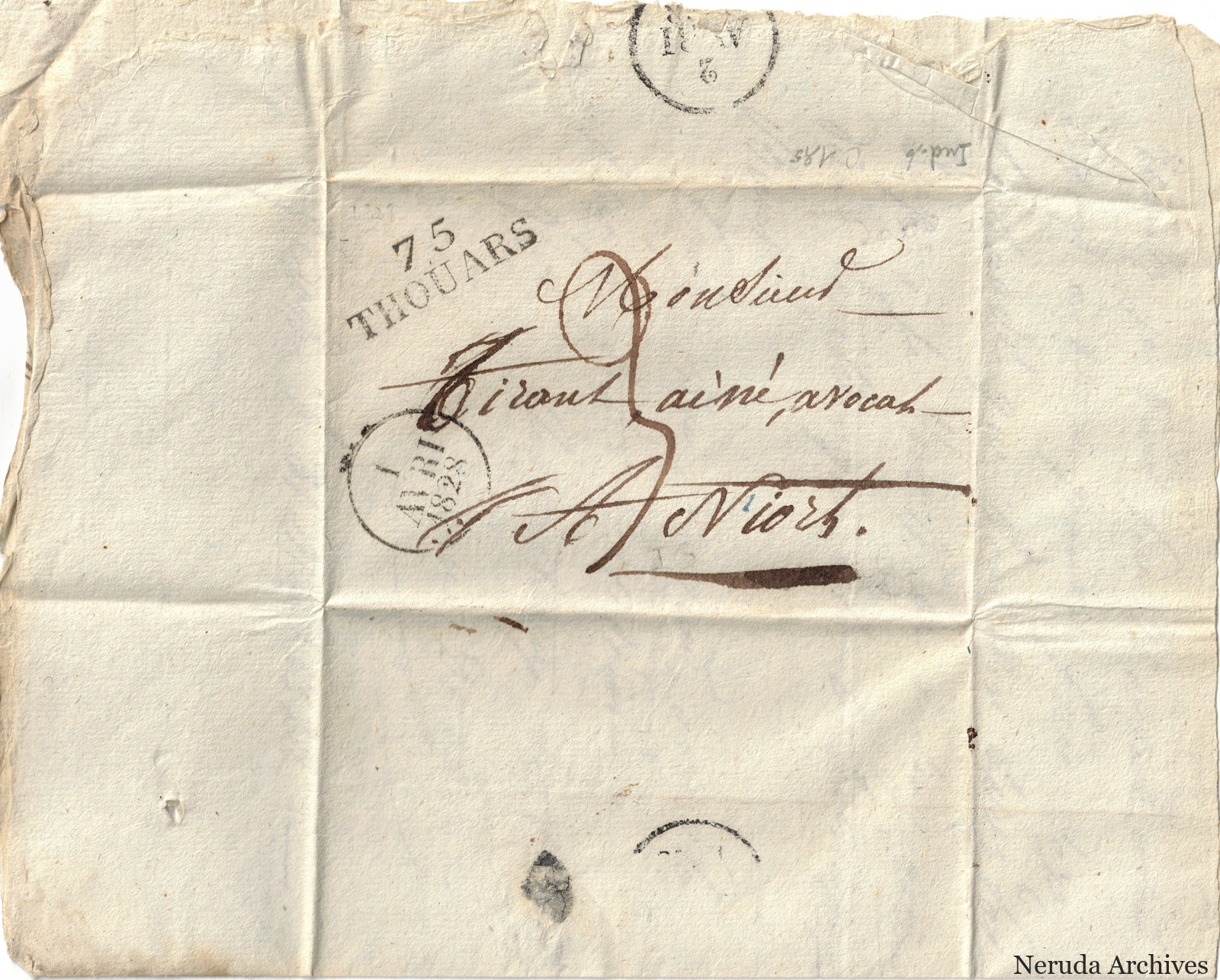
NRA-L-000918 image 1 showing the delivery address to a lawyer at Niort and the Thouars mark
Image 1Address panel and postal evidence.
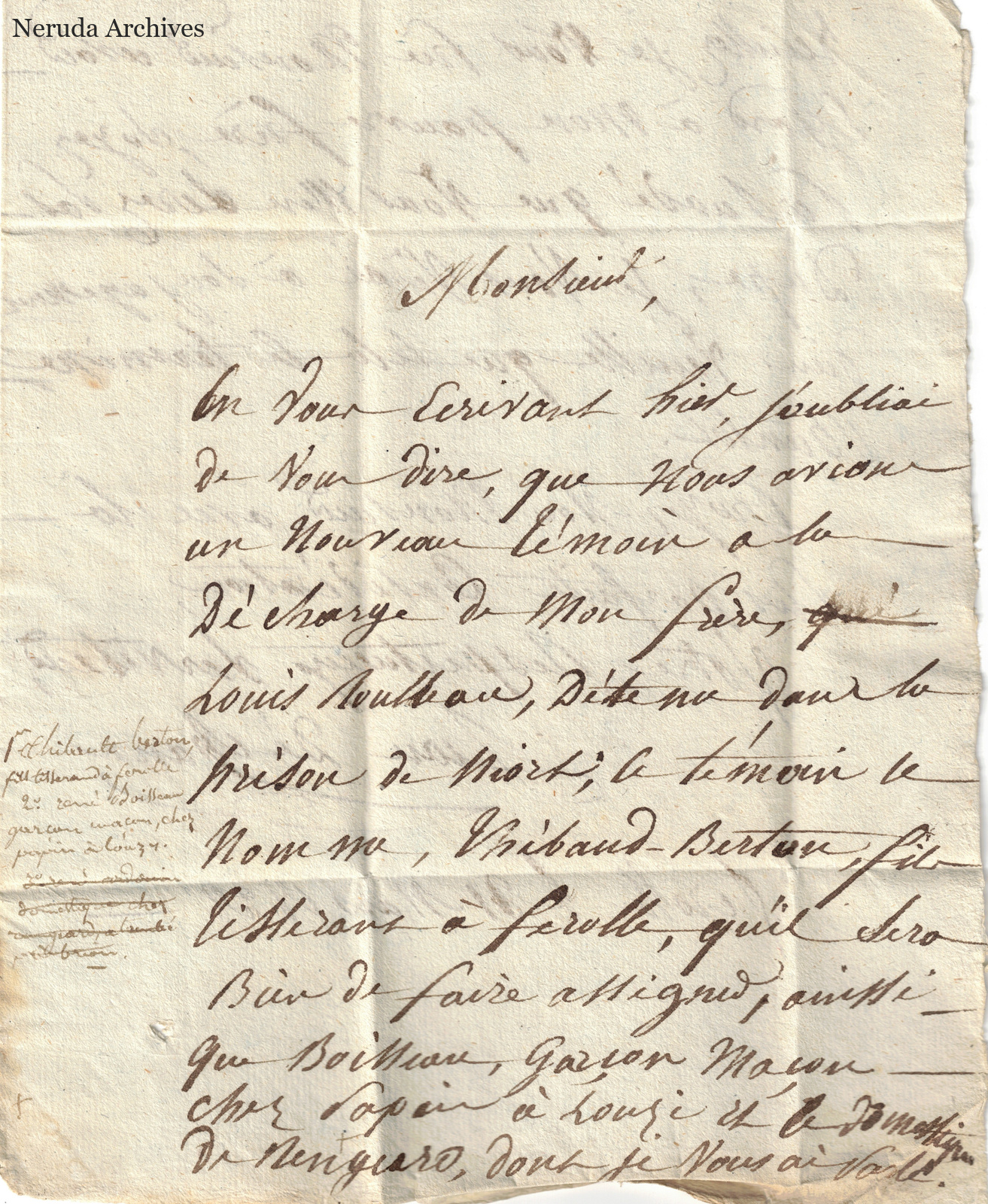
NRA-L-000918 image 2 showing the writer’s appeal regarding his imprisoned brother with a witness list in the left margin
Image 2Letter text and marginal witness list.
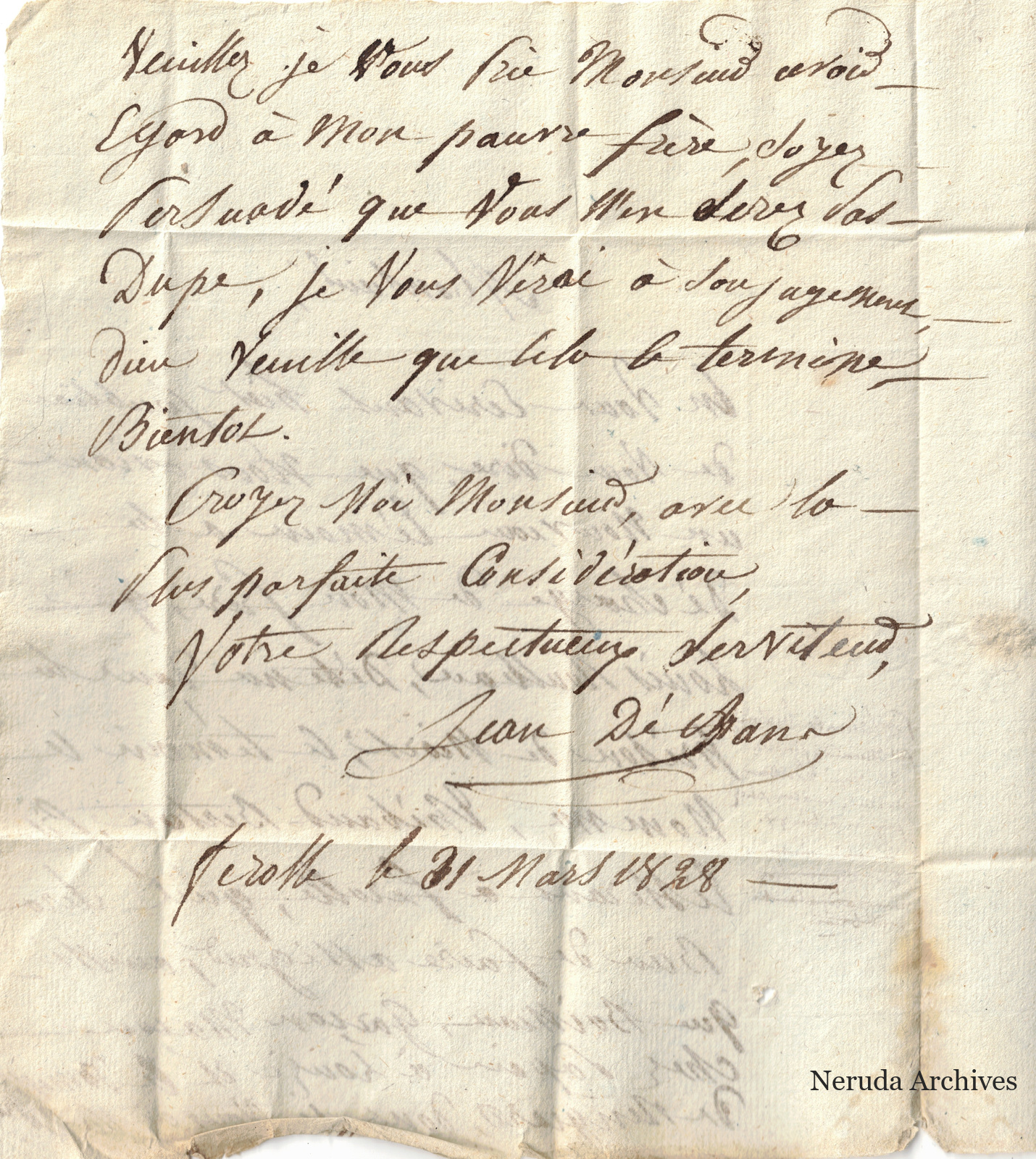
NRA-L-000918 image 3 showing the closing appeal, signature and March 1828 dateline
Image 3Letter ending, signature and dateline.

Transcript and English translation

working scholarly aid

Letter text and marginal witness list

Original transcript

Monsieur,

En Vous Ecrivant hier, j’oubliai
de Vous dire, que Nous avions
un Nouveau témoin à la
Décharge de Mon frère, [qui biffé]
Louis Roulleau, Détenu dans la
prison de Niort ; le témoin se
Nomme, Thibaud Berton, fils
tisserant à ferolle, qu’il Sera
Bien de faire assigner, ainsi
que Boisseau, Garçon Maçon
chez [Papin ?] à Louzi et le Domestique
de [Minguard ?], dont je Vous ai parlé.

Notes

Editorial notes:
A separate numbered witness list in the left margin gives Boisseau’s first name, René. Its third entry is crossed out. The source uses fils after the first witness’s name.

Letter text and marginal witness list

English translation

Sir,

When I wrote to you yesterday, I forgot to tell you that we have a new witness for the defence of my brother Louis Roulleau, who is being held in the prison at Niort. The witness is Thibaud Berton fils, a weaver in Férolle. It would be well to have him summoned, as well as Boisseau, a journeyman mason working for [Papin?] in Louzy, and the servant of [Minguard?] whom I told you about.

Notes

Editorial notes:
A separate numbered witness list in the left margin gives Boisseau’s first name, René. Its third entry is crossed out. The source uses fils after the first witness’s name.

Letter ending, signature and dateline

Original transcript

Veuillez je Vous Prie Monsieur avoir
Egard à Mon pauvre frère, Soyez
Persuadé que Vous N’en Serez pas
Dupe, je Vous Verai à Son jugement,
dieu Veuille que cela se termine
Bientot.
Croyez Moi Monsieur, avec la
Plus parfaite Considération,
Votre Respectueux Serviteur,
Jean [Déchan ?]
ferolle le 31 Mars 1828

Letter ending, signature and dateline

English translation

I beg you, sir, to take my poor brother’s case to heart. Rest assured that you will not be taken advantage of. I will see you at his trial. God grant that this will be over soon.

Believe me, sir, with the greatest respect,
your respectful servant,

Jean [Déchan?]

Férolle, 31 March 1828.

Address panel

Original transcript

Monsieur
Giraut aîné, avocat
A Niort.

Notes

Editorial notes:
The short reference above the address is upside down relative to the address. Its purpose is unknown.

Address panel

English translation

Mr
Giraut the elder, lawyer
Niort.

Notes

Editorial notes:
The short reference above the address is upside down relative to the address. Its purpose is unknown.

Discovery Terms

  • Criminal justice
  • Witnesses
  • Prisons
  • Family correspondence

Historical context

Before Niort's new prison

The prison of 1828

Jean asks a lawyer in Niort to summon witnesses for Louis Roulleau. This was not the semicircular prison still standing in Niort: that building opened in 1853. An architectural study based on the 1829 official inspection identifies two earlier places of detention in the town, one of them in the medieval keep. The request concerning Roulleau is an example of that earlier period, when Niort housed people awaiting proceedings in buildings adapted for detention. The letter does not distinguish between the two facilities.[1, 2, 3]

Where to look for the witnesses

The historical place-name dictionary locates Férolle in the commune of Saint-Cyr-la-Lande. That village, rather than the similar-sounding Férolles elsewhere in France, fits the letter's other locality, Louzy, near Thouars. Saint-Cyr-la-Lande and Louzy are therefore better starting points than Niort for tracing the weaver and mason named in the letter.[1, 4]

Evidence and limits

Neither the charge against Louis Roulleau, the building where he was held, nor the result of the proceedings has been established.[1, 2]

Sources & evidence (4)
  1. Primary source: manuscript Neruda Archives, NRA-L-000918, Jean to Giraut the elder, Férolle, 31 March 1828, text and address. Read the original letter Names Roulleau, Niort as the place of detention, the lawyer, and the work of two of the proposed witnesses.
  2. Historical research based on official inspection records Chantal Callais, “La première prison panoptique demi-circulaire en France,” in L’architecture carcérale, des mots et des murs, pp. 75–92; Archives nationales, F/21/2523, no. 532 (31 March 1829). Read Callais on the earlier places of detention Describes the state of the two earlier prisons and cites the 1829 inspection.
  3. Institutional heritage record Criminocorpus, HUGO, Maison d'arrêt de Niort, building history. See the history and plans of the later prison Dates the construction and opening of the later prison.
  4. Historical topographical dictionary Bélisaire Ledain, Dictionnaire topographique du département des Deux-Sèvres (1902), s.v. Férolle (p. 112) and Louzy. Find the historical entries for Férolle and Louzy Locates Férolle in Saint-Cyr-la-Lande and Louzy in the Thouars area.

Reviewed 2026-11-22 · Context version 1.0

Document image

Loading document viewer...