NRA-L-000925 / 1842

Letter from Lacombe: a missed letter and preparations for the grape harvest

Writing from Lacombe to Montélimar, an unnamed woman describes her worry after hearing nothing during the recipient’s journey and tries to fit a family meeting around the grape harvest, vats and unfinished spinning.

Neruda Archives
NRA-L-000925

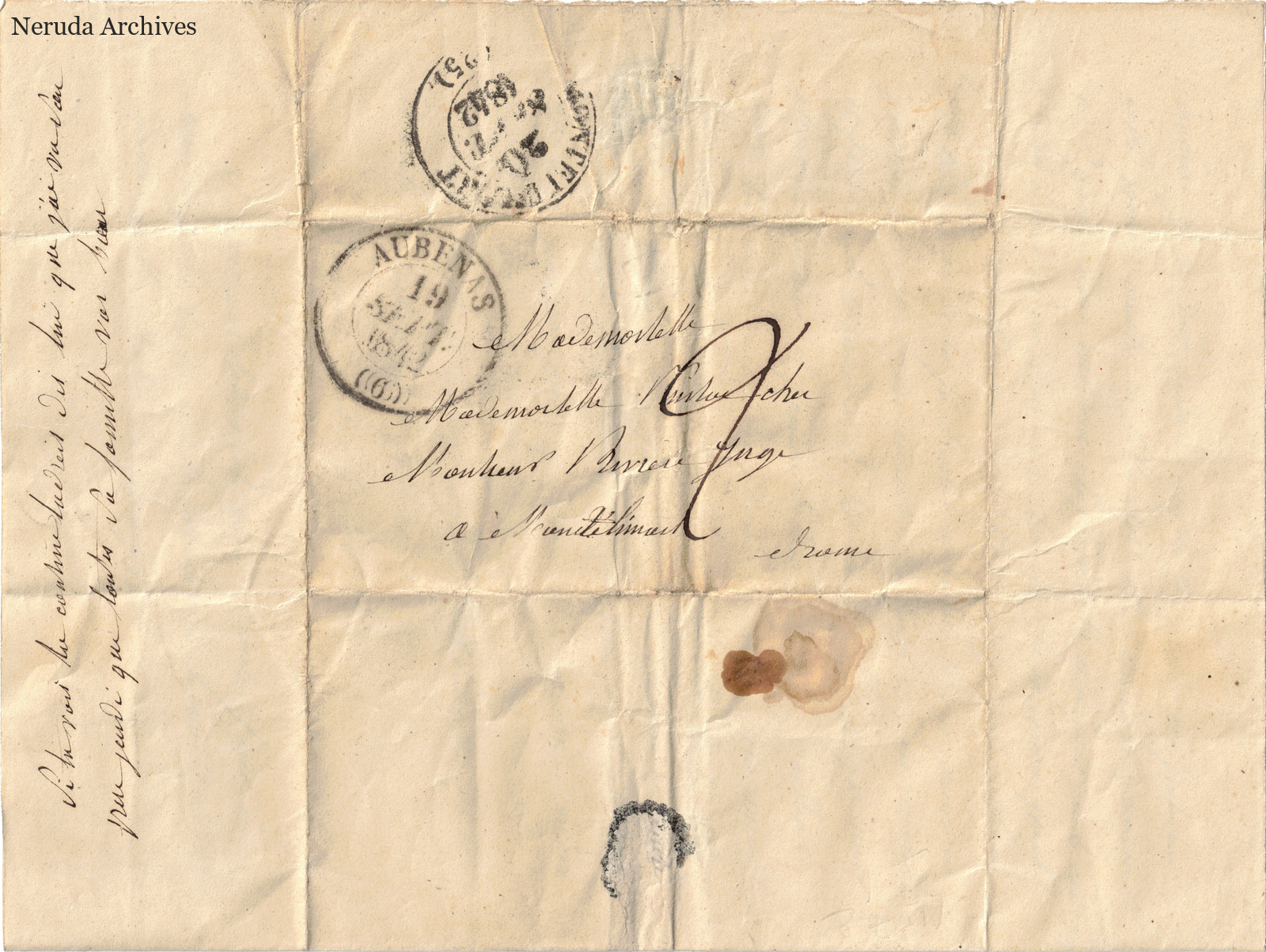
NRA-L-000925 image 1 showing the delivery address, Aubenas postmark and vertical handwritten addition on the left
Image 1Address panel, postal evidence and letter addition.
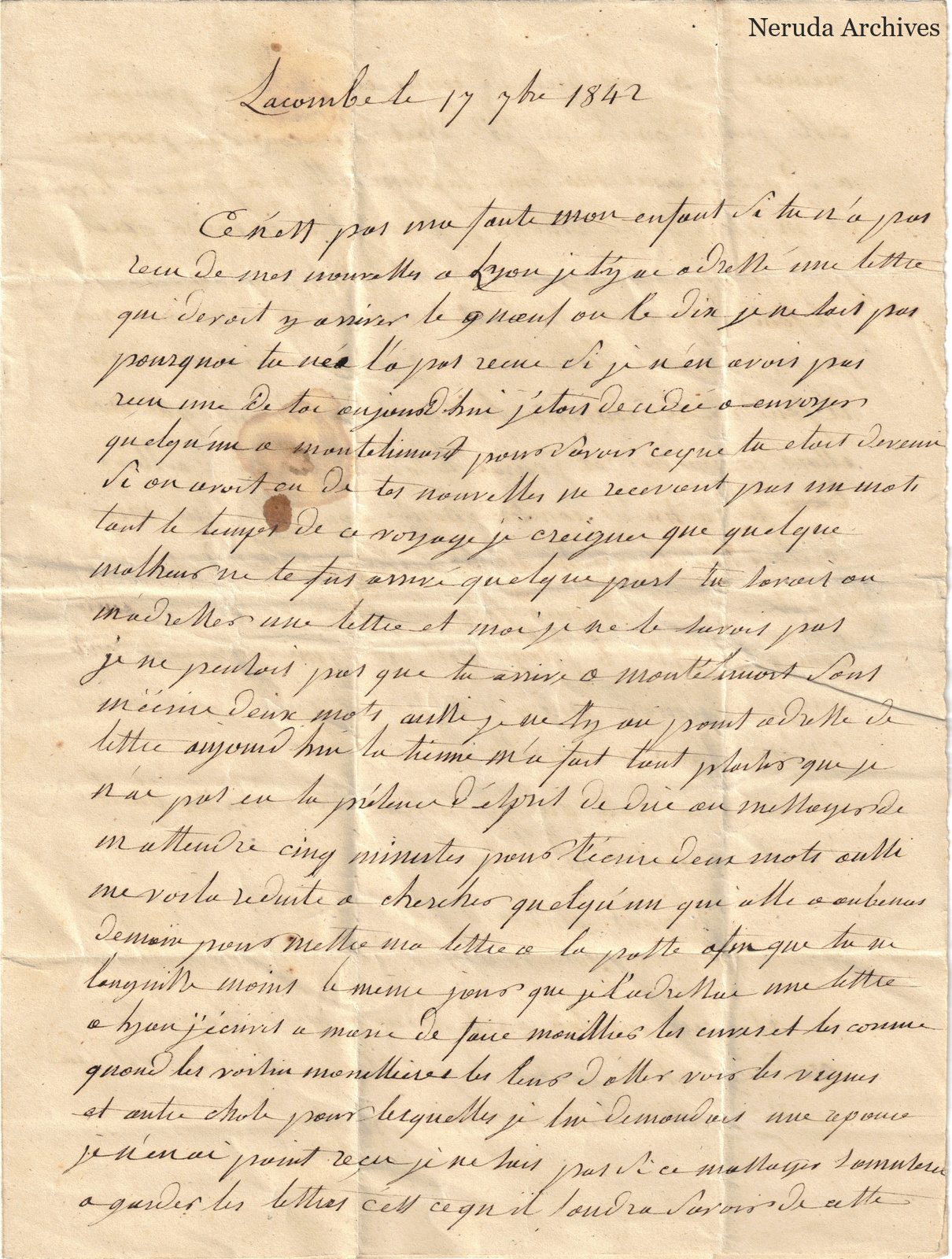
NRA-L-000925 image 2 showing the Lacombe dateline of 17 September 1842 and family news
Image 2Letter text - Page 1.
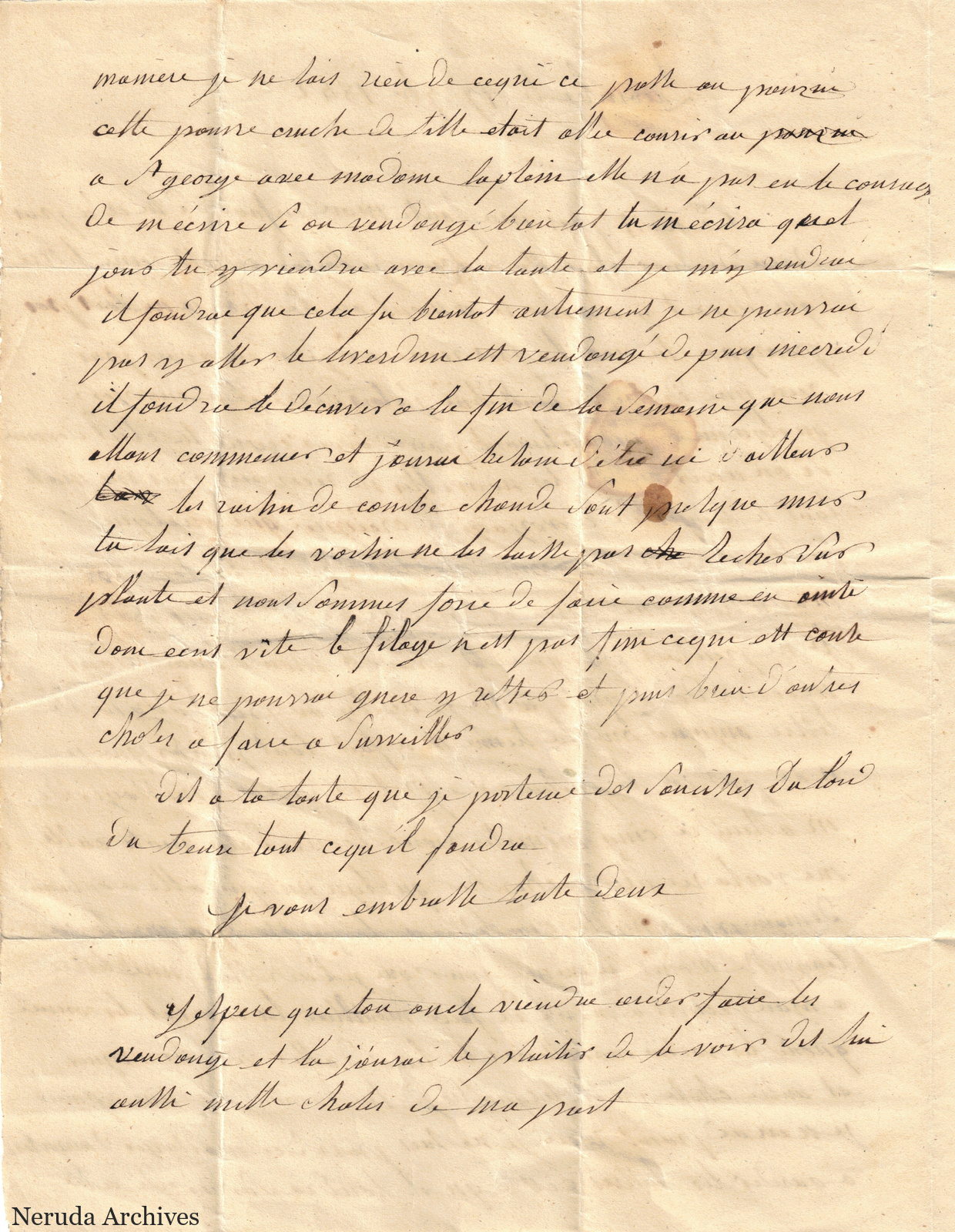
NRA-L-000925 image 3 showing the writer’s continuing family news and grape harvest, with greetings underneath
Image 3Letter ending and postscript.

Transcript and English translation

working scholarly aid

Address panel

Original transcript

Mademoiselle
Mademoiselle [Riviere ?] chez
Monsieur Riviere Juge
a Montelimart
Drome

Address panel

English translation

To Miss
Miss [Rivière?], care of
Monsieur Rivière, judge,
in Montélimar,
Drôme.

Letter opening

Original transcript

Lacombe le 17 7bre 1842

Ce n’est pas ma faute mon enfant si tu n’a pas
recu de mes nouvelles a Lyon je t’y ai adressé une lettre
qui devoit y arriver le 9 neuf ou le dix je ne sais pas
pourquoi tu ne l’a pas recue si je n’en avois pas
recu une de toi aujourd’hui j’etois decidée a envoyer
quelqu’un a montelimart pour savoir ce que tu etoit devenue
si on avoit eu de tes nouvelles ne recevant pas un mot
tout le temps de ce voyage je craigne que quelque
malheur ne te fut arrivé quelque part tu savoit ou
m’adresser une lettre et moi je ne le savois pas
je ne pensois pas que tu arrive a montelimart sans
m’écrire deux mots aussi je ne t’y ai point adressé de
lettre aujourd’hui la tienne m’a fait tant plaisir que je
n’ai pas eu la presence d’esprit de dire au messager de
m’attendre cinq minutes pour t’ecrire deux mots aussi
me voila reduite a chercher quelqu’un qui aille a aubenas
demain pour mettre ma lettre a la poste afin que tu ne
languisse moins le meme jour que je t’adressai une lettre
a Lyon j’ecrivi a marie de faire mouillier les cuves et les [comme ?]
quand les voisin mouilliero les leur d’aller voir les vignes
et autre chose pour lesquelles je lui demandois une reponse
je n’en ai point recu je ne sais pas si ce messager s’amusera
a garder les lettres c’est ce qu’il faudra savoir de cette

Letter opening

English translation

Lacombe, 17 September 1842

It isn’t my fault, my child, that you didn’t hear from me in Lyon. I sent you a letter there that should have arrived on the ninth or the tenth. I don’t know why you didn’t get it. If I hadn’t received one from you today, I had made up my mind to send someone to Montélimar to find out what had become of you and whether anyone there had heard from you. Not a word for the whole of your journey! I was afraid something might have happened to you somewhere. You knew where to send me a letter, and I didn’t know where to send you one. I didn’t think you would get to Montélimar without writing me a line, so I didn’t send you a letter there.

Your letter today made me so happy that I did not have the presence of mind to ask the messenger to wait five minutes while I wrote a line. Now I must find somebody who is going to Aubenas tomorrow to put my letter in the post, so you need not wait in such suspense. The same day I sent you a letter to Lyon, I wrote to Marie to have the vats wetted [unclear words] when the neighbours wet theirs, to go and look at the vines, and about other things I wanted her to write back about. I haven’t had an answer. I don’t know whether this messenger makes a habit of hanging on to letters; this should tell us.

Letter continuation and postscript

Original transcript

maniere je ne sais rien de ce qui ce passe au [prieuré ?]
cette pauvre cruche de fille etait allée courir au [mot rayé]
a St george avec madame [lapleine ?] elle n’a pas eu le courage
de m’ecrire si on vendange bientot tu m’ecrira quel
jour tu y viendra avec la tante et je m’y rendrai
il faudra que cela fu bientot autrement je ne pourrai
pas y aller le [verdun ?] est vendangé depuis mercredi
il faudra le décuver a la fin de la semaine que nous
allons commencer et j’aurai besoin d’être ici d’ailleur
[mot rayé] les raisin de combe chaude sont presque murs
tu sais que les voisin ne les laisse pas [mot rayé] secher sur
plante et nous sommes force de faire comme eu [aute ?]
donc ecris vite le filage n’est pas fini ce qui est cause
que je ne pourrai guere y rester et puis bien d’autres
choses a faire a surveiller

dit a ta tante que je porterai des saucisses du lard
du beurre tout ce qu’il faudra

je vous embrasse toute deux

j’espere que ton oncle viendra aider faire les
vendange et la j’aurai le plaisir de le voir dit lui
aussi mille choses de ma part

Letter continuation and postscript

English translation

I know nothing of what is going on at [the priory?]. That silly girl had gone off to Saint-Georges with Madame [Lapleine?] and couldn’t bring herself to write to me. If the grape harvest is soon, write and tell me which day you and your aunt will come, and I will meet you there. It will have to be soon; otherwise I won’t be able to go. The grapes at [Verdun?] were picked on Wednesday, and the vat will have to be emptied at the end of the week that is just beginning. I will need to be here. Besides, the grapes at Combe Chaude are nearly ripe. You know the neighbours don’t leave theirs to dry on the vine, and we have to do as they do. So write quickly. The spinning isn’t finished, which means I can hardly stay there for long, and there are many other things to do and to keep an eye on.

Tell your aunt I will bring sausages, bacon, butter, and everything we need.

I send you both a kiss.

I hope your uncle will come and help with the grape harvest. Then I shall have the pleasure of seeing him. Give him my warm regards too.

Postscript on the address sheet

Original transcript

Si tu vois la cousine [Audreit ?] dis lui que j’ai vu son
pere jeudi que toutes sa famille vas bien

Postscript on the address sheet

English translation

If you see cousin [Audreit?], tell her I saw her father on Thursday and that her whole family is well.

Discovery Terms

  • Family correspondence
  • Travel
  • Postal correspondence
  • Grape harvest
  • Vineyards
  • Spinning
  • Montélimar
  • Aubenas

Historical context

Getting a letter to the post

The journey recorded on the cover

On 17 September the writer had a reply ready for the woman she had been expecting to hear from. She had let the messenger go and now hoped to find someone to take this letter to Aubenas the next day. The cover has an Aubenas postmark dated 19 September and a Montélimar mark dated 20 September. The marks trace the postal journey, but not the person or the day on which it was carried to Aubenas.[1]

What the post did not replace

France had begun introducing rural delivery and collection in 1830. The change did not make daily rural service universal at once. Here the writer relies on a messenger and the post in the same exchange. She is also waiting for news from Marie, whom she had asked to prepare the vats and look at the vines. A missed letter could affect both the family visit and the timing of the harvest.[1, 2]

Evidence and limits

The address names a judge called Rivière. One possible match, André Michel Rivière Nocase, had served in Montélimar but was posted to Grenoble in September 1842. His career record does not identify the household on the cover.[1, 3]

Sources & evidence (3)
  1. Primary source: manuscript and postmarks Neruda Archives, NRA-L-000925, letter dated Lacombe, 17 September 1842; Aubenas and Montélimar marks, image 1. See the postmarks and read the letter The text describes finding someone to take it to the post in Aubenas; the date stamps record Aubenas on 19 and Montélimar on 20 September.
  2. Historical research by the postal history committee Comité pour l'histoire de La Poste, Il y a 180 ans, le facteur et la boîte aux lettres au village. Read about rural postal collection and delivery Explains the service introduced under the Sapey law, alternate-day rounds, and the slower move to universal daily delivery; it does not identify the local round.
  3. Research database based on judicial records Jean-Claude Farcy and Rosine Fry, Annuaire rétrospectif de la magistrature, record 86645, André Michel Rivière Nocase; cites Archives nationales BB/6*/531, no. 4725 and BB/6(II)/368. Check the magistrate's appointments Places him at Grenoble from 7 May 1841, before his next appointment at Montélimar on 13 February 1845.

Reviewed 2026-11-22 · Context version 1.0

Document image

Loading document viewer...