NRA-L-000926

Two historical wound remedies sent to Madame Turpin in Nantes

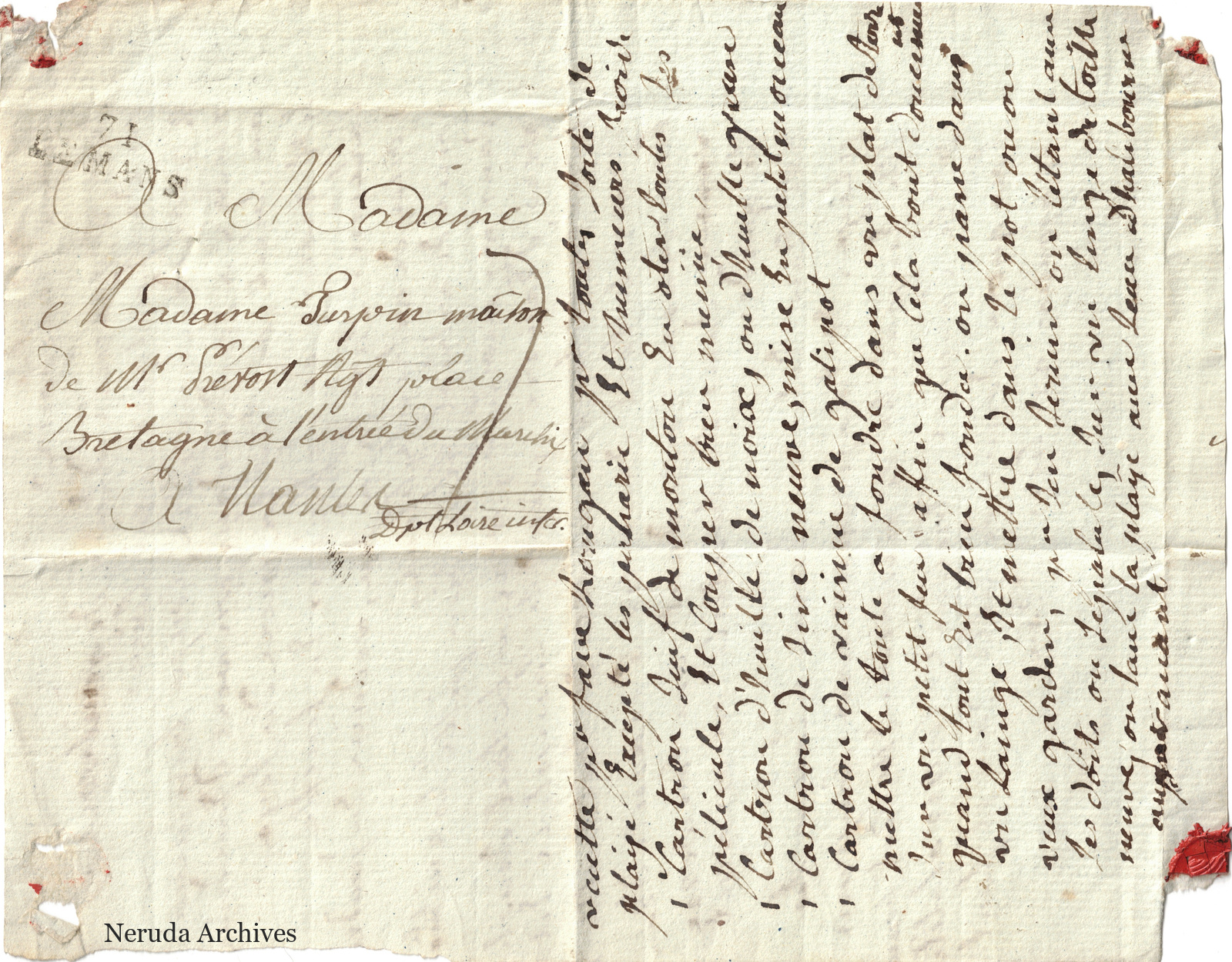
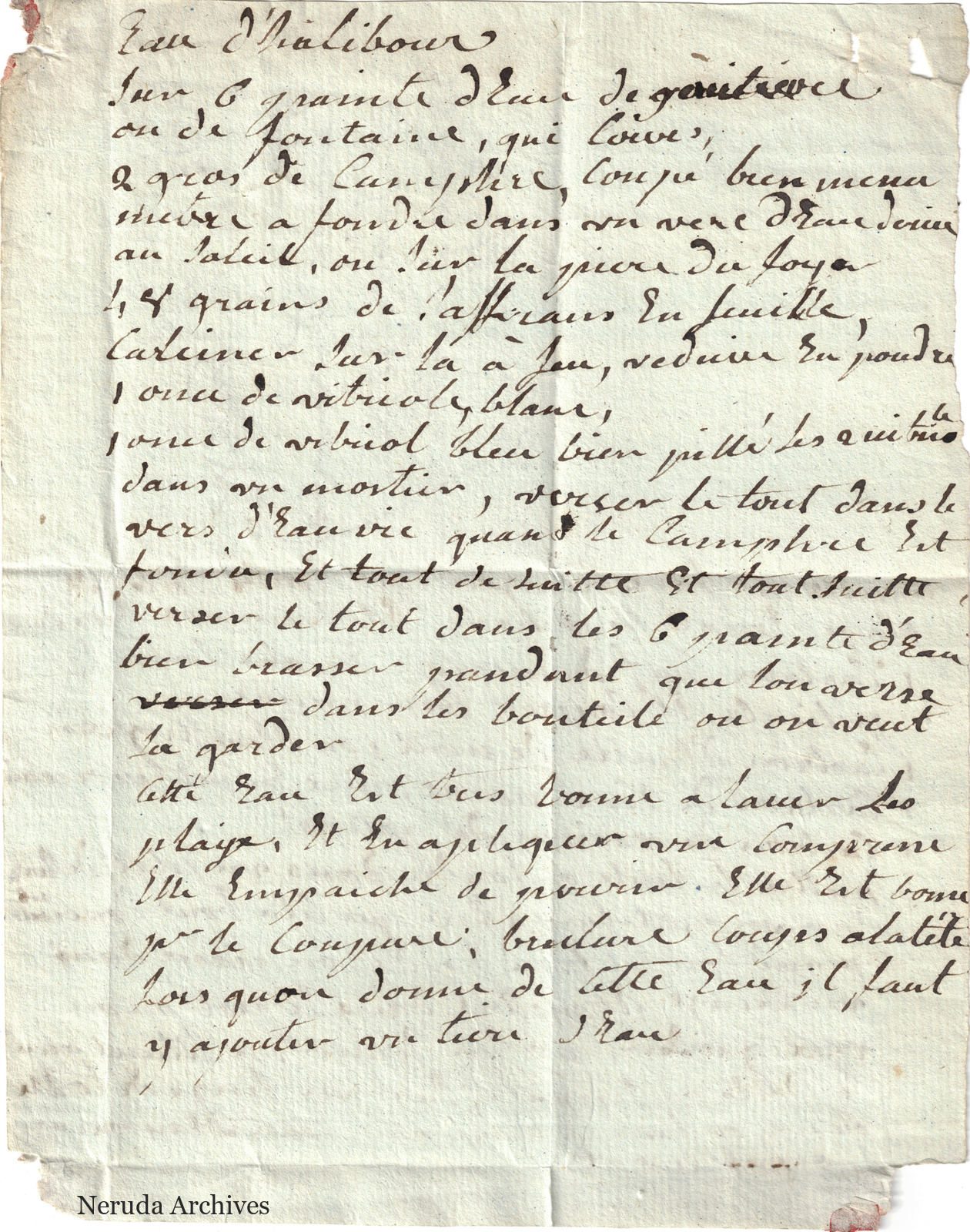
An addressed sheet sent to Madame Turpin at Place Bretagne in Nantes carries a historical ointment recipe beside the address and a recipe for Halibour water on the reverse. The ointment text refers explicitly to the second preparation. Neither text is signed or dated. The recipes are presented as historical evidence, not as medical guidance.

Neruda Archives
NRA-L-000926

NRA-L-000926 image 1 showing the address to Nantes and the sideways contemporary handwritten salve preparation
Image 1Delivery address and handwritten salve recipe.
NRA-L-000926 image 2 showing the historic Eau d’Alibour preparation and remnants of wax at the edges
Image 2Handwritten Eau d’Alibour recipe.

Transcript and English translation

working scholarly aid

Address panel

Original transcript

A Madame
Madame Turpin maison
de Mʳ [Levost?] Ngt place
Bretagne à l’entrée du Marché
A Nantes
Dpt Loire infʳᵉ

Address panel

English translation

To Madame
Madame Turpin, at the house
of Monsieur [Levost?], merchant, Place
Bretagne, at the entrance to the market
Nantes
Department of Loire-Inférieure

Historical recipe: water

Original transcript

Eau d’halibour

sur 6 painte d’Eau de [gouttiere?]
ou de fontaine, qui coule ;
2 gros de camphre, coupé bien menu
mettre a fondre dans un vere d’Eau de vie
au Soleil, ou sur la pierre du foyer
4 grains de saffrans en feuille,
calciner sur la [mot incertain] a feu, reduire en poudre
1 once de vitriol blanc,
1 once de vitriol bleu bien pillé les 2 vitriols
dans un mortier, verser le tout dans le
vere d’Eau vie quand le Camphre est
fondu, Et tout de suitte Et tout suitte
verser le tout dans les 6 painte d’Eau
bien brasser pandant que lon verse
[verser, biffé] dans les bouteile ou on veut
la garder

cette Eau est tres bonne a laver les
plaiye, Et en apliquer une compresse
Elle empaiche de pourrir. Elle est bonne
pʳ le coupure ; brulure coups a la tête
lors quon donne de cette Eau il faut
y ajouter un tier d’Eau

Historical recipe: water

English translation

Halibour water

For 6 paintes of water from [a gutter?] or from a flowing spring: 2 gros of finely chopped camphor. The recipe calls for dissolving it in a glass of brandy, in the sun or on the hearthstone. It lists 4 grains of saffron threads, to be heated “on the [uncertain word] at the fire” and reduced to powder; 1 ounce of white vitriol and 1 ounce of blue vitriol. The two vitriols are to be pounded well in a mortar, then all is poured into the glass of brandy after the camphor has dissolved. Then, immediately — at once — the mixture is poured into the 6 paintes of water and stirred well while it is transferred into the bottles in which it is to be kept.

The writer says the water is very good for washing wounds and for applying as a compress, and that it keeps them from rotting. The writer also says it is good for cuts, burns and blows to the head and that, when this water is used, one third of water is to be added.

Historical recipe: salve

Original transcript

recette pʳ faire l’onguan pʳ toutes sorte de
plaiye, excepté les panarie et humeurs noir[e?]
1 cartron Suif de mouton en oter toutes les
pélicule, et couper bien menüe,
1 cartron d’huille de noix, ou d’huille grasse
1 cartron de Sire neuve, mise en petit morceau
1 cartron de raisine de galipot
mettre le toute a fondre dans un plat de terre
sur un petit feu afin que cela bout doucemᵉⁿᵗ
quand tout est bien fondu. on passe dans
un Lainge, et mettre dans le pot ou on
veux garder, pʳ s’en servir on l’étant avec
les doits ou Spatule, sur un linge de toille
neuve, on lave la plaiye avec l’eau d’halibour
auparavant

Historical recipe: salve

English translation

Recipe for an ointment for wounds of all kinds, except whitlows and black humours:

1 cartron of mutton tallow, with all the membrane removed and the tallow chopped very fine;
1 cartron of walnut oil or fatty oil;
1 cartron of fresh wax, broken into small pieces;
1 cartron of galipot resin.

The recipe calls for melting it all in an earthenware dish over a low fire so that it boils gently. Once it is well melted, it is strained through a cloth and put in the pot in which it is to be kept. For use, the ointment is spread with the fingers or a spatula on a piece of new linen. The recipe specifies washing the wound first with Halibour water.

Discovery Terms

  • History of medicine
  • Household remedies
  • Manuscript recipes
  • Le Mans
  • Nantes

Historical context

A remedy sent through the post

The same name in another setting

The writer sent Madame Turpin two remedies: a wash headed Eau d'halibour and a separate ointment. A later printed description from the Hôpital Saint-Louis in Paris calls the wash eau d'Alibour. It shares the mineral salts, camphor and saffron of the manuscript, but the household and hospital versions are not identical. The printed account itself notes that formulas varied between pharmacopoeias.[1, 2]

A clue on an undated sheet

The recipe sheet doubles as the address panel. The partly obscured mark is consistent with the numbered Le Mans handstamp recorded on a dated 1821 letter in Benjamin Constant's correspondence. This comparison suggests an office through which the sheet passed, not a date or a place of composition.[1, 3]

Evidence and limits

No dated postmark or named author has been established. These are historical records of remedies, not instructions for making or using them.[1, 2, 3]

Sources & evidence (3)
  1. Primary source: manuscript Neruda Archives, NRA-L-000926, two manuscript remedies addressed to Madame Turpin in Nantes, undated, images 1–2. See the handwritten recipes and address panel Documents the two recipes, the heading Eau d'halibour, the Nantes address and the partly obscured numbered postal mark.
  2. Primary source: historical medical publication Albert Robin, ed., Traité de thérapeutique appliquée: Traitement des maladies de la peau, première partie (Paris: Rueff), p. 161, note 2. Read the historical description from Hôpital Saint-Louis Names eau d'Alibour, gives a hospital variant and notes that formulas vary between pharmacopoeias.
  3. Critical edition of a manuscript letter Laurent Hamard to Benjamin Constant, 30 January 1821, in Benjamin Constant, Correspondance générale; manuscript description for Bibliothèque cantonale et universitaire de Lausanne, Fonds Constant I, Co 1865. Find a dated comparison for the Le Mans mark (PDF) Records the 71/LE MANS handstamp on a separate, dated letter; its date does not transfer to the undated manuscript.

Reviewed 2026-11-22 · Context version 1.0

Document image

Loading document viewer...