NRA-L-000927 / 1805

Isaac Lippincott to James Widdifield & Co. after a dangerous voyage to Martinique

Isaac Lippincott reports a thirty-four-day passage from the Delaware Capes to Saint-Pierre, a captain he says threatened his life, repairs and cargo losses, and an unpromising market in Martinique.

Neruda Archives
NRA-L-000927

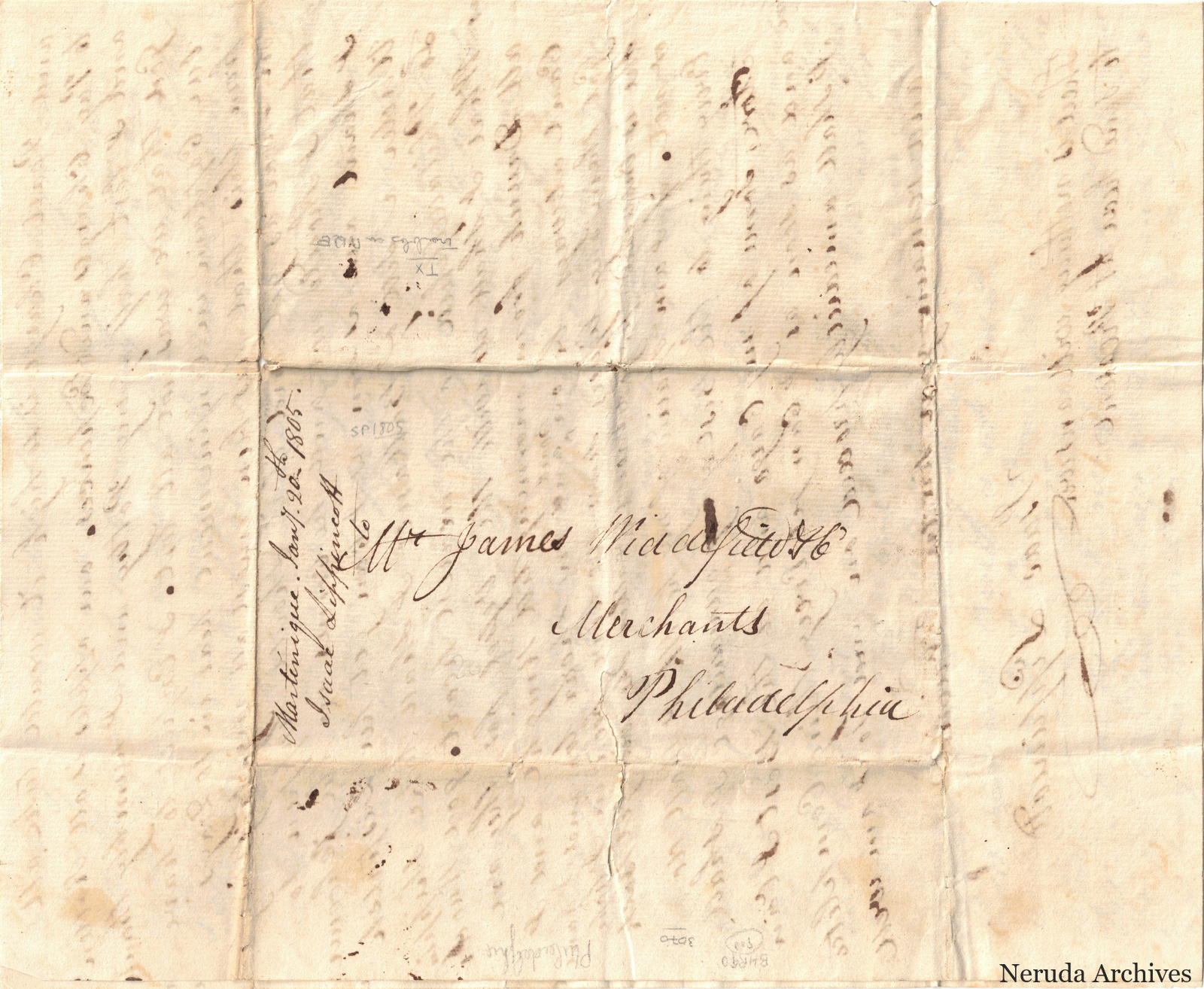
NRA-L-000927 image 1 showing the address to James Widdifield and Company in Philadelphia and the marginal dated endorsement
Image 1Address panel and dated endorsement.
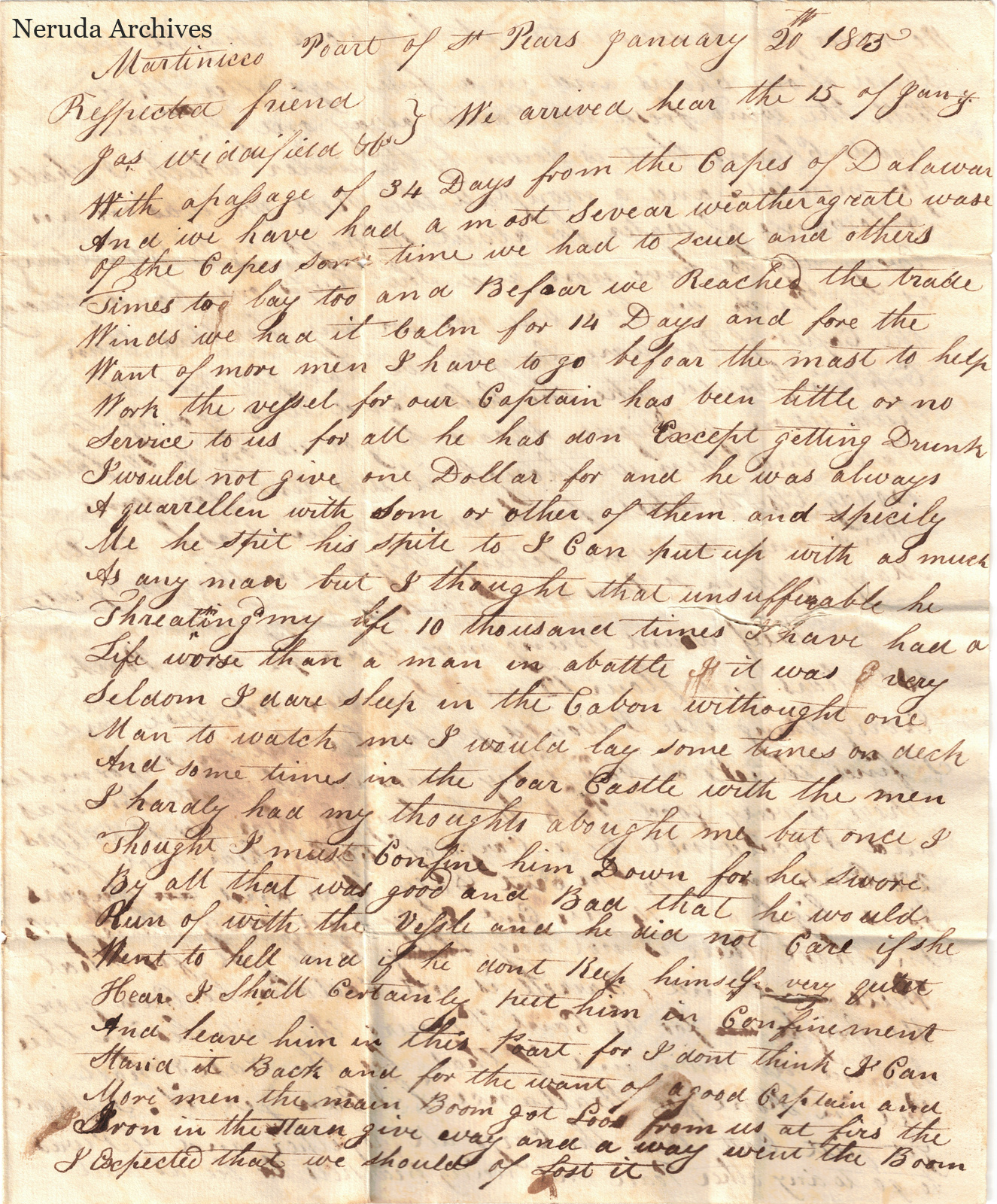
NRA-L-000927 image 2 showing Isaac Lippincott’s account of the passage from the Delaware capes to Martinique
Image 2Letter text - Page 1.
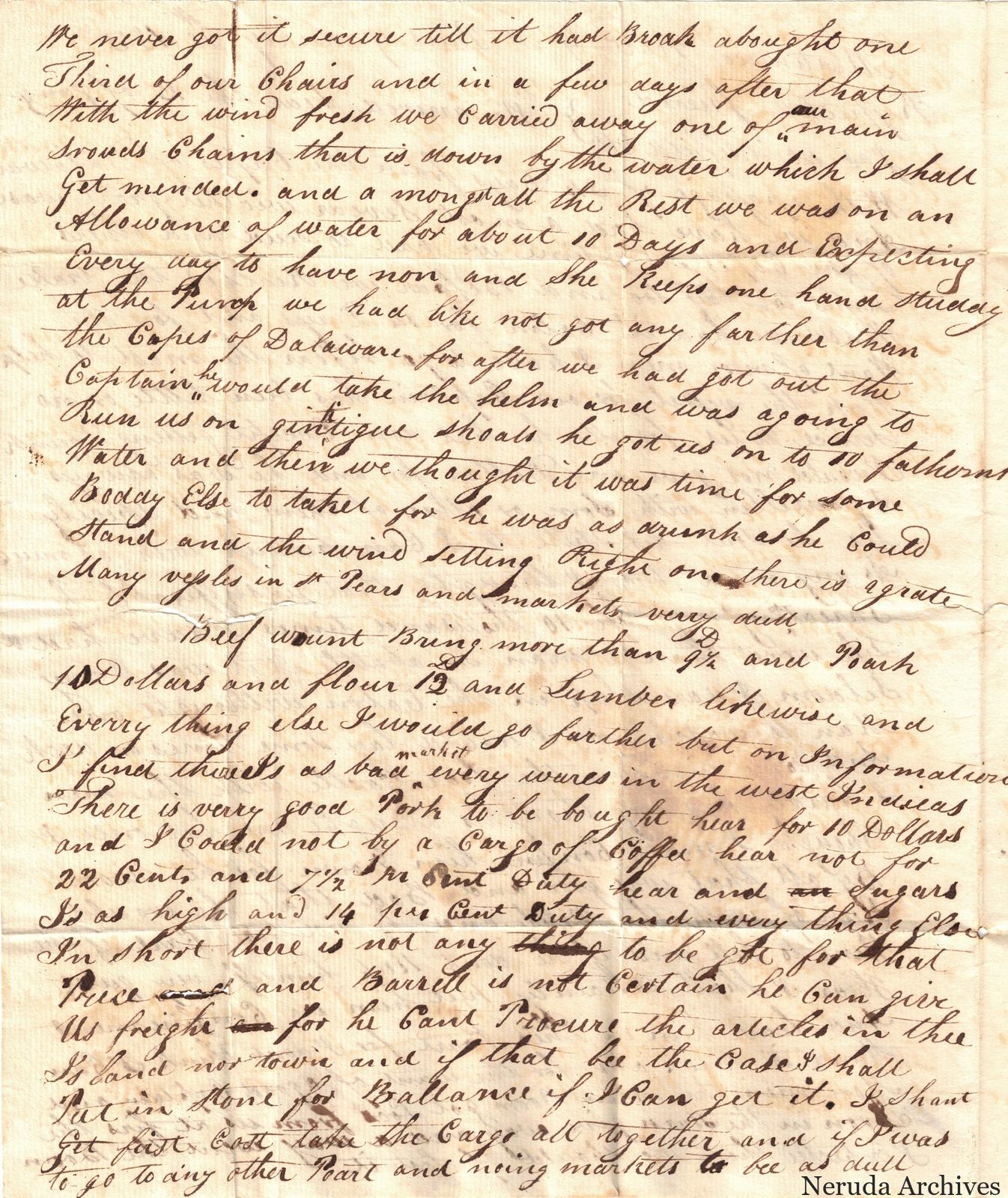
NRA-L-000927 image 3 showing the continuation on the state of the ship and market prices
Image 3Letter text - Page 2.
NRA-L-000927 image 4 showing the signed conclusion about the troubled voyage and a note on sending goods
Image 4Letter ending, signature and postscript.

Transcript and readable English text

working scholarly aid

Letter text - Page 1

Original transcript

Martinicco Poart of St Pears January 20ᵗʰ 1805

Respected friend
Jaˢ Widdifield & Co } We arrived hear the 15 of Jany.
With a pasage of 34 Days from the Capes of Dalawar
And we have had a most Sevear weather a greate wase
Of the Capes Some time we had to scud and others
Times to lay too and Befoar we Reached the trade
Winds we had it Calm for 14 Days and fore the
Want of more men I have to go befoar the mast to help
Work the vessel for our Captain has been little or no
Service to us for all he has don Except getting Drunk
I would not give one Dollar for and he was always
A quarrellen with Som or other of them and specily
Me he spit his spite to I Can put up with as much
As any man but I thought that unsufferable he
Threatengᵈ my life 10 thousand times I have had a
Life worse than a man in a battle & it was very
Seldom I dare sleep in the Cabon withought one
Man to watch me I would lay some times on deck
And some times in the foar Castle with the men
I hardly had my thoughts abought me but once I
Thought I must Confine him Down for he swore
By all that was good and Bad that he would
Run of with the Vessel and he did not Care if she
Went to hell and if he dont Keep himself very quiet
Hear I Shall Certainly put him in Confinement
And leave him in this Poart for I dont think I Can
Stand it Back and for the want of a good Captain and
More men the main Boom got Loos from us at firs the
Iron in the Starn give way and away went the Boom
I Expected that we should of Lost it

Notes

Editorial notes:
Modern English reading; the original is also in English.
“Before the mast” means he was working with the ordinary crew.

Letter text - Page 1

Readable English text

Martinique, port of Saint-Pierre, 20 January 1805

My esteemed friend, James Widdifield & Co.,

We arrived here on 15 January, after a passage of thirty-four days from the Delaware Capes. We had the severest weather for a great way out from the Capes. Sometimes we had to run before the wind and at other times lie to. Before we reached the trade winds, we were becalmed for fourteen days. For want of men I had to work before the mast to help sail the vessel, for our captain has been little or no use to us. I wouldn’t give a dollar for all he’s done, apart from getting drunk. He was forever quarrelling with one or other of the men, and it was chiefly on me that he vented his spite. I can put up with as much as anyone, but I found it unbearable. He threatened my life ten thousand times. I’ve had a worse time of it than a man in battle. I rarely dared sleep in the cabin without a man keeping watch over me. Sometimes I lay on deck and sometimes in the forecastle with the men. I scarcely kept my wits about me, but once I thought I would have to put him under restraint below, for he swore by all that was good and bad that he’d run off with the vessel and didn’t care if she went to hell. If he doesn’t keep very quiet here, I shall certainly have him locked up and leave him in this port. I don’t think I can stand it on the way back. For want of a good captain and more men, our main boom got loose: first the iron fitting at the stern gave way and away went the boom. I thought we should lose it.

Notes

Editorial notes:
Modern English reading; the original is also in English.
“Before the mast” means he was working with the ordinary crew.

Letter text - Page 2

Original transcript

We never got it secure till it had Broak abought one
Third of our Chairs and in a few days after that
With the wind fresh we Carried away one of [our, inserted] main
Srouds Chains that is down by the water which I shall
Get mended. and a mongst all the Rest we was on an
Allowance of water for about 10 Days and Expecting
Every day to have non and She Keeps one hand steady
at the Pump we had like not got any farther than
the Capes of Dalaware for after we had got out the
Captain [he, inserted] would take the helm and was a going to
Run us on [gintigue ?] shoals he got us on to 10 fathoms
Water and then we thought it was time for some
Boddy Else to take it for he was as drunk as he Could
Stand and the wind setting Right on. there is a grate
Many vesles in St Pears and markets very dull
Beef wont Bring more than 9½ [D above] and Poark
10 Dollars and flour 12 [D above] and Lumber likewise and
Everry thing else I would go farther but on Information
I find there Is as bad [market, inserted] every wares in the west Indias
There is verry good Pork to be bought hear for 10 Dollars
and I Could not by a Cargo of Coffee hear not for
22 Cents and 7½ pr Cent Duty hear and [word struck out] Sugars
Is as high and 14 per Cent Duty and every thing Else
In short there is not any [word struck out] to be got for that
Price [word struck out] and Barrell is not Certain he Can give
Us freight [word struck out] for he Cant Procure the articles in thee
Island nor town and if that bee the Case I shall
Put in Stone for Ballance if I Can get it. I shant
Get first Cost take the Cargo all together and if I was
to go to any other Poart and noing markets to bee as dull

Notes

Editorial notes:
The damaged objects called “Chairs” are distinct from “Srouds Chains” two lines below. The manuscript does not give a unit for the listed market prices.
Letter text - Page 2

Readable English text

We did not get it secured until it had broken about a third of our chairs. A few days later, with a fresh wind, one of the chains that secures the mainmast’s shrouds near the water gave way. I shall have it repaired. Among all our other troubles, we were on water rations for about ten days, expecting to run out every day. And she keeps one man constantly at the pump. We nearly got no farther than the Delaware Capes. After we got out, the captain insisted on taking the helm and was about to run us onto the [Chincoteague?] shoals. He brought us into ten fathoms of water. We thought it was time for someone else to take over: he was as drunk as he could be and still stand, and the wind was setting straight onto the shoals.

There are a great many vessels in Saint-Pierre and the markets are very dull. Beef won’t bring more than nine and a half dollars, pork ten, flour twelve, and it is much the same with lumber and everything else. I would go farther, but from what I hear the markets are just as bad throughout the West Indies. Very good pork can be bought here for ten dollars, and I couldn’t buy a cargo of coffee here even at twenty-two cents and seven and a half percent duty. Sugar is just as dear, with fourteen percent duty, and so it is with everything else. In short, nothing can be had for that price, and Barrell is not sure he can give us any freight, for he cannot obtain the goods either on the island or in town. If that is the case, I shall take on stone for ballast if I can get it. Taking the cargo as a whole, I shall not get back what it cost. If I went to another port, knowing the markets to be just as dull

Notes

Editorial notes:
The damaged objects called “Chairs” are distinct from “Srouds Chains” two lines below. The manuscript does not give a unit for the listed market prices.
Letter ending, signature and postscript

Original transcript

and Poart Charges is so high it would take all
to Pay Charges and Expences. our apples is all Rotten
and I lost half of my Pottry and I humbly thank
God that we was not all lost. I Expect to have
our Captain in Confinement hear in 10 Days
from this that has been amost all my Bussiness
on shoar as yet and if it should happen so
that I Should not and he Comes in the Schooner
I Shant and as soon as I Can get her Dispatch
Under a Sett of Ballance I shall take Shipping
To Philadelphia or the nearest poart. god knows
What I Shall do with the Vessel for they are
all Drunk from morning till Knight and I
Cant always be on [Board, inserted] and on shoar too and I han’t
Got them any liquers sence we have been in I hope
She is Ensueard for god knows weather she will get Back
or not. if I am Spaired of my health I shall do
Every thing to the Best of [word struck out] advantage I Shall
Store some of my Cargo and do the Best I Can
and as soon as I Can get Every thing Compleated
I shall ameadiately proceed on and so I am well

and remain your sincere Friend

Isaac Lippincott

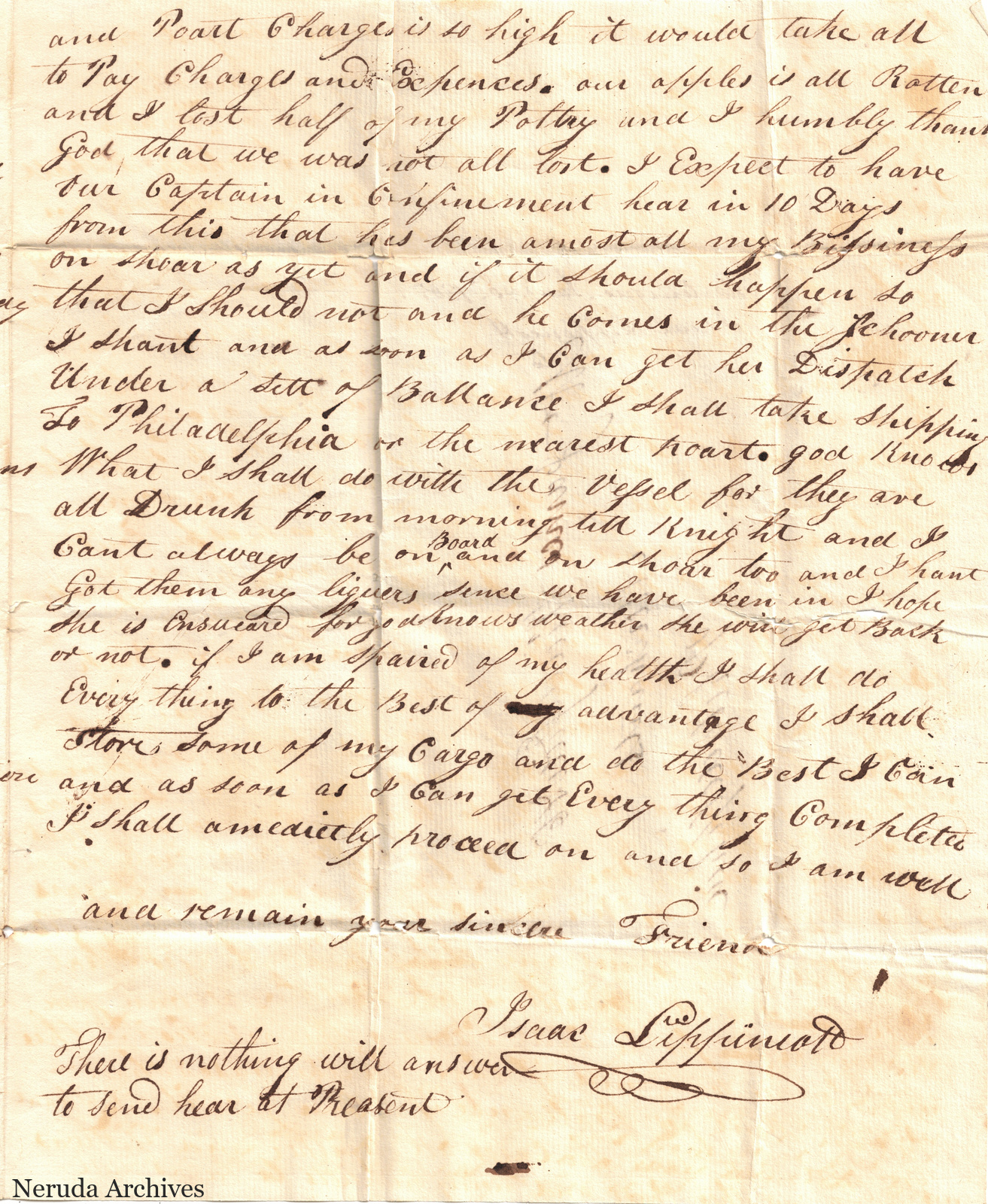
There is nothing will answer
to send hear at Preasent

Notes

Editorial notes:
The writer uses “Ballance” here and in the preceding page's reference to taking stone aboard, evidently for ballast.

Letter ending, signature and postscript

Readable English text

and the port charges so high, all the proceeds would go to pay charges and expenses. Our apples are all rotten, and I lost half my pottery. I humbly thank God we weren’t all lost. I expect to have our captain locked up here in ten days’ time. So far that has been almost all my business ashore. If I should fail and he comes aboard the schooner, I won’t sail in her. As soon as I can get her cleared to sail in ballast, I shall take ship for Philadelphia or the nearest port. God knows what I shall do with the vessel, for they are all drunk from morning till night. I can’t always be aboard and ashore at the same time, and I haven’t got them any liquor since we came in. I hope she is insured, for God knows whether she will get back or not. If my health holds, I shall do everything to the best advantage. I shall put some of my cargo in storage and do the best I can. As soon as I can get everything settled, I shall proceed at once. So I am well and remain your sincere friend,

Isaac Lippincott

Nothing would pay to send here at present.

Notes

Editorial notes:
The writer uses “Ballance” here and in the preceding page's reference to taking stone aboard, evidently for ballast.

Address panel

Original transcript

Mʳ James Widdifield & Co
Merchants
Philadelphia

Address panel

Readable English text

Mr James Widdifield & Co.
Merchants
Philadelphia

Discovery Terms

  • Atlantic shipping
  • Seafaring
  • Maritime trade
  • Cargo damage
  • Martinique
  • Philadelphia
  • Coffee
  • Sugar
  • Marine insurance

Historical context

A crowded harbour and no paying cargo

A difficult market before this schooner arrived

In August 1804, a Baltimore newspaper printed a report of forty-five vessels lying at Saint-Pierre and American cargoes being sold below cost. It describes an earlier episode, not Lippincott's arrival. Five months later his letter describes many vessels in port, little demand for his provisions and colonial produce too expensive for him to buy as a return cargo.[1, 2]

Why an empty return was on the table

The damaged schooner needed repairs, and Lippincott doubted that Barrell could obtain freight. He considered sailing her back weighted with stone ballast rather than paying charges to try another market. He also wrote that he would seek a different passage for himself if the captain remained aboard. Returning the schooner and getting home safely were no longer the same decision.[1]

Evidence and limits

The captain and the schooner are not named in the letter. Lippincott's account records his allegations and intentions, not proof of a detention or of how the voyage ended.[1]

Sources & evidence (2)
  1. Primary source: manuscript Neruda Archives, NRA-L-000927, Isaac Lippincott to James Widdifield & Co., Saint-Pierre, Martinique, 20 January 1805, letter and address panel. Read Lippincott's account of the voyage and his choices Describes the damaged schooner, the market and the options of taking stone ballast and arranging another passage.
  2. Primary source: contemporary newspaper American, and Commercial Daily Advertiser (Baltimore), 15 August 1804, commercial intelligence on Saint-Pierre; Maryland State Archives, M890-0147. Read the earlier report of shipping and trade at Saint-Pierre (PDF) Reports forty-five vessels and selling below cost in 1804, without identifying Lippincott's voyage or confirming the prices he quoted in 1805.

Reviewed 2026-11-22 · Context version 1.0

Document image

Loading document viewer...